Prahlada is the child devotee of Vishnu born to Hiranyakashipu, an asura king who hated Vishnu. His father tried again and again to kill him for his faith, and Vishnu came out of a pillar as Narasimha, half man and half lion, to save him. His story is told in the Bhagavata Purana (Book 7) and the Vishnu Purana (Book 1), and he appears in the Mahabharata as a wise and truthful king. In the Bhagavad Gita Krishna says, among the daityas I am Prahlada. The Holika bonfire on the night before Holi is told around his story, and he is the grandfather of Mahabali, the king Kerala welcomes home at Onam.
Also called: Prahlad or Prahrada, Bhakta Prahlada (Prahlada the devotee), Prahlada Maharaja, Daityendra (king of the daityas), Hiranyakashipu-suta (son of Hiranyakashipu)
Father: Hiranyakashipu, king of the daityas
Mother: Kayadhu
Uncle: Hiranyaksha, killed by Vishnu as Varaha
Brothers: Samhlada, Anuhlada and Hlada (Bhagavata Purana 6.18)
Son: Virochana; grandson: Bali, called Mahabali in Kerala; great-grandson: Bana
Teachers: Narada, who taught him in his mother's womb; Shanda and Amarka, sons of Shukracharya, at school
Later home: Sutala, with his grandson Bali, after Vamana's three steps (Bhagavata Purana 8.23)
Hearing about Vishnu, singing of him, remembering him, serving his feet, worshipping him, bowing to him, being his servant, being his friend, and offering him one's whole self.
Stories
Prahlada's story is told most fully in the Bhagavata Purana, Book 7, chapters 4 to 10, as the sage Narada tells it to Yudhishthira. The Vishnu Purana (Book 1, chapters 16 to 20) tells it too, with its own list of trials and Prahlada's prayers. The Mahabharata knows him not as a child but as a grown, truthful king of the daityas who gives wise counsel. The Gita (10.30) names him as one of Krishna's glories. The Holika bonfire story, the one most people know from Holi, is a later tradition and is not in the Bhagavata. Prahlada's grandson Bali carries the family's story on into the Vamana avatar and Onam.
A devotee born to Vishnu's enemy
Hiranyakashipu and his brother Hiranyaksha were mighty daityas. When Vishnu, as the boar Varaha, killed Hiranyaksha, Hiranyakashipu swore revenge (Bhagavata Purana 7.2). He went to the mountains and did such fierce penance that the worlds began to burn, until Brahma came and granted him a boon (7.3). He could not be killed by any being Brahma had made, not by man or beast, not inside or outside, not by day or night, not on the ground or in the sky, by no weapon.
While he was away doing penance, Indra attacked his city and carried off his pregnant wife Kayadhu. The sage Narada stopped him, saying the child she carried would be a great devotee, and took Kayadhu to his own ashram to stay until her husband returned (7.7). There Narada taught her about Vishnu, and, as Prahlada later tells it, the unborn child heard and remembered every word.
So the son of the greatest enemy of Vishnu was born already his devotee.
What the boy learned at school
Hiranyakashipu sent Prahlada to school with Shanda and Amarka, the sons of the asura teacher Shukracharya, to learn politics and kingship. One day he lifted the boy onto his lap and asked what was the best thing he had learned. Prahlada answered with the verse at the top of this page: hearing about Vishnu, singing of him, remembering him, serving him and the rest, nine ways of devotion offered to Vishnu with one's whole self (7.5.23 to 24).
The king flung him off his lap in fury and blamed the teachers. They swore they had taught him nothing of the kind. Prahlada said that such devotion does not come from teachers or from one's family; it comes by the grace of those who already love God.
Back at school, whenever the teachers were away, Prahlada gathered the other daitya boys and taught them. Begin now, while you are young, he told them, because a human life is rare and does not last (7.6.1). He told them that Vishnu lives in every being, so being kind to all is the way to please him. The boys listened, and the teachers, frightened, ran to the king.
Every attempt to kill him
Hiranyakashipu decided that his own son must die. The Bhagavata lists what he tried (7.5.43 to 44): he had the boy trampled by great elephants, bitten by poisonous snakes, attacked with sorcery, thrown from mountain tops, given poison, starved, and left in cold, wind, fire and water, and had heavy rocks thrown on him. The Vishnu Purana adds that he was bound and thrown into the sea, and that the cooks put poison in his food.
Nothing harmed him. Through all of it, the texts say, Prahlada kept his mind on Vishnu and felt no hatred for his father.
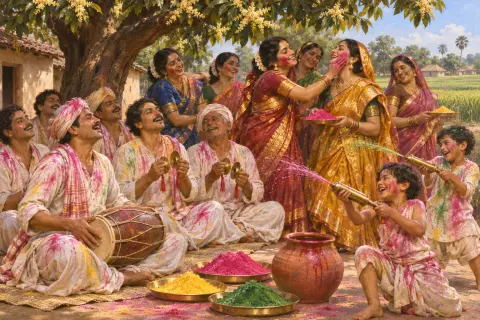
The best-known trial of all is not in the Bhagavata. In later retellings and folk tradition, Hiranyakashipu's sister Holika, who could not be burned by fire, sat on a pyre with the boy in her lap. Prahlada kept repeating Vishnu's name, and the fire burned Holika and left him untouched. This is the story told around the Holika Dahan bonfire on the night before Holi.
The pillar and Narasimha
Hiranyakashipu demands to know if Vishnu is in the pillar.
At last Hiranyakashipu called the boy before him. Where does your strength come from, he roared. Prahlada answered that it came from the same place as his father's strength and everyone's: from Vishnu, who is everywhere (7.8).
Is he in this pillar too, the king shouted, and struck the pillar with his fist. A terrible roar came from inside it. Out burst Narasimha, neither man nor beast but both: a man's body with a lion's head, mane and claws. It was twilight, neither day nor night. He dragged the king to the threshold of the hall, neither inside nor outside, laid him across his lap, neither on the ground nor in the sky, and killed him with his claws, which were no weapon. Not one condition of Brahma's boon was broken.
Narasimha's anger did not cool. The gods, Brahma and Shiva were afraid to go near him, and even Lakshmi held back. Brahma sent the boy instead. Prahlada walked up, bowed, and Narasimha, seeing him, grew gentle and put his hand on the boy's head (7.9).
The boy who asked for nothing
Prahlada's prayer to Narasimha is one of the long hymns of the Bhagavata (7.9). He does not ask to be saved or rewarded. He prays for the good of all beings, even the foolish and the cruel, and says he does not want to be freed alone.
Narasimha offered him any boon. Prahlada said that a servant who serves for a reward is only a trader, and asked only that no desire should ever rise in his heart (7.10). When Narasimha pressed him, he asked one thing more: that his father, who had sinned against Vishnu, be purified. Narasimha told him that because of Prahlada, twenty one generations of his family were already purified.
Then Prahlada was crowned king of the daityas. Narasimha told him to rule with his mind fixed on him, and he did. In the Bhagavata he becomes the model of a devotee who lives in the world and stays untouched by it.
The wise king and the grandfather of Bali
The Mahabharata shows the grown Prahlada as a king who will not lie. In the Udyoga Parva, in Vidura's counsel to Dhritarashtra, Prahlada's son Virochana quarrels with a brahmin youth named Sudhanva over which of them is better, and they bet their lives on it. They ask Prahlada to judge. Though it may cost his own son's life, Prahlada says truthfully that Sudhanva and his father are greater. Sudhanva, moved by his honesty, spares Virochana.
In the Shanti Parva, Bhishma tells how Indra came to Prahlada disguised as a brahmin student and served him so well that Prahlada offered him a boon. Indra asked for Prahlada's good character, and as soon as it was given, Prahlada's glory left him and followed it. The story is told to show that a king's real wealth is his conduct.
Prahlada's grandson was Bali, the generous asura king who gave Vishnu, as the dwarf Vamana, three steps of land. When Bali was bound for keeping his word, Prahlada came, praised Vishnu for taking away a kingdom that had made his grandson proud, and went with Bali to live in Sutala (Bhagavata Purana 8.22 to 23). Kerala remembers Bali as Mahabali and welcomes him home every Onam.
How to recognise
•A small boy, usually five to eight years old in paintings, in a simple dhoti, with palms joined and a calm, happy face. He often wears tulsi beads and a Vaishnava tilak on his forehead.
•Kneeling before Narasimha, who rests a hand on his head in blessing. In many temples, such as Ahobilam in Andhra Pradesh, a small image of Prahlada stands at Narasimha's feet with folded hands.
•Sitting unharmed in a burning pyre while his aunt Holika burns beside him. This is the scene of Holika Dahan; it comes from later retellings and folk tradition, not from the Bhagavata.
•Standing calmly while elephants are driven at him, snakes are set on him or he is thrown from a cliff, as in the Bhagavata's list of his father's attempts on his life (7.5.43 to 44).
•Pointing to a pillar as his father strikes it, the moment before Narasimha bursts out. Pahari painters of the eighteenth century made whole series of these scenes.
•As a grown king, crowned, sometimes shown with his grandson Bali in Sutala, the world beneath the earth where they live together.
And, I am Prahlada among the demons, among the reckoners I am time; among beasts I am the lion, and Vainateya (Garuda) among birds.
Listing his glories, Krishna says: among the daityas I am Prahlada. Of all the sons of Diti, the race of Vishnu's enemies, the one in whom God shows most is the child who loved him.