
Bharata
Rama's brother who ruled with his sandals
Bharata is the second son of King Dasharatha of Ayodhya and Queen Kaikeyi, and a younger brother of Rama in the Ramayana. His mother won the throne for him by sending Rama into exile, but Bharata refused it. He went to the forest to bring Rama back, and when Rama would not break their father's word, Bharata carried Rama's sandals home, set them on the throne and ruled for fourteen years from the village of Nandigram as Rama's stand-in, dressed as a hermit. He is remembered as the brother who would not take what was not his. His story is told in the Ayodhya and Yuddha Kandas of the Valmiki Ramayana, and Tulsidas's Ramcharitmanas gives him some of its most loved pages.
Also called: Kaikeyinandan (son of Kaikeyi), Bharat (in Hindi), Raghava and Kakutstha (of the line of Raghu and Kakutstha, names he shares with his brothers), Bharatan (in Malayalam and Tamil)
Parents: King Dasharatha of Ayodhya and Queen Kaikeyi, princess of Kekaya
Brothers: Rama (son of Kausalya), Lakshmana and Shatrughna (twins of Sumitra); Shatrughna was his close companion
Wife: Mandavi, daughter of Kushadhvaja and cousin of Sita
Sons: Taksha and Pushkala, who ruled from Takshashila and Pushkalavati (Uttara Kanda, sarga 101)
Mother's family: his grandfather Ashvapati, king of Kekaya, and his uncle Yudhajit
Home: Ayodhya; for fourteen years the village of Nandigram outside the city
कल्याणी बत गाथेयं लौकिकी प्रतिभाति माम्। एति जीवन्तमानन्दो नरं वर्षशतादपि॥
kalyāṇī bata gātheyaṃ laukikī pratibhāti mām, eti jīvantam ānando naraṃ varṣaśatād api.
How true the old saying seems to me now: joy comes to a man who stays alive, even if it takes a hundred years.
Stories
Bharata's story is told in the Valmiki Ramayana, mostly in the Ayodhya Kanda, which follows him from his grandfather's house to the forest at Chitrakuta and back, and in the last sargas of the Yuddha Kanda, where Rama comes home. The Uttara Kanda adds his conquest of the Gandharvas. Verse and sarga numbers below follow the southern text as given on sa.wikisource; the Critical Edition numbers some sargas differently. Later tellings love Bharata even more. Tulsidas's Ramcharitmanas gives much of its Ayodhya Kand to him and calls his love for Rama beyond words, and the Bharat Milap, the brothers' meeting, is one of the great nights of Ramlila.
Far away in Kekaya
Bharata was born to Kaikeyi under the star Pushya (Bala Kanda, sarga 18), and he married Mandavi in the same ceremony as Rama's wedding to Sita. Some time later he went with his brother Shatrughna to stay with his mother's family in Kekaya, far to the north-west.
So he was away when everything happened. Kaikeyi used her two boons to have Bharata crowned and Rama sent to the forest, and King Dasharatha died of grief. Messengers rode to Kekaya and told Bharata only that he was needed at home. The night before they arrived he had a bad dream about his father, and he set out uneasy (Ayodhya Kanda, sargas 68 to 70).
Coming home to grief
In Ayodhya, Kaikeyi greeted him gladly and told him his father was dead, Rama was in the forest, and the kingdom was his. Bharata was horrified. He turned on his mother with bitter words: she had killed his father and driven out his brother, and he would never take a throne won like this (Ayodhya Kanda, sargas 73 and 74).
Kausalya, Rama's mother, thought he had wanted this all along and spoke to him coldly. Bharata fell at her feet and swore oath after oath that he had known nothing (sarga 75). When Shatrughna caught the maid Manthara, who had turned Kaikeyi's mind, and dragged her across the floor, Bharata stopped him: Rama would not forgive them for harming a woman (sarga 78).
After his father's funeral the ministers asked him to be crowned. Bharata refused before the whole assembly. How could a son of Dasharatha steal a kingdom, he asked. The kingdom belonged to Rama, and he would go to the forest himself and bring Rama back (sarga 82).
Rama's sandals at Chitrakuta
Bharata set out with the army, the queens and the people of Ayodhya. On the way Guha, the Nishada king who had helped Rama, at first thought Bharata was coming to kill his brother (Ayodhya Kanda, sarga 84), and at Chitrakuta Lakshmana thought the same. Both were wrong. Bharata found Rama's hut, fell at his feet weeping, and told him their father was dead.
For days the brothers argued. Bharata begged Rama to come home and rule. Rama said that their father's word must stand, and that he would keep it. Bharata even lay down on a bed of grass in front of the hut, refusing to move or eat until Rama agreed, and Rama gently told him that this was not the way of a prince (sarga 111).
At last Bharata asked for Rama's sandals. 'Step onto these golden sandals, noble one,' he said. 'They will look after the welfare of the whole world' (sarga 112). Rama stepped into them and gave them to him. Then Bharata made a vow: for fourteen years he would wear matted hair and bark, eat fruits and roots, and live outside the city, holding the kingdom in trust for the sandals. If Rama did not return on the first day after the fourteenth year, he would enter the fire. Rama asked him to look after Kaikeyi and not to be angry with her.
Fourteen years at Nandigram
Bharata carried the sandals home on his head. He would not live in the palace. He went instead to Nandigram, a village outside Ayodhya, set the sandals on the throne and had the royal umbrella held over them. 'This kingdom has been given to me by my brother as a trust,' he told the elders. 'These sandals will keep it' (Ayodhya Kanda, sarga 115).
There he lived like a hermit, in bark clothes and matted hair, with the ministers and the army around him. Every matter of state was first laid before the sandals, and only then decided. The Ramayana says he ruled this way, in sorrow, for all the years Rama was away.
Joy after a hundred years
When the war in Lanka was over, Rama sent Hanuman ahead to Nandigram to see how Bharata felt about his return. Hanuman found him thin and in bark clothes, still ruling in the name of the sandals. When he heard that Rama was alive and coming home, Bharata fainted with joy, then embraced Hanuman and said the verse at the top of this page: joy comes to a man who stays alive, even after a hundred years (Yuddha Kanda, sargas 125 and 126).
When Rama arrived in the flying chariot Pushpaka, Bharata took the sandals and fitted them onto Rama's feet with his own hands. 'Here is the whole kingdom I held in trust,' he said. 'Today my life is fulfilled. Look at the treasury, the storehouses, the army: by your grace I have made all of it ten times greater' (Yuddha Kanda, sarga 127).
This meeting, the Bharat Milap, is one of the great nights of the north Indian Ramlila. In Varanasi the Bharat Milap at Nati Imli, held the day after Dussehra in the presence of the former royal family of Kashi, draws huge crowds every year; its organisers count its performances back more than four and a half centuries. Tulsidas's Ramcharitmanas adds a scene of its own: as Hanuman flies back over Ayodhya at night with the mountain of herbs, Bharata mistakes him for a demon and brings him down with an arrow.
Later years
In the Uttara Kanda, Bharata's uncle Yudhajit asked Rama for help against the Gandharvas, who held a rich land full of fruits and roots. Rama sent Bharata with an army. Bharata defeated them and founded two cities for his sons: Takshashila for Taksha and Pushkalavati for Pushkala (Uttara Kanda, sargas 100 and 101). Takshashila is the city later known as Taxila.
When Rama at last left the world, Bharata would not stay behind. He went with Rama into the river Sarayu with the people of Ayodhya (Uttara Kanda, sargas 109 and 110).
In Kerala, Bharata is worshipped at the Koodalmanikyam temple at Irinjalakuda, one of the few temples in India dedicated to him. During the Malayalam month of Karkidakam, when the Ramayana is read in Kerala homes, many pilgrims visit the four temples of the four brothers in one day, a pilgrimage called the Nalambalam.
How to recognise
- •A young prince with two arms in the clothes of a hermit: bark or plain ochre cloth, no crown, his hair matted and tied up. This is how the Ayodhya Kanda (sarga 115) describes him at Nandigram.
- •Rama's wooden sandals (padukas), set on the throne under the royal umbrella, or carried on Bharata's head. The sandals are his clearest sign, and in many homes and temples padukas are still worshipped as the presence of the one who wore them.
- •In the Ram Darbar picture he sometimes stands beside the throne with Shatrughna, holding the royal umbrella or a fly whisk over Rama and Sita.
- •Kneeling at Rama's feet in tears, or the two brothers holding each other: the Bharat Milap, the meeting of the brothers, a favourite scene in painting and Ramlila.
- •At the Koodalmanikyam temple at Irinjalakuda in Kerala, the image worshipped as Bharata is a form of Vishnu, as in the temples of the other three brothers on the Nalambalam pilgrimage.
Festivals
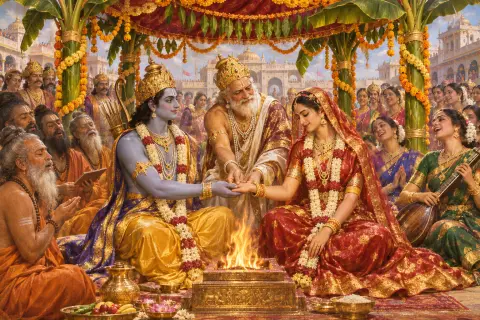 Vivah PanchamiDec 14, 2026He married Mandavi, Sita's cousin, in the same ceremony as Rama's wedding in Mithila.
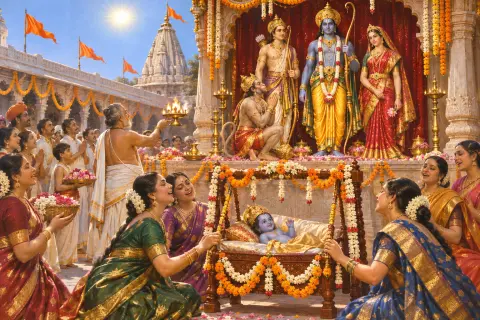 Ram NavamiApr 15, 2027The Ramayana's birth story, told on Rama's birthday, has Bharata born to Kaikeyi under the star Pushya.
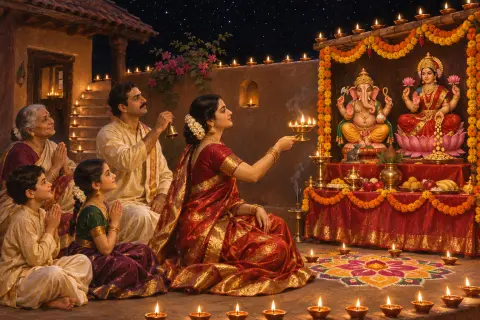 DiwaliOct 29, 2027In the Valmiki Ramayana it is Bharata who has the roads of Ayodhya sprinkled and decorated to welcome Rama home.
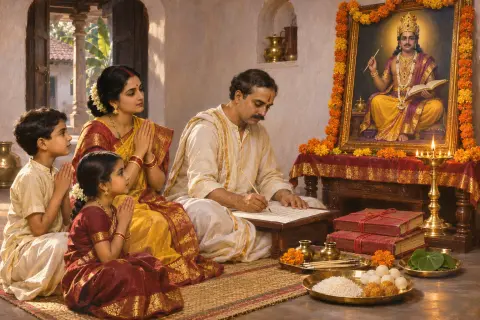 Chitragupta PujaOct 31, 2027In a folk tale, Bharata asks Vasishtha to invite every god to Rama's coronation, and Chitragupta is forgotten.
Ask about Bharata
Ask Gita Chat about Bharata and what their story can teach you.