The Story
The oldest account of the wedding of Rama and Sita is in the Valmiki Ramayana, Bala Kanda, sargas 66 to 73. It tells how King Janaka of Mithila promised his daughter Sita only to a man who could string the great bow of Shiva, how young Rama not only strung it but broke it, and how Rama and his three brothers were married in Mithila on one day. Valmiki names the star of the wedding, Uttara Phalguni (Bala Kanda 71.24), but not the month or the lunar day. Tulsidas, in the Ramcharitmanas (Bal Kand, just before doha 312), says the wedding day came in the lovely winter month of Agahan, that is Margashirsha. The exact date, the fifth day of the bright half of that month, comes from later tradition, and on that day Mithila, Ayodhya and Rama's devotees everywhere keep the wedding anniversary.
A Bow No King Could Lift
In the Valmiki Ramayana, the sage Vishvamitra brings the two young princes of Ayodhya, Rama and Lakshmana, to Janaka's court in Mithila. Janaka tells them the history of a bow kept in his family. It belonged to Shiva, who had raised it in anger when Daksha's sacrifice was destroyed, and Shiva later left it in trust with Devarata, a king of Janaka's line (Bala Kanda 66).
Then Janaka tells them about his daughter. Sita was not born to him in the usual way. She rose from the earth when he was ploughing a field, and he raised her as his own. He decided she would be a viryashulka, a bride whose price is strength: only the man who could string Shiva's bow would marry her. Many kings had come, tried and failed. The bow would not even move.
Janaka was not being harsh. In the story, the test keeps a girl born of the earth from being handed to any king who simply asks. Whoever marries her must be able to do what no one else can.
Rama Breaks the Bow
Janaka's men wheel in the bow in a huge iron chest. Vishvamitra tells Rama to look at it. Rama lifts it easily, strings it and draws it, and the bow snaps in the middle (Bala Kanda 67.17). Valmiki says the sound was like thunder, and the earth shook as if a mountain were splitting.
Janaka is overjoyed and sends messengers to Ayodhya to invite King Dasharatha. In Valmiki the scene is quiet: only Janaka's court, the sage and the princes are there. The fiery sage Parashurama, angry that Shiva's bow was broken, meets Rama later, on the road back to Ayodhya.
Tulsidas tells it as a grand Dhanush Yagya, a public contest with kings from many lands. When all of them fail, Rama bows to his guru in his heart, picks up the bow as lightly as a flash of lightning, and breaks it (Ramcharitmanas, Bal Kand, doha 261). In the Manas, Parashurama storms into the same hall right afterwards. Most Ramlilas follow Tulsidas, which is why the bow breaking and the argument with Parashurama are usually played one after the other.
The Meeting in the Flower Garden
Valmiki has no meeting between Rama and Sita before the wedding. The well loved garden scene comes from the Ramcharitmanas (Bal Kand, around dohas 227 to 236). The morning before the contest, Rama and Lakshmana go to King Janaka's garden to pick flowers for their guru's worship. Sita comes to the same garden with her friends to worship the goddess Gauri.
One of her friends sees the two princes and runs back to tell her. Sita and Rama see each other among the flowers, and neither can stop thinking of the other. Sita then prays to Gauri for the husband her heart has chosen, and the goddess's image smiles and blesses her.
This Pushp Vatika scene is a favourite in Ramlilas and in the songs of Mithila. It gives the story a gentle, human side: before the bow and the crowds, there were two young people who simply liked each other.
Four Weddings in One Day
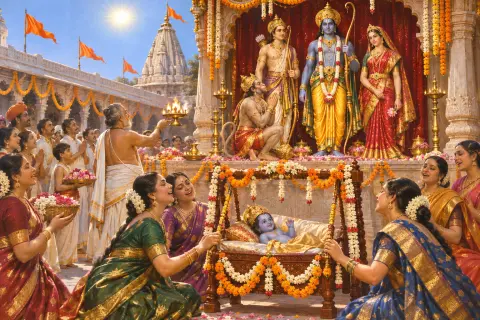
Dasharatha arrives in Mithila with his family, priests and army. Dasharatha's guru Vashishtha recites the line of Ayodhya's kings, and Janaka recites his own. Then Janaka offers more than one daughter. In the Valmiki Ramayana, Sita marries Rama, her sister Urmila marries Lakshmana, and Janaka's nieces Mandavi and Shrutakirti marry Bharata and Shatrughna (Bala Kanda 73).
Before the sacred fire, Janaka brings Sita, adorned with every ornament, and stands her facing Rama. He says the words in the verse at the top of this page: this is Sita, my daughter, take her hand in yours. He adds that she will follow Rama always, like his shadow, and sprinkles water purified with mantras on the couple.
Tulsidas adds the details a family remembers: the women of Mithila singing, Rama putting sindoor in the parting of Sita's hair, and the wedding feast where the Mithila women tease the groom's party with sweet gaari songs, calling out the guests by name while King Dasharatha laughs along (Ramcharitmanas, Bal Kand, around doha 329).
How Mithila Keeps the Day
In Janakpur, in Nepal, Vivah Panchami is the biggest event of the year. Pilgrims come from across Nepal and India. Images of Rama and Sita are carried in a groom's procession, the barat, often from the Ram Mandir to the Janaki Mandir, with elephants, horses and music, and a bow breaking is enacted at the Rangbhumi ground. The wedding is then performed at the Vivah Mandap beside the Janaki Mandir. In Sitamarhi, in Bihar, the Janaki Sthan temple holds a Ram Janaki Vivah Mahotsav, and in Ayodhya the Rama temples celebrate Vivah Utsav with the same rites.
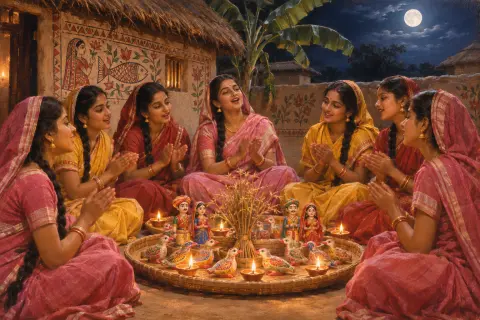
For Mithila this is not a distant story. Sita is Mithila's daughter, and Rama is still called the pahun, the son in law who came to Mithila to marry her. Women sing the same wedding songs they sing at their own family weddings: songs for the haldi, for the kohbar, the painted room for the bride and groom, and teasing gaari songs aimed at Rama and the people of Ayodhya. Folk tradition in Mithila says that the painting on the walls of Mithila homes began when King Janaka had his city painted for Sita's wedding.
There is also a quieter custom. Many families in Mithila and parts of north India, by folk belief, do not hold their own daughters' weddings on Vivah Panchami. They say Sita's married life brought exile, separation and suffering, and they would not wish that on their daughter. This is a belief and not a scriptural rule, and other families consider the day especially lucky for weddings.
Krishna says in the Gita (10.31) that among those who bear weapons, he is Rama. On Vivah Panchami, that strength is seen at its gentlest: Rama breaks the bow not to win a war but to win a bride who was promised only to the strongest, and then stands before the fire to take her hand with humility. Strength that ends in a promise kept, and in care for another person, is the kind worth having.