Stories
The oldest text that names her is the Mahabharata. In the Vana Parva, Indra rescues a maiden called Devasena and gives her in marriage to Skanda, the gods' new general, and the epic says Brahmins call her Shashthi, Lakshmi, Asha and other names (Vana Parva 3.218.47 in the Critical Edition). The Brahma Vaivarta Purana (Prakriti Khanda, chapter 43) and the Devi Bhagavata Purana (Book 9, chapter 46) make her the sixth portion of Prakriti and the guardian of children, and tell how she brought King Priyavrata's stillborn son back to life. They ask for her worship on the sixth day after a birth and on the sixth day of each bright fortnight. Chhath, the four-day festival of Kartika and Chaitra, does not appear in these texts. It grew in the villages of Bihar and its neighbours, where the goddess of the sixth day became Chhathi Maiya, worshipped together with the Sun.
Devasena, the Bride of the Gods' General
The Mahabharata (Vana Parva, the Markandeya section) tells that Indra, worried about the gods' defeats, heard a woman crying for help on Mount Manasa. The demon Keshin was carrying her off. Indra fought and drove him away, and the young woman told him who she was: Devasena, a daughter of Prajapati. Her sister Daityasena had chosen Keshin, but Devasena wanted a husband no god or demon could defeat.
Indra searched for such a husband. Soon after, Skanda was born, the six-faced son of Agni and, in other tellings, of Shiva, raised by the six Krittikas. The gods made him their senapati, the general of their army. Indra then gave Devasena to Skanda in marriage, and the epic plays on her name: the army of the gods (deva sena) had found its lord.
The same passage lists the names by which Brahmins know her: Shashthi, Lakshmi, Asha, Sukhaprada, Sinivali, Kuhu, Sadvritti and Aparajita. Shashthi, "the sixth", is the name that would grow into a goddess of its own.
The Sixth Portion of the Great Goddess
In the ninth book of the Devi Bhagavata Purana, Narada asks about three goddesses he has heard of: Shashthi, Mangala Chandi and Manasa. Narayana answers that each is a portion of Prakriti, the great goddess from whom all goddesses come. Shashthi is called so because she is the sixth portion (shashtha amsha).
She is Devasena, the dearest wife of Skanda. She presides over infants and children, gives children to those who have none, and watches over their lives. The Brahma Vaivarta Purana (Prakriti Khanda, chapter 43) tells the same in almost the same words.
This is the goddess whom Bihar's Chhath songs call Chhathi Maiya. The Puranas do not use that name, but the meaning matches: the mother of the sixth, who keeps children safe.
King Priyavrata's Son
Both Puranas tell the story that made her worship known. King Priyavrata, son of Svayambhuva Manu, had wanted to live as an ascetic and married only at Brahma's request. For a long time he and his wife Malini had no child. The sage Kashyapa performed a sacrifice for a son, and at last Malini gave birth. But the baby was born dead.
Priyavrata carried the small body to the cremation ground and, holding it, decided to give up his own life there. Then a shining chariot appeared in the sky, and in it a goddess as fair as a white champaka flower. She said she was Devasena, Shashthi, the sixth portion of Prakriti. She took the dead child into her lap, and he came back to life.
She told the king his son would be famous as Suvrata (Devi Bhagavata Purana), and asked him to make her worship known in all the worlds. Priyavrata did. From then on, the Purana says, she was worshipped on the sixth day after every birth, on the twenty-first day, at the child's first rice feeding, and on the sixth day of each bright fortnight.
The Chhathi of a Newborn
Across north India, the sixth day after a baby is born is still called chhathi, and many families mark it with a small puja, the mother's first proper bath, new clothes for the baby, kajal for its eyes and, in some homes, the naming. This is the sixth-day worship the Puranas ask for, kept in the language of the home.
A folk belief, told in Bihar, Uttar Pradesh and Rajasthan, says that on the night of the chhathi, Vidhata (in Rajasthan Bemata), the goddess or god of destiny, comes to write the child's fate on its forehead. A lamp is kept burning and a pen and paper are sometimes left out. This belief is folk tradition, not part of the Puranas, but it explains why the sixth night feels so important to so many grandmothers.
Chhathi Maiya of the Ghats
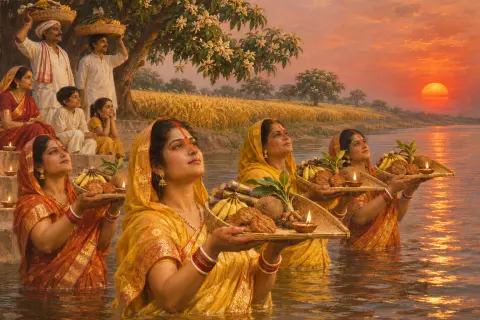
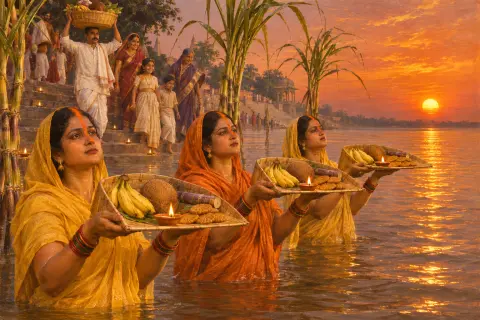
Chhath is kept twice a year, in Kartika and in Chaitra, on the sixth day of the bright fortnight, the same Shukla Shashthi that the Puranas set aside for her. Over four days the vrati bathes, eats one pure meal, fasts after Kharna, and then, without food or water, offers arghya to the setting sun and the rising sun from the water. The songs sung on the way to the ghat speak to Chhathi Maiya and to Surya Dev in the same breath.
In these songs and in common belief across Bihar, Chhathi Maiya is the sister of Surya. This is folk tradition: no Purana says it. People also say that the vow is made to her, that she is strict about purity, and that she always answers. Families whose prayer for a child or a cure was answered fill a kosi, setting lamps under a canopy of sugarcane in the courtyard and at the ghat.
The Chhath vrat katha read in many homes adds other stories: Draupadi keeping the vow in the forest on the advice of the sage Dhaumya, Sita and Rama keeping it after returning to Ayodhya, Karna worshipping the Sun standing in water. These belong to the vrat katha and to folk memory, not to the Mahabharata or the Valmiki Ramayana.
Shashthi in Bengal and Devasena in the South
Bengal knows her as Shashthi Ma and keeps several Shashthis in the year, for the health of children. The best known is Aranya Shashthi, also called Jamai Shashthi, on the sixth day of the bright half of Jyeshtha. A Bengali vrata story tells of a greedy daughter-in-law who ate the household's food and blamed the cat. The cat, Shashthi's own mount, complained to the goddess, and one by one the woman's children were taken. She repented, worshipped Shashthi in the forest, and her children were given back.
In Tamil Nadu, Devasena is Deivanai, the wife of Murugan, raised in Indra's heaven and given to Murugan after his victory over the demon Surapadman, which is celebrated at Skanda Shashti. Their wedding is remembered at the Thiruparankundram temple near Madurai. The Tamil Deivanai and Bihar's Chhathi Maiya are worshipped in very different ways, but they trace back to the same Devasena of the Mahabharata.