The Story
No Purana describes Chhath the way Bihar keeps it today. It is a folk vrat of the Bhojpuri, Magahi and Maithili speaking lands, and its two strands are old. Offering water to the sun at dawn and dusk goes back to the Vedic sandhya, and the Narada Purana (Purva Bhaga, chapter 119, verse 63) gives an arghya verse to the sun that many vratis still say at the water. Chhathi Maiya is widely identified with Shashthi Devi, the goddess who protects children, whose story the Devi Bhagavata Purana tells (Book 9, chapter 46). Chaiti Chhath keeps the same four days and the same vow as the Kartik Chhath, but in the month of Chaitra.
Shashthi Devi and King Priyavrat
The Devi Bhagavata Purana tells of King Priyavrat, son of Svayambhuva Manu. He and his wife Malini had no children for a long time. After a sacrifice for a son, Malini finally gave birth, but the baby was born dead.
Priyavrat carried the little body away in his grief and decided he would die too. Then a shining chariot appeared in the sky. In it was a goddess who told him she was Devasena, also called Shashthi, a portion of the Great Mother, who gives children to the childless and protects them. She took the baby on her lap, and he came back to life.
She asked the king to make her worship known. People in Bihar connect this goddess, whose name means the sixth, with Chhathi Maiya, the mother worshipped on the sixth day. This is why the Chhath vow is so often made for children: for a child to be born, for a sick child to get well, or simply for the children of the house to be safe.
The Sun Who Is Seen
The other half of Chhath is Surya, the sun. Most gods are seen only in images, but the sun is seen by everyone, every day. Chhath asks for nothing more than standing in water and offering it to him, first as he sets and then as he rises.
Offering water to the sun at dawn and dusk is part of the old daily sandhya worship, and the arghya verse from the Narada Purana asks the thousand rayed sun to accept the water and be kind. In Bihar people also remember Karna of the Mahabharata, Surya's son, who worshipped the sun every day.
Chhath puts these two together. The vrati thanks the sun for light and the harvest and prays to Chhathi Maiya for the family, especially the children.
Why Chhath Comes Twice a Year
Chhath is kept on the sixth day of the bright half of two months: Kartika, after Diwali, and Chaitra, in spring. The Kartik Chhath is the huge one, with crowded ghats in every town. Chaiti Chhath is smaller and quieter. Fewer families keep it, the ghats are less crowded, and it often feels more like a family's own vow than a festival of the whole town.
Many who keep Chaiti Chhath do so because of a mannat, a vow made in hard times: if my child recovers, if we have a child, if this trouble passes, I will keep Chhath. Some families keep only the Kartik Chhath, some keep both, and some keep Chaiti Chhath as their own family tradition. Once a woman or man takes up the vrat, it is usually kept for years.
Chaiti Chhath also sits inside a holy season. It falls during Chaitra Navratri, and Ram Navami comes three days later. In Mathura and Vrindavan the same date is kept as Yamuna Chhath, the birthday of the river Yamuna.
Four Days in the Chaitra Heat
The four days are the same as in Kartik. On Nahay Khay the vrati bathes, cleans the house and eats one simple meal of rice, chana dal and bottle gourd cooked without onion or garlic. On Kharna they fast all day and in the evening make kheer with jaggery, called rasiao, and roti, often on a clay stove with mango wood. After eating it as prasad, the 36 hour fast without water begins.
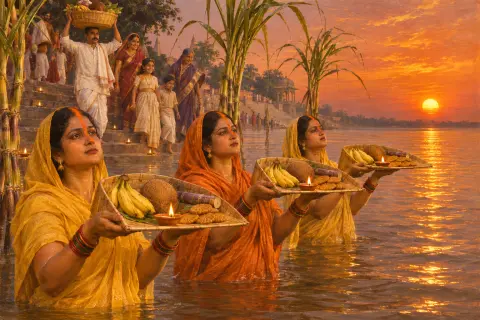
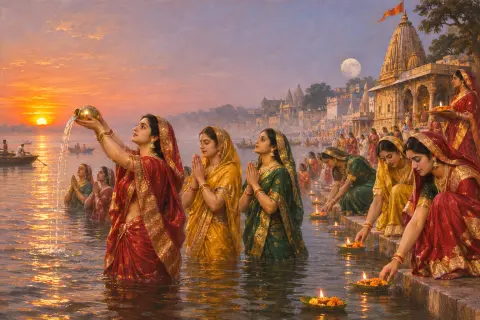
On the third day the family carries bamboo baskets (daura and soop) of thekua, fruit, coconut, sugarcane and fresh turmeric to the water. The vrati stands in the river or pond and offers arghya to the setting sun. Before dawn on the fourth day they return, stand in the water again and offer arghya to the rising sun. Then the fast is broken and prasad is shared.
What makes Chaiti Chhath different is the heat. By late March or April, Bihar is already hot and dry, and the wheat harvest is underway. Going a day and a half without water in that heat is hard, and families take special care of the vrati: shade at the ghat, someone to carry the baskets, and rest after the fast.
Chaiti Chhath Across Bihar
In Magadh, the sun temple at Deo in Aurangabad district holds a large Chaiti Chhath mela, and vratis come from far away to offer arghya at its Surya Kund. In Patna, families go to the Ganga ghats or to ponds in their own neighbourhoods, and many now make a small pool on the roof or in the courtyard.
In Anga, at Munger, people point to Sita Charan, a rock in the Ganga with what they believe are Sita's footprints, and tell that Sita kept Chhath there on the advice of the sage Mudgal. This is a local tradition told for Chhath in general, and it gives the Munger ghats a special place in both seasons.
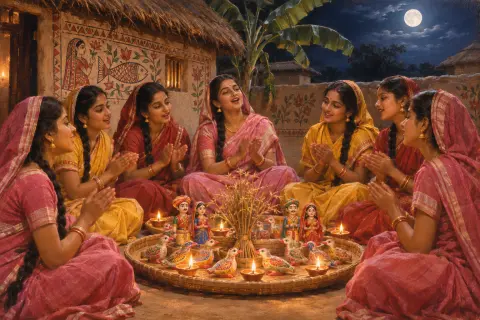
In Bhojpur and Mithila, Chaiti Chhath is kept the same way, with Chhath songs sung in Bhojpuri and Maithili as the families walk to the water. It is also kept in Jharkhand, eastern Uttar Pradesh and the Madhesh plains of Nepal, and by Bihari families wherever they have settled.
In Gita 18.5 Krishna says that sacrifice, giving and austerity should never be given up, because they purify even the wise. Chaiti Chhath holds all three, in the hardest season to keep them. The vrati keeps the house clean, eats simply, goes without water in the heat, offers arghya to the sun at dusk and dawn and then shares the prasad, not for show but for the people they love.