Dhritarashtra is the blind king of Hastinapura in the Mahabharata, the son of Vyasa and Queen Ambika, husband of Gandhari and father of Duryodhana and his ninety-nine brothers, the Kauravas. Passed over for the throne because of his blindness, he ruled after his brother Pandu retired, and spent his life torn between knowing what was right and giving in to his eldest son. He allowed the dice game, refused all advice to make peace, and lost every son in the war. The Bhagavad Gita opens with his question to Sanjaya: what did my sons and the sons of Pandu do at Kurukshetra?
Also called: Prajnachakshu (whose eyes are his wisdom), Kauravya and Kururaja (king of the Kurus), Ambikeya (son of Ambika), Vaichitravirya (son of Vichitravirya), Janeshvara and Mahipati (lord of men, of the earth, as Sanjaya addresses him)
Mother: Ambika, widow of King Vichitravirya; father: the sage Vyasa, by niyoga; legal father: Vichitravirya
Brothers: Pandu, son of Ambalika; Vidura, son of a maid, his wisest counsellor
Wife: Gandhari, princess of Gandhara; brother-in-law: Shakuni
Sons: a hundred with Gandhari, led by Duryodhana and Duhshasana; Yuyutsu, with a Vaishya maid, who fought for the Pandavas and survived
Daughter: Duhshala, wife of Jayadratha
Guardian: Bhishma, his uncle; charioteer and minister: Sanjaya
Kingdom: Hastinapura
सा तु बुद्धिः कृताप्येवं पाण्डवान्प्रति मे सदा।
दुर्योधनं समासाद्य पुनर्विपरिवर्तते॥
sā tu buddhiḥ kṛtāpy evaṃ pāṇḍavān prati me sadā,
duryodhanaṃ samāsādya punar viparivartate.
My mind, though always made up this way about the Pandavas, turns around again as soon as I meet Duryodhana.
Stories
Dhritarashtra's story runs through the whole Mahabharata, traditionally credited to Vyasa, his own father. The Adi Parva tells of his birth and marriage and the omens at Duryodhana's birth; the Sabha Parva of the dice game he allowed; the Udyoga Parva of his sleepless night with Vidura and the failed peace; the Bhishma Parva begins the war as Sanjaya's report to him; and the Stri and Ashramavasika Parvas follow his grief and his end. The section numbers below follow K. M. Ganguli's English translation unless the Critical Edition prepared at Pune is named. The epic does not make him a simple villain. It lets him say again and again that he knows what is right, and then shows him unable to act on it because he loves his son.
The blind prince
When King Vichitravirya died without children, his mother Satyavati asked her son Vyasa to give sons to the two widows. Ambika shut her eyes in fear at the sage's dark, wild appearance. Vyasa told his mother the child would have the strength of ten thousand elephants and a hundred sons, but would be blind because of his mother's fault (Adi Parva, section 106). That child was Dhritarashtra.
Because he was blind, the throne went to his younger brother Pandu (section 109). Bhishma arranged his marriage to Gandhari, princess of Gandhara, who, on hearing her husband was blind, bound her own eyes (section 110). When Pandu gave up the kingdom and went to the forest, Dhritarashtra ruled in his place, but he never forgot that the crown had first gone to someone else.
The son he would not give up
When Duryodhana was born he brayed like an ass, and jackals, vultures and crows answered him. Violent winds blew and fires broke out. Frightened, Dhritarashtra asked Bhishma, Vidura and the Brahmins whether this son could be king after Yudhishthira. Vidura and the Brahmins said: these omens show he will destroy your family; give him up, and you will still have ninety-nine sons. Out of love, the epic says, Dhritarashtra did not have the heart to do it (Adi Parva, section 115).
That choice repeats through the rest of his life. He let Duryodhana send the Pandavas to Varanavata and the house of lac, and he agreed to the game of dice. When Draupadi was dragged into the hall and jackals howled in the palace, he took fright and gave her boons, freeing her husbands (Sabha Parva, section 70). Then, at Duryodhana's urging, he allowed a second game that sent them into exile.
The sleepless night
Before the war Sanjaya came back from the Pandavas with Yudhishthira's message, and Dhritarashtra could not sleep. He sent for Vidura at night and asked him what a sleepless man burning with worry should do (Udyoga Parva, sections 33 and 34). Vidura's long answer, known as the Vidura Niti, is still read as a book of practical wisdom.
At the end of it Dhritarashtra said the words at the top of this page: you are right, and my own heart agrees; but whenever I meet Duryodhana it turns around again. No one can escape fate, he said; what is destined will happen, and effort is useless (section 40). When Krishna came as a peace envoy, and when Bhishma, Drona, Gandhari and Vidura all pleaded, he still did not stop his son.
What did my sons do?
Just before the battle Vyasa came to his son and told him plainly that his sons and the kings with them had reached their time. He offered Dhritarashtra sight so he could watch. Dhritarashtra refused: he did not want to see his family killed, only to hear of it. So Vyasa gave divine sight to Sanjaya (Bhishma Parva, section 2).
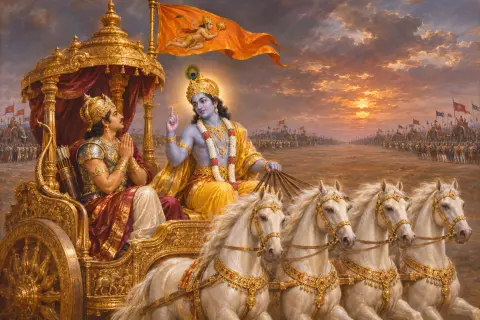
The Bhagavad Gita begins with Dhritarashtra's question: on the field of dharma, at Kurukshetra, what did my sons and the sons of Pandu do? His words mamakah, my own, and pandavah, Pandu's sons, divide the family in a single line, and commentators have read the whole war into that split. Day after day Sanjaya told him how his sons fell, until Duryodhana too was dead, and Sanjaya's sight left him (Sauptika Parva, section 9).
The iron Bhima
Dhritarashtra crushes the iron statue of Bhima.
After the war the Pandavas came to greet their uncle. He embraced Yudhishthira, then asked for Bhima, who had killed Duryodhana and Duhshasana. Krishna understood what was in his heart, pulled the real Bhima aside, and put in front of the king an iron statue of Bhima he had kept ready. Dhritarashtra crushed it to pieces in his arms, bruised his own chest, vomited blood and fell. Then he wept, crying out for Bhima. Krishna told him: you have not killed Bhima, only an iron image; no man could survive your arms (Stri Parva, section 12).
For about fifteen years Dhritarashtra lived in honour at Yudhishthira's court. In the Ashramavasika Parva he tells his people that all those years he had been burning inside, eating only a little at long intervals as secret penance, and Gandhari alone knew it (Critical Edition 15.5.9). Then he left with Gandhari and Kunti for the forest. On the night Vyasa called the dead warriors out of the Ganga, he gave Dhritarashtra divine sight for the first time, and he saw his sons. Years later the three elders died together in a forest fire by the Ganga, sitting still and facing east (Ashramavasika Parva, sections 32, 33 and 37).
How to recognise
•A large, powerfully built old king with a white beard, seated on a throne, his eyes open but unseeing or closed. Vyasa says at his birth that he will have the strength of ten thousand elephants (Adi Parva, section 106).
•Seated in his palace with Sanjaya at his side, who looks into the distance and describes the battlefield: the opening picture of countless printed Gitas.
•Crushing an iron statue of Bhima in his arms, with Krishna standing by: the scene after the war in the Stri Parva.
•As an ascetic in the forest, thin and bareheaded, walking with his hand on Gandhari's shoulder while she holds Kunti's.
•Next to him, almost always, the blindfolded Gandhari. Their joined image, the blind king and the queen who chose not to see, is how many people first meet the Kaurava family.
Dhritarashtra said: What did my people and the sons of Pandu do when they had assembled together eager for battle on the holy plain of Kurukshetra, O Sanjaya.
The first verse of the Gita and the only one he speaks: what did my sons and the sons of Pandu do at Kurukshetra, O Sanjaya?