The Story
The oldest account of Vyasa is in the Mahabharata itself. Its Adi Parva (chapter 57 in the critical edition) tells how the sage Parashara and Satyavati had a son on an island in the Yamuna, named Krishna Dvaipayana, who divided the Veda and became known as Vyasa. The epic does not give his birthday. The custom of honouring Vyasa and one's own guru on the full moon of Ashadha comes from later tradition, kept especially by monks, who perform Vyasa Puja on this day. For Buddhists, the Pali texts (the Vinaya's Mahavagga and the Dhammacakkappavattana Sutta) record the Buddha's first teaching at Sarnath, which Buddhist tradition places on this same full moon. So the day is kept to thank the teachers through whom knowledge reaches us.
The boy born on an island
The Mahabharata tells how the sage Parashara met Satyavati, a young woman who ferried people across the Yamuna. Their son was born on a small island in the river. He was dark skinned, so he was called Krishna, and because he was born on an island (dvipa) he was called Dvaipayana. Krishna Dvaipayana grew up quickly, took leave of his mother, and promised to come whenever she called him.
He became a great ascetic and scholar. Later he did come when Satyavati called, and from him came Dhritarashtra, Pandu and Vidura. So the man who wrote the Mahabharata was also the grandfather of both the Kauravas and the Pandavas. He watches the whole story from close by, and steps in again and again to advise, warn and console.
Why he is called Vyasa
Vyasa means the one who arranges or divides. The Vishnu Purana and the Bhagavata Purana say that Vedic knowledge had grown vast and hard to hold, and that people of a weaker age would not manage it whole. So Krishna Dvaipayana divided it into four: the Rig, Yajur, Sama and Atharva Vedas. He taught each one to a disciple, Paila, Vaishampayana, Jaimini and Sumantu, who passed them on to their own students.
Tradition also credits him with the Mahabharata, the Puranas and the Brahma Sutras. Scholars debate how much one person could have written, and many think the name stands for a whole line of compilers. Either way, for Hindus Vyasa is the teacher behind most of the texts they still read. That is why the guru's seat in many traditions is called the Vyasa peetha, the seat of Vyasa.
The Mahabharata and the Gita
Vyasa composed the Mahabharata and taught it to his student Vaishampayana, who recited it at King Janamejaya's great sacrifice. A well loved story, found in some versions of the epic and left out of others, says Vyasa dictated it to Ganesha, who agreed to write only if Vyasa never paused. Vyasa added one condition of his own: Ganesha must understand every verse before writing it down.
The Gita sits inside the Bhishma Parva of the Mahabharata. Before the war, Vyasa offered blind Dhritarashtra the gift of sight so he could watch the battle. The king refused, so Vyasa gave divine sight to his charioteer Sanjaya instead. Through that sight Sanjaya heard every word Krishna spoke to Arjuna. At the very end of the Gita (18.75) Sanjaya says it plainly: by the grace of Vyasa I heard this supreme yoga from Krishna himself.
Krishna also names Vyasa in the Gita. Listing the places where his glory shows most clearly, he says (10.37): among the sages, I am Vyasa.
The Buddha's first teaching
Buddhists keep the same full moon for their own reason. After his awakening under the bodhi tree at Bodh Gaya in Bihar, the Buddha walked to the deer park at Sarnath near Varanasi. There he found the five companions who had once practised hard austerities with him, and gave his first teaching, known as setting the wheel of the Dhamma in motion. One of them, Kondanna, understood it that day.
In Theravada countries this full moon is called Asalha Puja, and in Sri Lanka it is Esala Poya. The next day monks begin the rains retreat, staying in one place for the monsoon months. For Buddhists too, then, it is a day about a teacher and the first students who listened.
How the day is kept
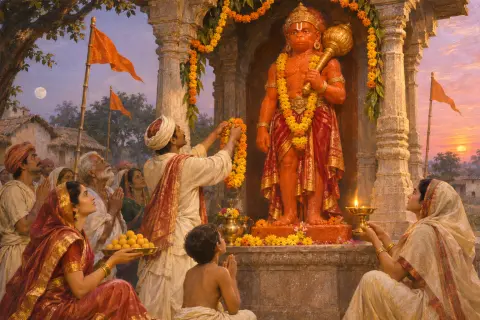
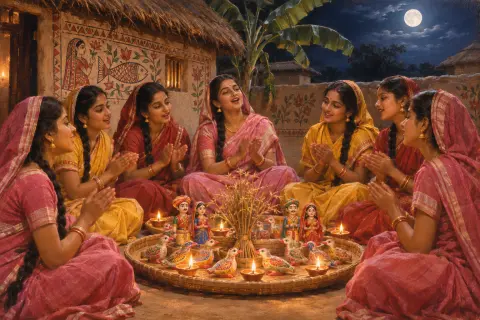
Most Hindus mark it simply. They visit their guru, or the ashram or math of their tradition, touch the teacher's feet, offer flowers, fruit and a gift called guru dakshina, and listen to a talk. People who have no living guru often worship Vyasa, read from the Gita or the Mahabharata, or thank a teacher who shaped them. Students in schools, music and dance halls and wrestling akharas honour their teachers the same way.
In the monasteries of the Shankara tradition, monks perform Vyasa Puja on this day and begin Chaturmasya, the rainy season retreat when wandering monks stay in one place. Shirdi in Maharashtra holds one of its biggest festivals, and large crowds gather at ashrams across India. In Nepal the day is kept as a day for teachers, and students visit their teachers with gifts.
In Bihar the two sides of the day meet. Families go to the kul guru, the family's spiritual teacher, for blessings, and many take diksha, formal initiation, on this day. At Bodh Gaya, where the Buddha's search ended, monasteries from many countries mark Asalha with chanting and offerings before the rains retreat begins.
Arjuna only began to hear the Gita when he said, "I am your disciple, teach me" (2.7). Krishna then tells him how knowledge is passed on (4.34): go to those who have seen the truth, bow to them, ask them honest questions and serve them, and they will teach you. Guru Purnima is a day to do exactly that. Thank the teachers you have had, and stay humble enough to keep learning. The Gita itself reached us through a chain of such people, Krishna to Arjuna, Vyasa to Sanjaya, teacher to student, all the way to whoever is reading it today.