
Markandeya
The ever-young sage who outlived the flood
Markandeya is the sage of endless life. In the Mahabharata he is an ancient sage of Bhrigu's line who has outlived the end of the world, and who tells the exiled Pandavas many stories, among them Savitri's, Rama's and his own vision of a divine child lying on a banyan tree in the waters of the flood. The Bhagavata Purana tells the same vision, and the Markandeya Purana, which contains the Devi Mahatmya, is named after him. Later Shaiva tradition adds the best loved story: a boy fated to die at sixteen, who held on to a Shiva linga when Yama came for him and was saved by Shiva, who struck Death down.
Also called: Mrikandaputra or Markandeya (son of Mrikanda), Bhargava (of Bhrigu's line), Dirghayu and Chiranjivi (the long-lived), Bala Markandeya (the boy Markandeya, in the Shaiva story)
Father: the sage Mrikanda (also Mrikandu), of Bhrigu's line; the Mahabharata calls Markandeya "of Bhrigu's race"
Mother: Manasvini in some Puranas; other names are given in other texts
Teacher and protector: Shiva in the Shaiva story; in the Mahabharata and Bhagavata he is a devotee of Vishnu-Narayana
Listeners: Yudhishthira and the Pandavas in the Mahabharata; Kraushtuki, to whom he tells the Devi Mahatmya, in the Markandeya Purana
Age: the Mahabharata says he has seen many thousands of ages pass; in the Shaiva story Shiva keeps him sixteen for ever
कामो महर्षे सर्वोऽयं भक्तिमांस्त्वमधोक्षजे । आकल्पान्ताद् यशः पुण्यमजरामरता तथा ॥
kāmo maharṣe sarvo 'yaṃ bhaktimāṃs tvam adhokṣaje, ā-kalpāntād yaśaḥ puṇyam ajarāmaratā tathā.
Great sage, all that you wish will be yours, for you are devoted to Vishnu. Until the end of this age of the world you will have holy fame, and freedom from old age and death.
Stories
Markandeya appears first in the Mahabharata. In the Vana Parva a long section, the Markandeya-samasya, has him visit the Pandavas in the forest and tell them stories of the ages, the flood, Savitri, Rama, the birth of Skanda and more. The Bhagavata Purana (Book 12, chapters 8 to 10) tells his tapas, his vision of Vishnu's illusion and Shiva's blessing. The Markandeya Purana is told in his name. The story that most people know, the boy saved from Yama by Shiva, is not in any of these. It belongs to later Puranic and temple tradition: the Padma Purana's Uttara Khanda tells a version, and the Tamil temple of Thirukkadavur keeps it as its own.
The Boy Who Would Live Sixteen Years
The sage Mrikanda and his wife had no children, and they prayed to Shiva. Shiva offered them a choice: a son who would live long but be dull and without virtue, or a son who would be wise and good but live only sixteen years. They chose the good son, and Markandeya was born.
The boy grew up gentle and learned, and devoted to Shiva. As his sixteenth year came, his parents could not hide their grief, and when he learned why, he went to worship Shiva at a linga and did not stop. When his last day came, Yama's messengers could not come near him. Then Yama came himself and threw his noose. The boy threw his arms around the linga, and the noose fell around the linga too.
Shiva burst out of the linga in anger and struck Yama down with his foot, for daring to bind what was his. Markandeya was free. In most tellings the gods then begged Shiva to restore Yama, since the world needs death, and Shiva did, but blessed Markandeya to stay sixteen for ever.
This story is told in later Puranic and Shaiva sources rather than in the epics. The Padma Purana (Uttara Khanda) tells a version in which the boy, seized by Death on the sea shore, keeps reciting a hymn to Shiva until Shiva comes out of the linga. In Tamil Nadu the Thirukkadavur temple holds that it happened there, and the Tamil Tevaram hymns of the seventh century already sing of Shiva kicking Death to save a devotee who served him.
The Child on the Banyan Tree
In the Mahabharata (Vana Parva, section 187 in Ganguli's translation), Yudhishthira says to Markandeya that he has seen many thousands of ages pass, and asks him what he has seen. Markandeya describes the end of an age: the world burnt, then drowned, and he alone left, swimming wearily over endless water with no place to rest.
Then he saw a great banyan tree in the flood, and on one of its branches, on a divine couch, sat a boy with a face like the moon and eyes like lotus petals, dark like the flax flower, with the shrivatsa mark on his chest. Even Markandeya, who knew past, present and future, could not tell who this was. The boy said: "You are tired and want rest. Enter my body and rest there." He opened his mouth, and Markandeya was drawn inside.
Inside the boy's body he found the whole earth: its kingdoms and cities, the Ganga, the Yamuna and the other rivers, the mountains, the oceans, people at their work and sacrifices. He wandered there for many centuries, living on fruits, and never reached the end of that body. When he turned to the god for refuge, he was suddenly thrown out again and saw the boy still sitting on the tree. The boy told him that he was Narayana, who sleeps on the waters between the ages (section 188). At the end Markandeya tells the Pandavas that their kinsman Krishna is that very god, and that by his boon his memory does not fail and death itself is under his control.
The Bhagavata's Telling
The Bhagavata Purana (Book 12, chapters 8 to 10) tells the vision again, with its own beginning. Markandeya did tapas for so long that Indra grew afraid and sent Kama, the spring and the apsaras to break it. They failed; the sage did not even notice them. Pleased, Nara and Narayana appeared to him and offered a boon. He asked only to see the Lord's maya, the power that makes the world seem real.
One evening a flood rose out of nowhere and swallowed everything. Markandeya swam alone for ages until he saw a young banyan tree, and on a leaf a baby boy who had put his toe in his mouth and was sucking it (12.9.22 to 25). The child breathed in and drew the sage in like a mosquito, and inside him Markandeya saw the whole universe as it had been. Breathed out again, he reached to embrace the child, and the child, the tree and the flood vanished. He was back in his hermitage, as if nothing had happened.
In chapter 10 Shiva and Parvati pass by, and Parvati asks Shiva to grant the sage something. Markandeya, lost in meditation, does not notice them at first. When he does, he asks only for devotion. Shiva blesses him with fame, freedom from age and death until the end of the cosmic age, and the role of a teacher of the Puranas, the verse at the top of this page.
Storyteller to the Pandavas
Because he has seen so much, the Mahabharata uses Markandeya as a storyteller. During the Pandavas' exile he tells Yudhishthira about the ages of the world and the flood, and many stories besides.
When Yudhishthira asks whether any woman has ever been as devoted as Draupadi, Markandeya tells him the story of Savitri, who followed Yama and won back her husband Satyavan. When he asks whether anyone has suffered as he has, Markandeya tells him the story of Rama, the Ramopakhyana. He also tells of the birth of Skanda and his marriage to Devasena, and the story of the proud brahmin Kaushika who learned dharma from a faithful wife and from a meat seller in Mithila.
So when women hear Savitri's story at Vat Savitri and Karva Chauth, they are hearing it, in the epic's own frame, from Markandeya.
The Markandeya Purana and the Devi Mahatmya
The Markandeya Purana is named after him. In it the sage Jaimini comes to Markandeya with questions left over from the Mahabharata, and Markandeya sends him to four wise birds who answer them. Later in the Purana Markandeya himself speaks.
Its most famous part is the Devi Mahatmya (chapters 81 to 93), also called the Durga Saptashati or Chandi Path. Markandeya tells it to his pupil Kraushtuki: how King Suratha and the merchant Samadhi came to the sage Medhas, and how Medhas told them the three great victories of the Goddess, over Madhu and Kaitabha, over Mahishasura, and over Shumbha and Nishumbha.
The hymns recited before the Durga Saptashati keep him in the frame. In the Devi Kavacha, Markandeya asks Brahma for a secret that protects all beings, and Brahma names the nine forms of Durga for him, the Navadurga worshipped on the nine nights of Navaratri.
How to recognise
- •A boy of about sixteen with his arms around a Shiva linga, often with Yama's noose looped around both of them. This is the scene of the later Shaiva story, and it is the way most people picture him.
- •In south Indian temples the same story is carved as Kalantaka or Kalasamhara-murti, Shiva the ender of Death: Shiva bursts from the linga with four or eight arms and a trident, his foot on the fallen Yama, while the boy clings to the linga. The Thirukkadavur temple in Tamil Nadu is dedicated to this form.
- •As the old sage of the Mahabharata he is drawn with a white beard, sitting with the Pandavas in the forest and telling them stories.
- •The vision of the flood gives another well known picture: a dark child lying on a banyan leaf on endless water, sucking his toe, while a tiny sage swims toward him. The child is Vishnu or Krishna as Vatapatrashayi, the one who lies on the banyan leaf.
- •Because Shiva gave him life, his story is remembered at prayers for long life. The Thirukkadavur temple is a favourite place for the rites of a sixtieth and eightieth birthday.
Festivals
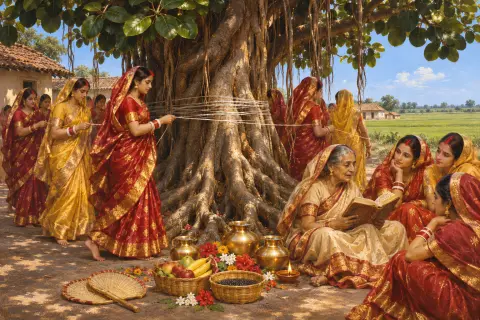 Vat SavitriJun 4, 2027He tells Yudhishthira the story of Savitri in the Mahabharata, the oldest source of the vrat's story.
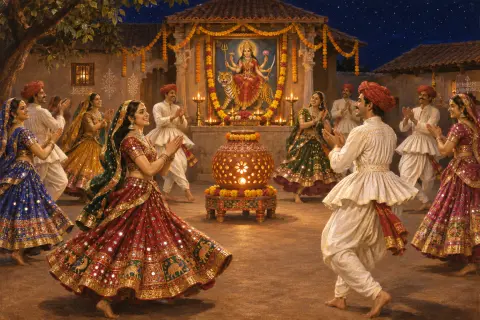 NavaratriSep 30 - Oct 9, 2027In the Devi Kavacha, recited with the Durga Saptashati, Brahma names the nine forms of Durga for him.
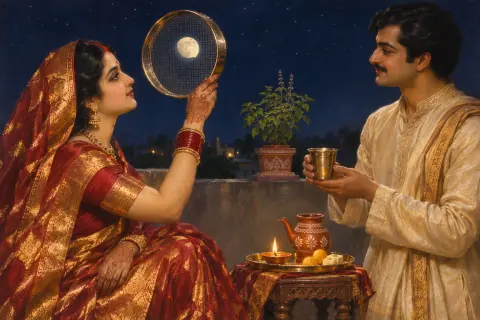 Karva ChauthOct 18, 2027Savitri's story, told at the Karva Chauth puja, comes from the Mahabharata, where he tells it to the Pandavas.
Ask about Markandeya
Ask Gita Chat about Markandeya and what their story can teach you.