The Story
The oldest account is in the Mahabharata, in the Vana Parva (chapters 277 to 283 of the third book in the Critical Edition). The sage Markandeya tells it to Yudhishthira, who has asked whether any woman was ever as devoted as Draupadi. Savitri chooses Satyavan though she has been told he will die within a year, keeps a three-night fast before the day, follows Yama when he takes Satyavan's life, and wins it back through her words. The epic does not mention a banyan or fix a day in the calendar. The vrat kept today, with worship of the banyan on Jyeshtha Amavasya or Purnima, comes from later vrata tradition and folk practice, which made Savitri the model for every wife who prays for her husband's life.
A princess named after a goddess
Ashvapati, king of Madra, was a good and generous ruler, but he had no children. For eighteen years he kept strict vows and made offerings to the goddess Savitri. At last she appeared and promised him a daughter. When the girl was born, he named her Savitri after the goddess.
Savitri grew up so radiant and so sure of herself that no prince dared to ask for her hand. Her father, unwilling to see her stay unmarried, did something unusual. He told her to travel and choose a husband for herself, and sent her off with his ministers.
Choosing Satyavan, knowing the cost
Savitri came back with her choice. In a forest hermitage lived Dyumatsena, the king of Shalva, who had gone blind and lost his kingdom to an enemy. His son Satyavan had grown up in the forest with him. Savitri had chosen Satyavan in her heart.
The sage Narada was in the court that day. He praised Satyavan as truthful, generous and kind, then gave the bad news. Satyavan had one flaw that outweighed all his virtues: he would die in exactly one year. Ashvapati begged his daughter to choose someone else. Savitri replied that a person chooses only once. Whether his life is long or short, she said, she had chosen him and would not choose again. Narada saw her firmness and gave his blessing.
Savitri married Satyavan, took off her royal jewels and lived in the hermitage, caring for her blind in-laws. She told no one what Narada had said, but she kept counting the days.
The day Yama came
Three days before the end of the year, Savitri began a fast of three days and nights, standing for much of it. Her father-in-law worried it was too hard for her, but she held to it. On the final morning she asked to go with Satyavan when he went into the forest to gather fruit and firewood.
As he split wood, Satyavan's head began to ache badly. He lay down with his head in Savitri's lap. Then she saw a tall figure in red, dark and shining, with a noose in his hand. It was Yama himself. He told her that Satyavan's time was over and that, because Satyavan was a good man, he had come for him in person rather than sending his messengers. He drew out Satyavan's soul, a being the size of a thumb, and set off south.
Walking after Death
Savitri followed. Yama told her to go back and perform the last rites. She said that wherever her husband was taken, she would go too, and then she began to speak. She spoke of dharma, of how the wise walk together, and of how friendship with good people is never wasted. Yama was moved by every answer and offered her a boon, as long as it was not Satyavan's life.
She asked for her father-in-law's sight. Granted. She kept walking and kept speaking. For the second boon she asked that Dyumatsena win back his kingdom. For the third, that her father, who had no sons, have a hundred. Each time Yama agreed and told her to turn back, and each time she followed and spoke more wisely than before.
For the fourth boon she asked for a hundred sons of her own, born to her and Satyavan. Yama granted it. Savitri kept walking and spoke about the good, who protect others and expect nothing back. Yama, more moved than ever, now offered a boon with no condition at all. Savitri asked for Satyavan's life, pointing out that Yama had just promised her sons while taking her husband away. Yama was pleased, not tricked. He untied the noose, released Satyavan, promised them a long life together, and left.
The banyan and the two dates
Satyavan woke as if from sleep, and they walked home through the dark forest. Dyumatsena had his sight back by the time they reached the hermitage, and soon his kingdom was restored as well. The Mahabharata does not say what kind of tree Satyavan lay under. The banyan, or vat, comes from later vrata tradition and folk practice. The banyan lives for centuries and keeps sending down new roots, and many people believe Brahma, Vishnu and Shiva dwell in it. That made it the natural tree to pray to for a long life.
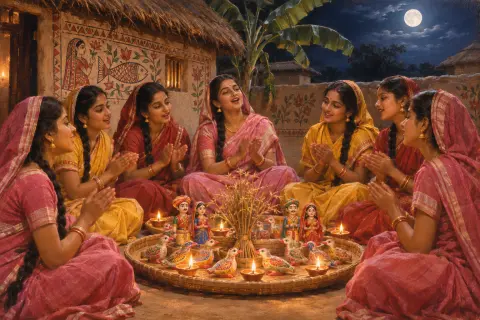
Different regions keep the fast on different days. In Uttar Pradesh, Bihar, Jharkhand, Madhya Pradesh and Odisha it falls on the new moon of Jyeshtha. In Bihar and Mithila it is called Barsait, and in Odisha it is Savitri Brata, when women eat fruit offered to the goddess. In Maharashtra, Gujarat, Karnataka and Goa, Vat Purnima is kept on the full moon of the same month. In Maharashtra women in their best saris tie thread around the banyan and pray to have the same husband for seven lives.
In Bihar, Barsait is one of the biggest days of a married woman's year. From early morning women in new clothes and full sindoor gather at the village banyan with their neighbours. In Mithila they offer mango, lychee and other seasonal fruit, soaked gram and sweets, and each woman carries a new bamboo hand fan. A bride's first Barsait after her wedding is a special occasion: it is usually kept at her in-laws' home, and a basket of new clothes and puja items is sent from her parents' home for it.
Savitri's strength was not anger and not tears. It was a mind made up. She chose once, knowing the cost, and nothing after that moved her: not her father's fear, not three days without food, not Death telling her to go home. When her father-in-law worried about her fast, she told him it was made by resolve, vyavasaya, and resolve would carry it through (Vana Parva 3.280.7). The Gita (2.41) uses the same word: the resolute mind, vyavasayatmika buddhi, has one single aim, while an unsteady mind splits into endless branches. Vat Savitri asks what you have truly chosen, and whether you will walk after it when it gets hard.