
Savitri
The princess who followed Death
Savitri is the princess of the Mahabharata who won her husband back from death. The daughter of King Ashvapati of Madra, she chose to marry Satyavan, an exiled prince living in the forest, even after the sage Narada warned that he would die within a year. On that day she followed Yama, the god of death, and spoke to him so wisely about dharma that he gave Satyavan's life back. The sage Markandeya tells her story to Yudhishthira in the Vana Parva. Married women remember her on Vat Savitri, often around a banyan tree, and name her at Karva Chauth.
Also called: Savitri (named after the goddess Savitri, who granted her birth), Sati Savitri (the faithful Savitri, as she is called in popular tradition), Rajaputri (the princess, as Yama addresses her), Ashvapati's daughter, Satyavan's wife
Father: Ashvapati, king of Madra
Mother: Malavi, Ashvapati's queen
Husband: Satyavan, son of King Dyumatsena of Shalva, also called Chitrashva
In-laws: Dyumatsena, blind and exiled, and his queen Shaibya
Children: a hundred sons, by Yama's boon; her father too was given a hundred sons, the Malavas
Named after: the goddess Savitri, whom Ashvapati worshipped for eighteen years
सन्तो हि सत्येन नयन्ति सूर्यं सन्तो भूमिं तपसा धारयन्ति । सन्तो गतिर्भूतभव्यस्य राजन् सतां मध्ये नावसीदन्ति सन्तः ॥
santo hi satyena nayanti sūryaṃ santo bhūmiṃ tapasā dhārayanti, santo gatir bhūtabhavyasya rājan satāṃ madhye nāvasīdanti santaḥ.
By their truth the good lead the sun on its way; by their austerity the good hold up the earth. The good are the refuge of what has been and what will be, O king. Among the good, the good never lose heart.
Stories
Savitri's story is told in the Mahabharata, Vana Parva (also called Aranyaka Parva), chapters 277 to 283 in the Pune Critical Edition, a section known as the Pativrata Mahatmya. Yudhishthira, in exile, asks the sage Markandeya whether any woman was ever as devoted as Draupadi, and Markandeya answers with Savitri. The epic does not mention a banyan tree or a calendar day. The vrat kept today on Jyeshtha Amavasya or Purnima, the worship of the banyan, and her place in the Karva Chauth katha come from later vrata tradition and folk practice. Sri Aurobindo retold her story as a long English epic poem, Savitri, published in 1950 and 1951.
A Daughter from the Goddess
Ashvapati, king of Madra, was good, generous and childless. To have children he took on a strict vow: he lived simply, ate only at every sixth mealtime, and made a hundred thousand offerings with the Savitri verse to the goddess Savitri. He kept this up for eighteen years (Vana Parva, 3.277). Then the goddess rose out of the sacred fire and told him that he would have a daughter, full of light.
His queen Malavi gave birth to a girl, and the king named her Savitri after the goddess. She grew up so radiant that the princes who saw her held back, thinking her too splendid, and no one asked for her hand. At last her father told her to go and choose a husband herself, and sent her out with his ministers.
The Boy Who Painted Horses
Savitri came home with her choice. In the forest, she said, lived Dyumatsena, king of the Shalvas, who had gone blind and lost his kingdom to an enemy. His son Satyavan had grown up there. She had chosen him in her heart (3.278).
The sage Narada was with her father. Satyavan, he said, was truthful, generous, wise and handsome. As a boy he had loved horses, made them out of clay and painted them, so people called him Chitrashva. But he had one fault that outweighed everything: in a year from that day he would die.
Her father begged her to choose again. Savitri answered that a girl is given only once: long life or short, virtues or none, she had chosen her husband and would not choose a second (3.278.27, the verse on the Vat Savitri page). Narada blessed her firmness. She married Satyavan in the forest, put away her jewels for bark cloth and an ochre garment, and looked after her husband and his blind parents. She told no one, but she counted the days (3.279).
Three Days Standing
When only four days were left, Savitri began a three-night vow, standing day and night. Her father-in-law said it was too hard. She answered that she would see it through, because it was made by resolve and resolve would carry it (3.280.6). He said he could not ask her to break it, only to complete it, and she stood on, the text says, like a piece of wood.
On the last morning she made her offerings, greeted the elders, and asked to go with Satyavan into the forest. He warned her the paths were hard; she said she would not be tired. Her in-laws let her go. Walking beside him through the lovely forest, she watched him with a heart split in two.
Speaking to Death
As Satyavan split wood, his head began to ache, and he lay down with his head in her lap. She saw a tall man in red, dark and shining, with a noose in his hand. It was Yama. Because Satyavan was a good man, he said, he had come himself. He drew out Satyavan's soul, no bigger than a thumb, and walked south. Savitri followed (3.281). The Yama and Vat Savitri pages tell this part in full.
When Yama told her to go back, she said: where my husband is taken, or goes by himself, I must go too; that is the old dharma. The wise say that walking seven steps together makes people friends. Then she spoke of dharma, of the company of good people, of kindness even to enemies. Each time Yama was pleased, and each time he gave her a boon except her husband's life: her father-in-law's sight, his kingdom, a hundred sons for her father, a hundred sons for herself with Satyavan.
Then she said the words at the top of this page: by their truth the good lead the sun; by their austerity they hold up the earth. Yama offered a boon with no condition. She said she wanted no happiness, no heaven and no wealth without her husband, and that the hundred sons he had promised her could not come if he took Satyavan away. Yama untied the noose, gladly. He promised Satyavan four hundred years of life with her, and went home (3.281.51 to 59).
Night in the Forest
Savitri went back to where Satyavan's body lay, took his head into her lap again, and he woke like a man coming home from a journey. "I slept so long," he said. "Why didn't you wake me? Where is the dark man who was dragging me away?" She told him Yama had gone, and that she would tell him everything tomorrow: it was deep night now, the sun had set, jackals were howling to the south-west, and they should think about getting home (3.281.62 to 74).
Satyavan could only think of his parents. They never let him come back after dark, he said; his blind father would be asking every hermit about him. He raised his arms and wept. Savitri wiped her eyes and made a vow: if she had ever done penance or given anything, and if she had never spoken a lie, even in jest, then let his parents live through this night. She lifted him up, put his arm over her shoulder, took the axe and the basket, and they walked home in the dark.
At the hermitage, Dyumatsena had suddenly got his sight back and had been searching the forest with his queen Shaibya until their feet bled. The sages calmed them one by one: as Savitri is, they said, so Satyavan lives (3.282). When the couple came in, Savitri told everyone what had happened. The very next morning Dyumatsena's people came to say that his enemy had been killed by his own minister, and he went home as king, with Satyavan as crown prince (3.283).
Savitri in the Calendar
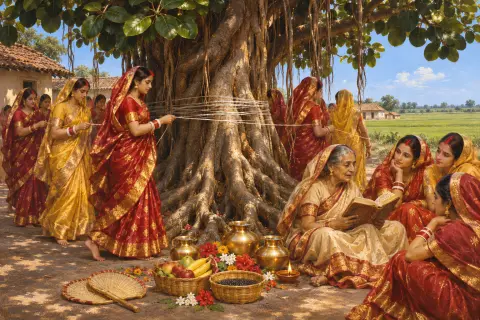
Markandeya ends by telling Yudhishthira that Draupadi, like Savitri, would save them all. Later tradition took Savitri out of the epic and into the home. On Vat Savitri, on the new moon of Jyeshtha in north India and on the full moon in Maharashtra, Gujarat and the south-west, married women fast, worship a banyan tree, tie thread around it and listen to her story. In Bihar it is Barsait, and in Odisha Savitri Brata.
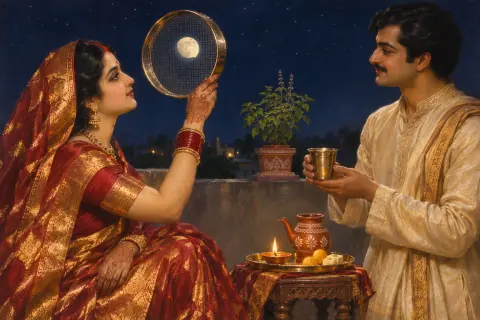
At Karva Chauth women name her in the evening katha as the wife who turned back death, though her own day is in Jyeshtha. The Mahabharata does not mention the banyan or either fast. The customs grew around the story because it is one of the very few in which someone argues with death and wins, by being right rather than by force.
How to recognise
- •Most often shown following Yama through the forest with folded hands: Yama dark, in red, with his noose and his buffalo, and Savitri a step behind him.
- •Or seated on the forest floor with Satyavan's head in her lap, an axe and a bundle of firewood beside them, the moment before Yama comes or the moment Satyavan wakes.
- •Dressed simply: the Mahabharata says that after her wedding she put away her jewels and wore bark cloth and an ochre garment in the hermitage. Calendar art usually gives her a red or saffron sari and sindoor, as a married woman.
- •On Vat Savitri pictures and in vrata booklets she is shown under a banyan tree. The banyan comes from later vrata tradition and folk practice, not from the Mahabharata.
- •Early Indian cinema loved her: Sati Savitri and Savitri films were made in many languages from the silent era on, and they shaped how she looks in posters and calendar prints.
Festivals
Paintings
1 paintingsAsk about Savitri
Ask Gita Chat about Savitri and what their story can teach you.