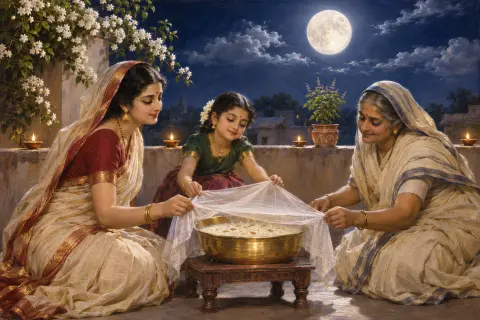
Valmiki is the sage-poet who composed the Ramayana in Sanskrit, and tradition calls him the adikavi, the first poet. In his own epic he hears Rama's story from Narada, speaks the first shloka out of grief for a bird killed by a hunter, and is told by Brahma to tell the whole story in that metre. He also takes part in it: Rama visits his hermitage at Chitrakuta, and in the last book he shelters the exiled Sita, sees her twin sons Lava and Kusha born, and teaches them to sing the poem. The story that he was once a robber comes from later texts. His birthday, Valmiki Jayanti, is kept on Sharad Purnima.
Also called: Adikavi (the first poet), Maharshi Valmiki, Prachetasa (son of Prachetas, as he calls himself in the Uttara Kanda), Bhagwan Valmiki (among Valmiki communities), Ratnakar (the robber's name in popular retellings)
Father: Prachetas; in the Uttara Kanda (sarga 96) Valmiki says he is Prachetas's tenth son. Later tradition often identifies Prachetas with Varuna
Disciple: Bharadvaja, who walks with him to the Tamasa river in the Bala Kanda
Pupils: Lava and Kusha, Sita's twin sons, raised in his hermitage
Home: a hermitage on the Tamasa river near the Ganga (Bala Kanda 2); in the Ayodhya Kanda Rama finds his hermitage at Chitrakuta. Several places, among them Bithoor near Kanpur and Ram Tirath near Amritsar, are honoured locally as his ashram
Later legend: born a Brahmin but raised among forest hunters, he lived as a robber with a wife and children before turning to the sages (Adhyatma Ramayana)
Hunter, may you find no rest for endless years, for you killed one of this pair of krauncha birds while it was lost in love.
Stories
Almost everything known about Valmiki comes from the Ramayana itself. Its first four sargas tell how it was made: Valmiki's question to Narada, the killing of the krauncha bird, Brahma's visit and the teaching of the poem to Lava and Kusha. Its last book, the Uttara Kanda, brings him into the story as Sita's protector. Scholars think the first and last books are later than the five in the middle, so Valmiki's own place in the story may also have grown over time. The well known tale of the robber who became a sage is much later. It is told in Puranic texts and in the Adhyatma Ramayana, and from there in popular retellings, pictures and films.
The First Verse
Valmiki's grief at the Tamasa river becomes the first shloka.
The Bala Kanda (sarga 2) tells the story. Narada had just left after telling Valmiki about Rama. Valmiki walked to the Tamasa river, not far from the Ganga, with his disciple Bharadvaja. The water was so clear that he said it was like the mind of a good man, and he asked for his bark garment so that he could bathe.
Close by, a pair of krauncha birds were together, calling sweetly. A hunter (nishada) shot the male. It fell bleeding and struggled on the ground, and its mate, seeing him, cried out. The text calls the male bird copper-headed. Valmiki was filled with pity, and words came out of him: "Hunter, may you find no rest for endless years, for you killed one of this pair while it was lost in love."
Then he stopped and wondered what he had said. The words had fallen into four equal quarters and could be sung to a stringed instrument. He told Bharadvaja that this, born of grief (shoka), should be called a shloka. Later, when Brahma himself came to the hermitage, Valmiki was still thinking of the bird. Brahma smiled and told him that the verse had come by his will, and that he should now tell the whole story of Rama in this metre. As long as mountains stand and rivers flow on the earth, Brahma said, the Ramayana will be told in the world.
The Question to Narada
The Ramayana begins with a question (Bala Kanda, sarga 1). Valmiki asks Narada whether there is anyone living in the world now who is good, brave, grateful, truthful and firm in his vows, kind to all beings, learned and free of envy, someone even the gods fear in battle. Narada answers that there is such a man, Rama of the Ikshvaku line, and tells his whole life in brief.
So the epic opens with a poet looking for a good person, and it is built on what he heard. The Narada page on this site tells this meeting from Narada's side.
The Bala Kanda (sarga 4) adds that Valmiki composed the poem after Rama had regained his kingdom: twenty four thousand verses in five hundred sargas, in six books and the Uttara Kanda. He then looked for someone to carry it, and chose two young boys living in his hermitage, Kusha and Lava, who had sweet voices and knew the Veda.
Sita in the Hermitage
In the Uttara Kanda, Rama sends the pregnant Sita away because of gossip in Ayodhya, and Lakshmana leaves her in the forest near Valmiki's hermitage. The sage's young pupils find her weeping and run to tell him (sarga 49). Valmiki comes to her on the bank of the Ganga, welcomes her as Dasharatha's daughter-in-law and Rama's beloved queen, and tells her that he knows by the sight his tapas has given him that she is without fault. He leaves her with the women ascetics of the hermitage, who he says will care for her as for their own child.
There Sita gives birth to twins (sarga 66). Valmiki performs the rites to protect them with kusha grass: the elder is wiped with the tips of the grass and named Kusha, and the younger with its lower part, called lava, and named Lava. Shatrughna, passing that night on his way to fight the demon Lavana, hears the news and is overjoyed.
Years later, when Rama holds his great horse sacrifice by the Gomati, Valmiki comes with his pupils and sends the two boys to sing the Ramayana in the streets and before the king (sargas 93 and 94). They refuse the gold Rama offers them, saying they live in the forest on fruits and roots. Rama listens day after day and learns that they are Sita's sons.
"I Do Not Remember Speaking an Untruth"
Rama asks Sita to come before the whole assembly and swear to her purity. The next morning the great sages gather, Vasishtha, Vishvamitra, Markandeya, Agastya and many more, with crowds from every land. Valmiki walks into the middle of them with Sita behind him, her head bowed and her hands folded (Uttara Kanda, sarga 96).
He speaks for her: "This Sita, faithful to her vows, was abandoned near my hermitage because of gossip. These twins are your sons; I tell you the truth. I am the tenth son of Prachetas, and I do not remember ever speaking a lie. If Sita has done wrong, may I lose the fruit of all my thousands of years of tapas."
Then Sita, looking down, calls on the Earth to take her if she has never thought of anyone but Rama. The ground opens, a throne rises, and the Earth takes her in her arms (sarga 97). Many readers feel that this is where the poet himself takes a side: Valmiki stands next to Sita and pledges everything he has on her word.
The Robber Who Became a Sage
The story most people know about Valmiki is not in his Ramayana. One of its best known early forms is in the Adhyatma Ramayana (Ayodhya Kanda, chapter 6), a later devotional Ramayana. There Valmiki tells it to Rama himself when Rama visits his hermitage: he was born a Brahmin but grew up among the Kiratas, a forest people, lived like them, married and had many children, and fell in with thieves.
One day, bow in hand, he stopped seven shining sages in the forest to rob them. They asked him to go home and ask his family whether they would share the sin he committed to feed them. His wife and sons said the sin was all his; they only shared the gains. Shaken, he went back and fell at the sages' feet. They gave him Rama's name to repeat, turned around as "mara", since he could not yet say "Rama". He repeated it so long without moving that an anthill grew over him. When the sages returned and called him out, they named him Valmiki, the one born again from the anthill (valmika).
The Skanda Purana tells a different version, about a Brahmin named Lohajangha who turned to robbery in a famine. Popular retellings call the robber Ratnakar, and some say it was Narada, not the seven sages, who changed him. These versions do not agree, and none of them is in the Valmiki Ramayana. They are loved because they say that anyone can turn back, however far they have gone.
How to recognise
•An old sage with a long white beard and matted hair tied in a topknot, in plain white or ochre cloth, usually seated on a deerskin outside a thatched hut by a river.
•Palm-leaf manuscripts and a stylus, or a book in his lap. They mark him as the author of the Ramayana.
•Often shown with two boys, Lava and Kusha, holding small veenas, because in the Uttara Kanda he teaches them to sing the poem. Sita sometimes sits nearby.
•An anthill (valmika) rising around a meditating man. This belongs to the later story of the robber who sat so long repeating Rama's name that ants built a mound over him, and it explains his name in that story. Valmiki's own Ramayana does not tell it.
•Popular prints and children's books of the same later legend show two scenes side by side: the robber with a bow stopping a group of sages, and the same man sitting in meditation as the anthill grows around him.
•Among Valmiki communities, especially in Punjab and north India, he is worshipped as Bhagwan Valmiki: an old sage in saffron with a halo, writing or blessing, carried in processions on Valmiki Jayanti.
Even if the most sinful worships Me, with devotion to none else, he too should indeed by regarded as righteous for he has rightly resolved.
Krishna says that even a person of very bad conduct who turns to him with undivided devotion should be thought of as good. The Gita does not name Valmiki, but Swami Sivananda's commentary on this verse gives him as the example: the robber Ratnakar became Valmiki through his resolve.