The Story
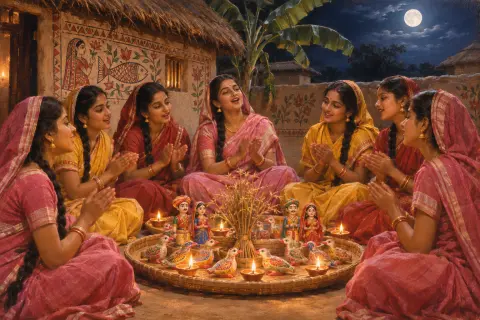
The oldest text tied to this night is the Bhagavata Purana, in the five chapters of Canto 10 (chapters 29 to 33) known as the Rasa Panchadhyayi. They tell how Krishna called the gopis of Vrindavan with his flute on the autumn nights and danced the Raas with them on the bank of the Yamuna. The Bhagavata speaks of autumn nights and a rising full moon; the Braj tradition keeps Ashvin's full moon as the night of the Maha Raas. The second thread of the day, staying awake for Lakshmi, comes from the Kojagara vrat tradition: the goddess is said to go around on this night asking "ko jagarti?", "who is awake?". Both are why the night is spent awake, outdoors and under the moon.
The Flute on an Autumn Night
The Bhagavata (10.29) begins on an autumn evening, with jasmine in bloom and the moon rising over the eastern sky, reddening it with its first light like a husband who comes home and gently wipes his wife's tired face. Krishna looked at the forest and the moon and began to play his flute.
The gopis heard it in their homes. The text lists what they were doing: milking cows, cooking, serving food, feeding their children, getting dressed. Each one left the task half done and ran to the forest. Nobody told anyone else.
When they arrived, Krishna asked them, almost teasing, why they had come out at night, and told them to go back to their families. The gopis cried and answered that they had given up everything to come to him, and they asked him not to turn them away. Krishna smiled and stayed with them.
Krishna Disappears
As they walked and played in the moonlit forest, the gopis began to feel proud that Krishna was theirs alone. The Bhagavata (10.29) says that to cure that pride and to show them his grace, Krishna suddenly vanished.
In chapter 30 the gopis search the forest for him. They ask the trees, the creepers and the deer if they have seen him. They act out his childhood deeds to feel close to him. They find his footprints, and next to them the footprints of one gopi he had taken with him. The Bhagavata does not name her; later devotional tradition identifies her as Radha. When she, too, grew proud, he left her as well.
Chapter 31 is the Gopi Gita, the song the gopis sing on the bank of the Yamuna, longing for him. Devotees still sing it today. In chapter 32 Krishna appears again among them, and they seat him on their shawls and ask him about love.
The Maha Raas
Chapter 33 describes the Raas itself. The gopis formed a circle, and Krishna placed himself between each pair of them, so that every gopi felt he was beside her alone. The gods, the text says, came in their aerial cars to watch, and flowers fell from the sky.
The Bhagavata adds that the night was stretched to the length of a night of Brahma, so long did the dance last. Then, before dawn, the gopis went home.
Devotees read the Raas as the meeting of the soul with God, where nothing is held back. That is why in Vrindavan and across Braj this full moon is called Raas Purnima. At the Banke Bihari temple in Vrindavan, this is the one night of the year when the deity is shown holding a flute, dressed in white, and darshan goes on in the moonlight.
Lakshmi Asks, "Who Is Awake?"
The name Kojagari comes from the question "ko jagarti?" In the vrat tradition, Lakshmi walks the earth on this night and blesses the homes where people are awake, watchful and ready to receive her. So families keep a lamp burning, play games, sing and stay up past midnight.
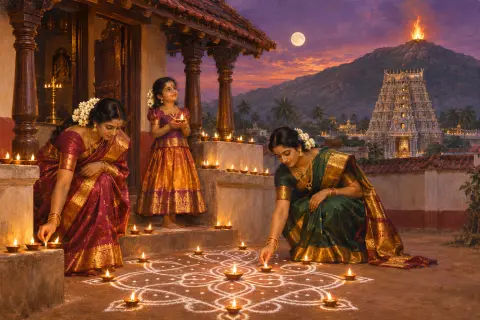
In Bengal, Tripura and Assam the night is Kojagori Lakshmi Puja, the first full moon after Durga Puja. Women draw alpana on the floor with Lakshmi's small footprints leading into the house, worship her at home and read the Lakshmi Panchali, a vernacular book of her stories. In Odisha the same day is Kumar Purnima: unmarried girls bathe early, wear new clothes, worship Kartikeya, offer food to the moon in the evening and sing and play together. Many places in Odisha also worship Gaja Lakshmi from this night.
In Maharashtra it is Kojagiri Purnima, kept with milk boiled with saffron and dry fruits, shared under the moon. In Gujarat, Sharad Poonam is kept with doodh pauva, flattened rice soaked in milk and set out in the moonlight, and many people play garba once more. Across north India, families leave kheer under the moonlight and eat it as prasad the next morning, believing the moon's rays on this night carry something healing. The same full moon is also kept as Valmiki Jayanti, the birthday of the poet of the Ramayana.
Kojagara in Mithila
In Mithila, north Bihar and the Madhesh of Nepal, Kojagara is above all the night of the newly married groom. In the year of his marriage, the bride's family sends a bhaar to his home: baskets of makhana, paan, batasha, sweets, bananas and new clothes. The festival is kept most closely in Maithil Brahmin and Kayastha families, and the whole neighbourhood joins in.
In the evening the groom puts on the clothes his in-laws sent. The women of the house perform chumaon, blessing him with paddy, durva grass and Maithili songs, and elder men bless him with the durvakshat mantra. Then comes the game: the groom plays pachisi with his wife's brother, with cowries and dice that must come from the bride's side, and the loser gives the winner a gift while the women sing and tease.
Makhana kheer is left under the moon and given to the groom to eat, for his health and long life. Lakshmi is worshipped at night, and makhana, batasha and paan are carried from house to house and shared with everyone. Families in Mithila say King Janaka first sent such a bhaar to his son-in-law Rama; this is a folk tradition, not a scriptural account. Elsewhere in Bihar, in Bhojpur, Magadh and Anga, the night is kept more simply, with kheer in the moonlight and Lakshmi puja at home.
In the Gita (15.13) Krishna says that it is he who becomes the moon, full of rasa, and nourishes every plant on earth. The kheer left under the Sharad moon is a small way of saying the same thing: what feeds us comes from beyond us. Stay awake to it, share it, and the night becomes a blessing for the whole house.