Vyasa, also called Veda Vyasa and Krishna Dvaipayana, is the sage whom Hindu tradition credits with arranging the Vedas into four, composing the Mahabharata, which contains the Bhagavad Gita, and compiling the Puranas. He is the son of the sage Parashara and Satyavati, and he is also a character inside his own epic: the grandfather of the Pandavas and Kauravas, who appears at every turning point to advise, console and foresee. The Bhagavata Purana counts him among the avatars of Vishnu. He is honoured on Guru Purnima, also called Vyasa Purnima, and in the Gita Krishna says: among sages I am Vyasa.
Also called: Veda Vyasa (the one who arranged the Veda), Krishna Dvaipayana (the dark one born on an island), Badarayana (of the jujube grove, the name under which the Brahma Sutras are traditionally ascribed to him), Parasharya (son of Parashara), Satyavatisuta (son of Satyavati)
Father: the sage Parashara, grandson of Vasishtha; mother: Satyavati, a fisherman's foster daughter who later married King Shantanu
Half brothers: Chitrangada and Vichitravirya, Satyavati's sons by Shantanu; step-brother: Bhishma
Sons: Dhritarashtra (with Ambika), Pandu (with Ambalika) and Vidura (with a maid of Ambika), born at his mother's request; and the sage Shuka, born from fire sticks (Shanti Parva, section 325 in Ganguli)
Grandchildren: the Kauravas through Dhritarashtra and the Pandavas through Pandu
Disciples: Paila, Vaishampayana, Jaimini, Sumantu and his son Shuka; Romaharshana (Suta) for the Puranas
Birthplace: an island in the Yamuna; tradition later places his hermitage at Badari in the Himalayas
नमोऽस्तु ते व्यास विशालबुद्धे फुल्लारविन्दायतपत्रनेत्र।
येन त्वया भारततैलपूर्णः प्रज्वालितो ज्ञानमयः प्रदीपः॥
Salutations to you, Vyasa of vast understanding, with eyes long like the petals of a full-blown lotus, who lit the lamp of knowledge filled with the oil of the Mahabharata.
Stories
Vyasa's own story is told inside the Mahabharata, mostly in its first book, the Adi Parva, and he keeps stepping into the story to the very end. The Puranas add more: the Vishnu Purana (book 3, chapter 4) explains how he divided the Veda among his disciples, and the Bhagavata Purana (book 1, chapters 3 to 7) counts him as the seventeenth avatar of Vishnu and tells how, still restless after writing the Mahabharata, he was told by Narada to sing of Krishna and composed the Bhagavata. Scholars debate how much one person could have written, and many think Vyasa stands for a long line of compilers. The section numbers below follow K. M. Ganguli's English translation of the commonly read Mahabharata text.
Born on an island
Satyavati, the foster daughter of a fisherman chief, ferried people across the Yamuna. Her body smelled of fish. One day the wandering sage Parashara saw her and desired her. She pointed to the sages on both banks; Parashara covered the river in a fog. She said she was a maiden under her father's care; he promised she would remain one, and granted her wish that her body would smell sweet instead of fishy (Adi Parva, section 63).
That same day, on an island in the Yamuna, she gave birth to a son. He was dark, so he was called Krishna, and born on an island (dvipa), so he was called Dvaipayana. The child at once set his mind on austerity and took leave of his mother with a promise: whenever you think of me in need, I will come.
Why he is called Vyasa
The Adi Parva says Dvaipayana saw that dharma loses a leg with each age, and that people's lives and strength shrink with it. So he arranged the Veda, and for this he was called Vyasa, the arranger (section 63). He taught it to Sumantu, Jaimini, Paila, his son Shuka and Vaishampayana, with the Mahabharata as a fifth Veda.
The Vishnu Purana (3.4) gives the familiar division: the Rigveda to Paila, the Yajurveda to Vaishampayana, the Samaveda to Jaimini and the Atharvaveda to Sumantu, with the old stories, the Puranas, given to the bard Romaharshana. The Bhagavata Purana (1.3.21) puts it simply: in his seventeenth descent, the Lord was born of Satyavati and Parashara and divided the tree of the Veda into branches, seeing that people had less capacity to hold it whole.
When his mother called
Satyavati later married King Shantanu of Hastinapura. Her two sons by him died young, and the younger, Vichitravirya, left two widows, Ambika and Ambalika, and no heir. Bhishma had vowed never to marry. So Satyavati remembered her first son, and Vyasa came, as he had promised (Adi Parva, sections 105 and 106).
By the custom of niyoga he went to the widows. Ambika shut her eyes in fear at his dark face and matted hair, and Vyasa said her son would be strong and wise but blind: that was Dhritarashtra. Ambalika turned pale with fear, and her son was born pale: Pandu. When Ambika was asked again, she sent her maid instead. The maid received the sage with respect, and her son was Vidura, the wisest man in the epic.
So the Kauravas and the Pandavas are all Vyasa's grandsons. He watches over them through the whole story, advising Drupada at Draupadi's marriage, sending Arjuna to seek divine weapons, and telling Dhritarashtra again and again where his sons are heading.
Writing the Mahabharata
The Mahabharata says Vyasa composed it and taught it to his disciple Vaishampayana, who recited it at King Janamejaya's snake sacrifice; the version we read is then retold by the bard Ugrashravas to the sages of the Naimisha forest.
The commonly read text adds a famous scene (Adi Parva, section 1). Brahma tells Vyasa to call Ganesha as his scribe. Ganesha agrees on one condition: his pen must never stop. Vyasa adds his own: Ganesha must not write anything without understanding it. So whenever he needed time, Vyasa composed a knot of a verse, and while Ganesha puzzled over it, Vyasa composed many more. The scholars who prepared the Critical Edition at Pune found this passage missing from many old manuscripts and moved it out of the main text, but it remains one of the most loved stories about the epic.
The gift of sight to Sanjaya
Just before the war, Vyasa came to the blind king Dhritarashtra and told him plainly that his sons and the kings with them had reached their time. He offered the king sight so he could watch the battle. Dhritarashtra refused: he did not want to see his family killed, only to hear of it (Bhishma Parva, section 2).
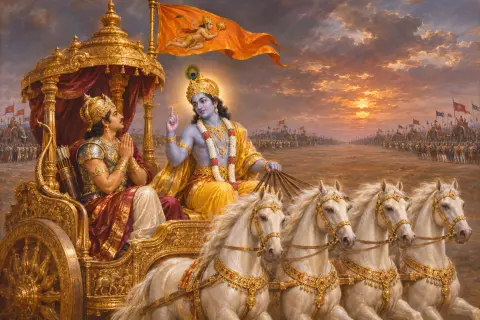
So Vyasa gave the gift to Sanjaya, the king's charioteer and minister. Sanjaya would see everything on the battlefield, by day or night, even what people only thought, and weapons would not hurt him. Through that sight Sanjaya heard Krishna teach Arjuna, and at the end of the Gita he says it himself (18.75): by the grace of Vyasa I heard this supreme secret yoga from Krishna, the lord of yoga.
One night at the Ganga
Vyasa calls the fallen warriors out of the Ganga for one night.
Years after the war, Dhritarashtra, Gandhari and Kunti were living as ascetics in the forest, and the Pandavas came to visit them. Gandhari and Kunti still grieved for their sons. Vyasa told them he would show them all their dead for one night.
In the evening he went into the Ganga and called out to the warriors of both sides. With a roar like the sound of the old armies, Bhishma and Drona, Karna and Duryodhana, Abhimanyu, Draupadi's sons and thousands more rose from the water, shining, free of anger and pride. Vyasa gave Dhritarashtra divine sight for that night, so for the first time he saw his sons. Fathers met sons, wives met husbands, and the old enemies met without hatred (Ashramavasika Parva, sections 31 to 33). At dawn they went back into the river.
How to recognise
•An old sage with a dark complexion, long matted hair and a long beard. The Adi Parva describes him through the eyes of a frightened princess: a dark face, matted locks of a copper colour, blazing eyes and a heavy beard.
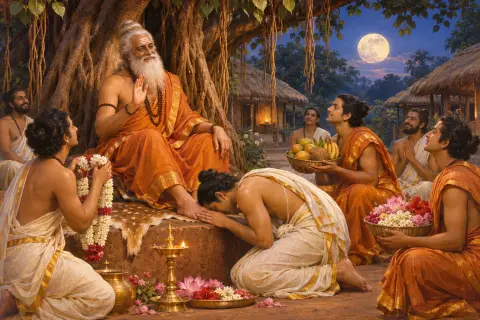
•Seated cross-legged on a deerskin or a grass mat in a forest hermitage, often under a tree, in the simple dress of an ascetic.
•Dictating while Ganesha writes beside him with his broken tusk or a stylus on palm leaves. This picture comes from a story found in many Mahabharata manuscripts but placed outside the main text by the Pune Critical Edition.
•Holding a book or palm-leaf manuscript, or with one hand in the teaching gesture, as the first teacher of the Vedic and Puranic tradition. A teacher's seat is called the Vyasa peetha, the seat of Vyasa, after him.
•On Guru Purnima, monasteries of the Shankara tradition worship him in the Vyasa Puja, often together with Shankaracharya and the line of teachers.