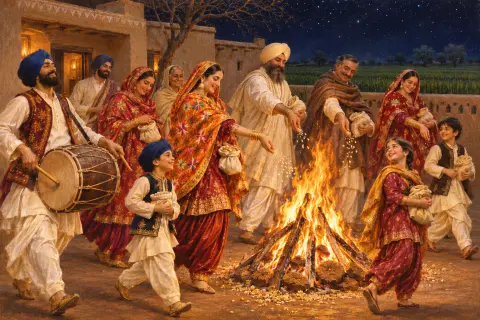
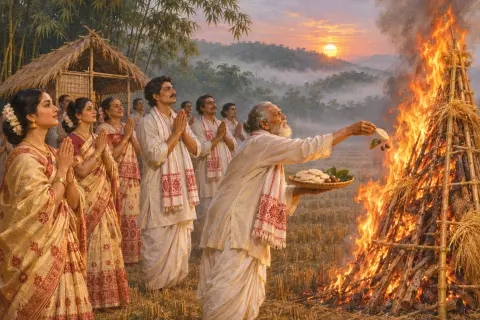
Agni is fire as a god: the fire on the household hearth, in the sacrificial altar, in lightning and in the sun. In the Rigveda he is the second most praised god after Indra, and its very first verse is addressed to him. He is the priest and messenger who carries offerings from people to the gods, which is why every Vedic rite, and every Hindu wedding, takes place before him. In the Mahabharata he burns the Khandava forest with the help of Krishna and Arjuna, and in the Ramayana he brings Sita out of the fire unharmed. People still offer to him in the Lohri bonfire and the Meji fire of Magh Bihu.
Also called: Pavaka (the purifier), Vahni (the carrier), Hutashana and Havyavahana (eater and bearer of offerings), Jatavedas (who knows all that is born), Vaishvanara (belonging to all people), Anala, Jvalana, Dhananjaya, Saptajihva (seven tongued), Dhumaketu (whose banner is smoke), Tanunapat, Shuchi (the bright)
Wife: Svaha, daughter of Daksha in the Puranas; her name is said at every offering into the fire
Sons: Pavaka, Pavamana and Shuchi in the Vishnu Purana (1.10); in the Mahabharata he is also a father of Skanda
Father: accounts differ; the Rigveda calls him born of the rubbing sticks, of the waters and of heaven, and the Puranas name different fathers
Mount: a ram
Direction: the south east
Home: the sacred fires of every household and altar; the Agni Purana is named after him, as he is its narrator
agnim īḷe purohitaṃ yajñasya devam ṛtvijam,
hotāraṃ ratnadhātamam.
I praise Agni, the household priest, the god of the sacrifice, the priest of the seasons, the caller of the gods, the greatest giver of treasure.
Stories
Agni is one of the oldest Hindu gods and one of the few still present at almost every rite. The Rigveda gives him about two hundred hymns, second only to Indra, and opens with him. There he is the priest, the guest in every home, and the messenger between people and gods. The Brahmanas build the whole sacrifice around his altars. In the epics he becomes a character with wants and weaknesses: cursed by Bhrigu, in love with the sages' wives, sick from too much ghee and hungry for a forest. In the Puranas he is one of the guardians of the directions, a little below the great gods, but he never lost his work. Every homa, every wedding and every cremation still goes through him.
Priest, Guest and Messenger
The first word of the Rigveda is Agni. The verse at the top of this page praises him as purohita, the household priest who stands in front, and as hotar, the one who calls the gods to the offering. Another hymn (1.12) begins, "We choose Agni as our messenger." Whatever is poured into the fire, he carries up to the gods.
The Vedic poets love to describe his birth. He is churned out of two pieces of wood, the arani, and comes out hungry, eating his way through the dry grass. He is the son of strength, because it takes strength to rub the sticks. He is born in three places: here on earth as fire, in the clouds as lightning, and in the sky as the sun.
He is also the guest who never leaves. The household fire was kept burning day and night, and Agni was called the guest in every home and the friend of every family. The Gita echoes this when Krishna says he lives in the body of every creature as Vaishvanara, the fire that digests food (15.14).
Agni Hides in the Waters
Even the god of fire could be afraid. In Rigveda Book 10, hymn 51, the gods find Agni hidden in the waters and in the plants. He tells them he ran away because his brothers before him had worn themselves out carrying the offerings, and he was afraid of the same fate.
The gods coax him back. They promise him a share of every offering and a long life, and he agrees to return to his work as priest. Later texts retell the hiding with more detail, and in the Mahabharata the creatures who give away his hiding place get cursed for it.
In the Kena Upanishad (part 3) Agni is humbled in another way. A mysterious being puts a single blade of grass before him and says, "Burn this." Agni, who boasted he could burn anything on earth, cannot. The being is Brahman, and the gods learn that their power is not their own (the Parvati page tells the rest).
Bhrigu's Curse: the Eater of Everything
The Mahabharata tells why fire eats everything, clean or unclean (Adi Parva, the Pauloma Parva, Critical Edition 1.5 to 1.7). The sage Bhrigu's wife Puloma had once been promised to a rakshasa, also named Puloman. One day, while Bhrigu was away, the rakshasa came to the hermitage and asked the sacred fire whose wife she really was.
Agni was caught. He feared the curse of the sage if he spoke, and he feared the sin of lying if he did not. He told the truth: she had been promised to the rakshasa first, but Bhrigu had married her with the proper rites. The rakshasa carried her off. On the way her child, Chyavana, fell from her womb, shining so brightly that the rakshasa was burned to ash.
Bhrigu, angry that Agni had spoken, cursed him to eat everything. Agni answered that he had only told the truth and withdrew from all the sacrifices, so the world went without offerings. Brahma made peace: fire would eat all things, but everything it touches would become pure. That is why Agni is called Pavaka, the purifier.
Svaha and the Birth of Skanda
The Vana Parva of the Mahabharata (Critical Edition 3.213 to 3.216) tells a love story with Agni at its centre. At a sacrifice of the seven great sages, Agni came out of the fire and saw their wives. He fell in love with them, and knowing it was wrong, he went into the forest to die of longing.
Svaha, daughter of Daksha, had long loved Agni. She took the form of six of the wives, one after another, and went to him. Each time she carried his seed to a golden pool on a white mountain. She could not take the form of the seventh, Arundhati, whose devotion to her husband was too strong.
From that seed the six-headed child Skanda was born. The sages, hearing rumours, gave up six of their wives, who became the Krittikas, the Pleiades. In other tellings, followed on the Murugan page, Skanda is the son of Shiva and Parvati and Agni only carries Shiva's seed. Svaha became Agni's wife, and her name is still spoken with every offering poured into the fire.
The Burning of the Khandava Forest
Agni feeds on the Khandava forest while Krishna and Arjuna hold back Indra's rain.
At the end of the Adi Parva, Krishna and Arjuna were resting by the Yamuna when a tall Brahmin, bright as molten gold, came to them asking for food. He was Agni. He wanted to eat the Khandava forest, but every time he tried, Indra poured rain on it, because his friend the naga Takshaka lived there. The text Ganguli translated explains that Agni had grown sick from drinking ghee for twelve years at King Shvetaki's sacrifice and needed the forest to recover; the Critical Edition leaves that part out.
Arjuna said he would help, but he needed a bow worthy of the task. So Agni called Varuna, who gave Arjuna the bow Gandiva, two quivers that never empty and a chariot with a monkey banner, and Krishna received the discus Sudarshana and the mace Kaumodaki. Then Agni blazed up on every side of the forest.
Indra came with storm clouds, but Arjuna covered the sky with arrows and the rain dried before it reached the fire. The two friends drove round the forest and let nothing escape. At last a voice from the sky told Indra to stop, and he left, pleased with his son. Agni ate for fifteen days and was cured. Of the forest's creatures only a few were spared, among them the asura Maya, who later built the Pandavas' assembly hall.
Witness of the Wedding, Keeper of Sita
Because Agni carries words and offerings to the gods, he is also a witness. A Hindu marriage is made in front of the fire: the couple walk round it and take the seven steps, and promises made before Agni are thought to be heard by all the gods.
In the Valmiki Ramayana (Yuddha Kanda), after Ravana's death, Rama speaks harshly to Sita in front of everyone. She asks Lakshmana to build a fire and walks into it. Agni rises from the flames holding her unharmed and gives her back to Rama, declaring that she has never been unfaithful in word, thought or glance (the Sita page tells this in full).
The Ramcharitmanas of Tulsidas adds a twist: before Sita was taken, Rama asked Agni to keep the real Sita safe in the fire, and a shadow Sita went to Lanka. The ordeal brings the real Sita back. In the Mahabharata, Draupadi too is born from a fire altar. Fire in these stories does not destroy the pure; it shows them.
How to recognise
•Red skin, often with a beard and with flames rising from his head and body. He is fire itself, so the flames are part of him, not a halo.
•Later image texts give him two faces and seven tongues (Saptajihva), and some add extra arms and legs. The details differ between texts, and many temple sculptures simply show a bearded, pot bellied man with flames behind him.
•His mount is a ram. Paintings show him riding it or with it at his side.
•In his hands: a sacrificial ladle (sruk or sruva) for pouring ghee, a torch or flame, and sometimes a rosary and a water pot. These mark him as the priest of the sacrifice.
•On temple walls he guards the south east as one of the eight dikpalas, which is why the kitchen and the fire place are put in the south east corner in Vastu.
•In the Vedic picture he has three homes: fire on earth, lightning in the middle air and the sun in the sky. He is born from two rubbed sticks (arani), and so is called the son of strength.
And, among the Rudras I am Sankara; among the Yakshas and Rakshasas, the Lord of wealth (Kubera); among the Vasus I am Pavaka (fire); and among the (seven) mountains I am the Meru.
"Among the Vasus I am Pavaka." Pavaka, the purifier, is Agni, who in the Vedic lists is one of the eight Vasus. Krishna names him as the best among them.
Thou art Vayu, Yama, Agni, Varuna, the moon, the Creator, and the great-grandfather. Salutations, salutations unto Thee, a thousand times, and again salutations, salutations unto Thee.
After seeing the cosmic form, Arjuna praises Krishna as Vayu, Yama, Agni, Varuna and the Moon. Agni is one of the great Vedic gods now seen as forms of the one Lord.
Having become the fire Vaisvanara, I abide in the body of living beings and, associated with the Prana and the Apana, digest the fourfold food.
"I become Vaishvanara and live in the bodies of living beings." Vaishvanara is an old Vedic name of Agni, here the fire of digestion inside every creature.