The Story
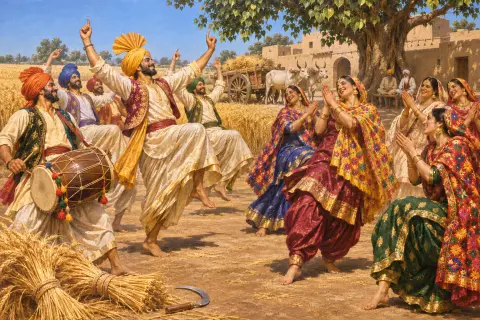
Magh Bihu is not told in any Purana or scripture. It comes from the farming year of Assam and is handed down as village tradition. It is kept on the first day of the Assamese month of Magh, the day the sun enters Capricorn, because by then the rice harvest is in and the granaries are full. Its other name, Bhogali Bihu, comes from bhog, which means enjoying and eating. The night before, Uruka, is for the shared feast, and the morning is for the fire offered to Agni.
Three Bihus, one farming year
Assam has three Bihus, and each one marks a point in the life of the rice crop. Bohag Bihu, or Rongali Bihu, comes in mid April with the Assamese New Year and the start of sowing. Kati Bihu, or Kongali Bihu, comes in autumn when the paddy is still green in the fields and granaries are low, so it is a quiet festival of lamps. Magh Bihu, or Bhogali Bihu, comes in mid January, when the harvest is finally home.
So Magh Bihu is the festival of plenty. Families who went without in Kati can now cook freely. It is also called Maghar Domahi, the meeting point of two months, because it falls where Puh ends and Magh begins. This is the same solar turning that the rest of India marks as Makar Sankranti, when the sun enters Capricorn.
Uruka: the night of the feast
The day before Magh Bihu is Uruka, the last day of Puh. Young people of the village go out to the harvested fields and build a bhelaghar, a makeshift hut of bamboo, hay and thatch, and next to it a Meji, a tall tower of firewood, bamboo and straw. Building them is a shared job, and every village takes some pride in how tall its Meji stands.
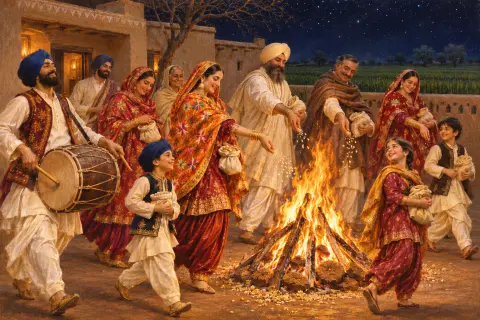
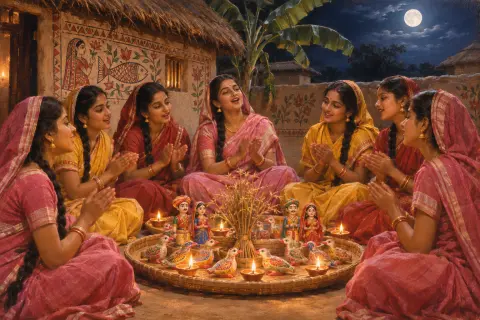
In many places the morning of Uruka also brings community fishing in ponds and wetlands, and the catch goes into the evening meal. At night the whole group, or sometimes the whole village, sits down to a feast cooked in or near the bhelaghar: rice, fish, meat, vegetables and sweets. Many people stay up through the night around small fires, talking and singing, and some sleep in the bhelaghar until dawn.
The Meji fire at dawn
Early on Magh Bihu morning people bathe and then gather at the Meji. They set it alight and pray to Agni, the fire god, for a good harvest next year and for a home that has enough. Into the flames go offerings: pitha (rice cakes), tamul-paan (areca nut and betel leaf), and sometimes rice and sesame. In many villages the bhelaghar is burned along with it.
When the fire dies down, people take a little of the ash or a half burned stick home. The ash is scattered in the fields, or placed at the foot of fruit trees, in the hope of a good crop in the coming year. Some families roast potatoes or sweet potatoes in the embers and share them while the fire is still warm.
Pitha, laru and jolpan
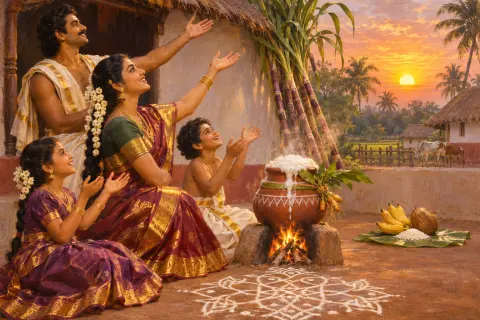
Bhogali Bihu is above all a food festival, and much of the cooking starts days earlier. Homes make til pitha, a thin rice flour roll filled with sesame and jaggery; ghila pitha, fried and sweet; and narikol laru and til laru, sweet balls of coconut or sesame.
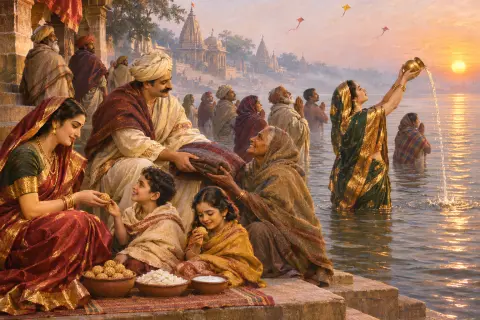
Breakfast on Bihu morning is often jolpan: chira (flattened rice), muri (puffed rice), akhoi or soft komal saul rice, eaten with doi (curd) and gur (jaggery). Guests are fed wherever they go, and a visit to a relative's house means another plate of pitha whether you are hungry or not.
Games, visits and many communities
The days after Uruka are for visiting relatives and friends, and for games. Villages hold traditional sports such as tekeli bhonga, where a blindfolded player tries to break a clay pot, along with football matches and races. Some places have long held buffalo and bird fights, but courts have restricted these more than once on animal welfare grounds, and in many places they are limited or no longer held.
Magh Bihu belongs to the whole of Assam, and many communities keep it in their own way. Bodo families know it as Domasi. Around this season, near Jagiroad in central Assam, the Jonbeel Mela still has Tiwa and other hill communities trading goods with plains villagers by barter. The names and details differ, but the shape is the same everywhere: the harvest is in, so feed people, thank the fire, and give the season its due.
Nobody eats alone on Uruka night, and the first share of the harvest goes into the fire. In the Gita (3.11) Krishna says: nourish the gods with offering, and let the gods nourish you; by nourishing one another you will reach the highest good. Bhogali Bihu is named for enjoyment, bhog, and it keeps that circle turning: the fields have given, so the fire gets its share first, then the feast is shared, and every guest goes home with pitha.