The Story
Lohri has no scriptural source. Its oldest layer is Punjabi folk song, above all the songs about Dulla Bhatti, a rebel against Mughal rule who was executed in Lahore in the late sixteenth century. The songs say he rescued a poor girl and married her off, giving a ser of sugar as her dowry, and children still sing them from door to door before the fire is lit. The day itself is kept because it is the last night of the winter month of Poh. The next morning is Maghi (Makar Sankranti), the wheat is green in the fields and the sugarcane harvest is in.
The end of the longest nights
Lohri is held on the last night of Poh, the month of the deepest Punjabi winter. The next morning is Maghi, the first day of Magh, which the rest of India knows as Makar Sankranti, when the sun enters Capricorn and begins its northward journey. For people who work the land, this turn matters. The days are about to grow longer and warmer.
It is also a farmers' festival. The wheat sown in autumn is standing green in the fields, and the sugarcane harvest is in. That is why the foods of Lohri are the foods of this season: jaggery and gajak from the new cane, sesame, peanuts, popcorn, sarson da saag with makki di roti, and rice cooked with sugarcane juice.
Nobody agrees on where the name comes from. Some say it comes from tilohri, joining til (sesame) and rorhi (jaggery). Others link it to lohi or loh, words for fire and warmth. These are folk explanations, and Punjabis have happily argued about them for generations.
Dulla Bhatti, the folk hero of the songs
The best known Lohri story is about Dulla Bhatti. Punjabi tradition remembers him as Rai Abdullah Khan Bhatti, a Muslim Rajput rebel from the Sandal Bar region who defied Mughal rule in the time of the emperor Akbar. Historians accept that a rebel of this name lived and was executed in Lahore in the late sixteenth century. Most of what is told about him, though, comes from folk songs, not written records.
In those songs, Dulla is a Robin Hood of the Punjab. He robs the rich and the powerful, and he protects poor families. The story everyone knows is about a girl, often named Sundri or Sundar Mundri, whom a powerful man wanted to take away. Dulla rescued her, found her a husband, and acted as her father at the wedding. He had nothing to give as a dowry except a ser of sugar, so that is what he gave.
The details change from village to village. In some versions there are two sisters, Sundri and Mundri. In some the wedding happens in the forest by the light of a fire. What stays the same is the heart of it: a man with no family duty towards a girl took on that duty because no one else would.
The song the children sing
In the days before Lohri, groups of children go from house to house singing and asking for "Lohri", which means a little money, sweets, peanuts or popcorn. The most famous song begins "Sundar mundriye ho!" and the children answer each line with a loud "ho!". It tells Dulla's story in a few quick lines: Dulla Bhatti wala, Dulle di dhee viyahi, ser shakkar payi. Dulla married off the daughter and gave a ser of sugar.
Households are expected to give, and to give cheerfully. Children who are sent away empty handed sometimes sing a teasing verse in reply. The whole custom works as a small lesson: what the season gives is meant to be shared, and the house that gives is the house that is blessed.
Around the fire
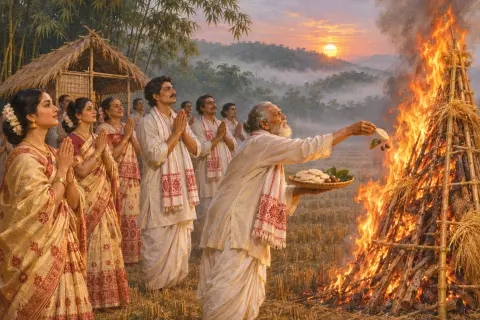
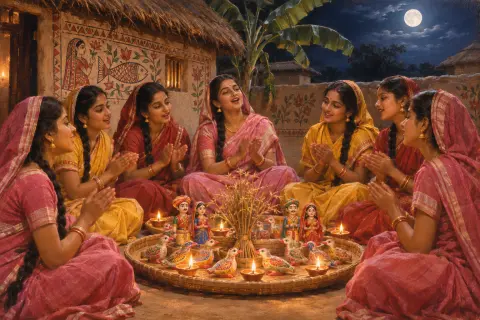
When the sun has gone down, the fire is lit. Families walk around it, often in a circle of parikrama, and throw sesame, jaggery, rewri, peanuts and popcorn into the flames. Many people say a short prayer to Agni, the fire, for a good harvest and a home that has enough. Then the same foods are passed around and eaten together.
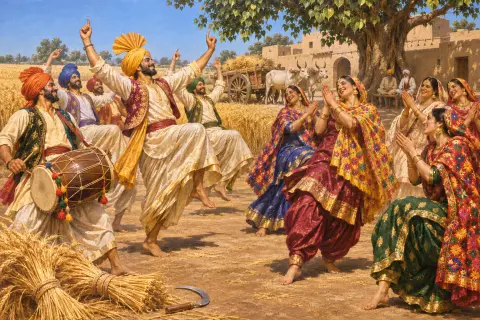
Lohri is loud. Dhol drums start up, men dance bhangra and women dance giddha, and the old songs go on late into the night. People sit close to the fire wrapped in shawls, talking with neighbours they may not have sat with all year.
A family's first Lohri after a wedding or a birth is a big event. The newly married couple or the baby is placed at the centre, relatives bring gifts, and the celebration is larger than usual. For a long time this was mostly done for sons. Today many families also celebrate a daughter's first Lohri, sometimes called Dhee di Lohri, and more and more people see that as only right.
Who keeps Lohri, and the day after
Lohri belongs to the Punjab as a whole rather than to one religion. Hindu and Sikh families keep it in the same way, and before Partition Punjabi Muslims kept it too. It is big in Punjab, Haryana, Jammu, Himachal Pradesh and Delhi, and wherever Punjabi families live in the world. In Jammu, children carry a decorated peacock figure called a chajja and dance with it from house to house.
The next morning is Maghi. Hindus bathe in rivers and give in charity for Makar Sankranti. For Sikhs, Maghi has its own meaning: it remembers the Forty Liberated Ones (Chali Mukte), the Sikhs who fell fighting beside Guru Gobind Singh at Khidrana, now Sri Muktsar Sahib, and a large fair is held there. So the Punjabi winter ends with two nights side by side: one around a fire at home, one remembering courage.
On Lohri everything goes into the fire with a prayer, and whatever is left is shared out to everyone around it. In the Gita (4.24) Krishna describes a way of seeing where the offering, the fire and the one who offers are all held as sacred, and the act itself becomes worship. Lohri brings that idea down to a village courtyard on a cold night: give the first handful away, eat the rest together, and remember, as Dulla Bhatti did, that looking after someone who has no one is itself an offering.