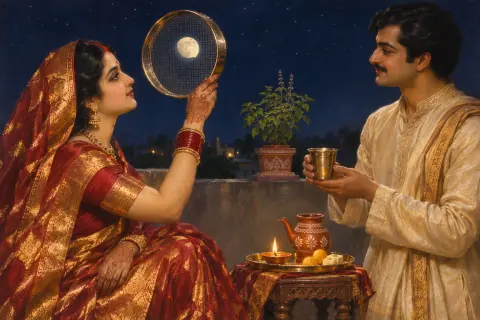
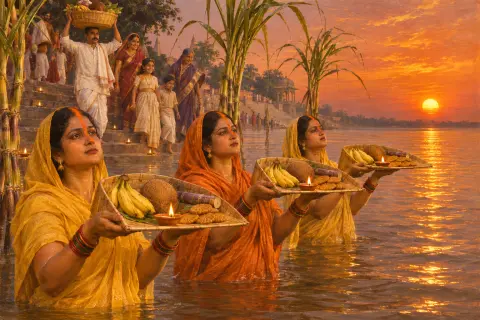
Draupadi is the queen of the Pandavas in the Mahabharata, the daughter of King Drupada of Panchala, born from a sacrificial fire. Arjuna won her at her swayamvara, and she became the wife of all five Pandava brothers. Her humiliation in the dice hall, where she was dragged in and nearly stripped, and her question that no elder could answer, set the epic on its course to war. She shared the Pandavas' exile, outfaced kings and demons, lost all five of her sons, and stayed fierce and clear-sighted throughout. She appears in festival stories of Akshaya Tritiya, Raksha Bandhan, Karva Chauth and Chhath, and is worshipped as a goddess, Draupadi Amman, in parts of Tamil Nadu.
Also called: Krishnaa (the dark one, her birth name), Panchali (princess of Panchala), Yajnaseni (daughter of Yajnasena, that is Drupada, or born of the sacrifice), Sairandhri (the maid she pretended to be at Virata's court), Draupadi Amman (the goddess of her Tamil temples)
Father: King Drupada of Panchala; she was born from his sacrificial fire, and the queen asked that the children know no other mother
Twin brother: Dhrishtadyumna, born from the same fire, commander of the Pandava army; brother: Shikhandi
Husbands: Yudhishthira, Bhima, Arjuna, Nakula and Sahadeva
Sons (the Upapandavas): Prativindhya, Sutasoma, Shrutakirti, Shatanika and Shrutasena, one by each husband, all killed by Ashvatthama on the last night of the war
Mother-in-law: Kunti; friend and protector: Krishna, who calls her sakhi
Previous life: the Mahabharata says she was a sage's daughter who asked Shiva five times for a husband and was granted five
गोविन्द द्वारकावासिन् कृष्ण गोपीजनप्रिय।
कौरवैः परिभूतां मां किं न जानासि केशव॥
O Govinda, you who live in Dwaraka, Krishna, dear to the cowherd women: do you not see that the Kauravas are humiliating me, Keshava?
Stories
Draupadi's story is told in the Mahabharata, from her birth in the Adi Parva to her fall on the last journey in the Mahaprasthanika Parva. The Sabha Parva holds the dice game, the Vana and Virata Parvas her years of exile, and the Sauptika Parva her grief for her sons. The section numbers below follow K. M. Ganguli's English translation of the commonly read text, unless the Pune Critical Edition is named. Some of the best known parts of her story, like Krishna's answer to her prayer in the dice hall, are in the commonly read text but not in the Critical Edition's main text; and some, like the strip of sari she tore for Krishna's finger, are folk stories not found in the epic at all. Both are marked below.
Born from the fire
Draupadi rises from Drupada's sacrificial fire, with her twin Dhrishtadyumna beside her.
King Drupada of Panchala had been humiliated by Drona, who had taken half his kingdom. Wanting a son who would kill Drona, he found two Brahmin brothers, Yaja and Upayaja, to perform a great sacrifice for him (Adi Parva, sections 168 and 169).
When the offering was poured, a young prince in armour rose from the fire, and a voice said he was born to destroy Drona: that was Dhrishtadyumna. Then from the middle of the altar rose a daughter, dark, with eyes like lotus petals and curling blue-black hair. A voice from the sky said this dark woman would bring about the destruction of the kshatriyas and fulfil the purpose of the gods. Because she was dark, the Brahmins named her Krishnaa.
One bride, five husbands
At her swayamvara, king after king failed to string Drupada's great bow. Arjuna, disguised as a Brahmin, strung it and hit the target, and Draupadi garlanded him (Adi Parva, section 190). When the brothers reached home with her and called out that they had brought alms, Kunti, without looking, said: share it among you all (section 193).
Drupada was troubled by the idea of one woman with five husbands. Vyasa took him aside and explained (sections 197 to 200): in a former life she had been a sage's daughter who asked Shiva for a husband, repeating her request five times, and Shiva granted her five. The five brothers, Vyasa said, were portions of Indra. Drupada agreed, and she married each brother in turn, starting with Yudhishthira.
The question in the dice hall
At Hastinapura, Yudhishthira was drawn into a game of dice against Shakuni. He lost his wealth, his kingdom, his brothers, himself, and finally staked Draupadi. A servant was sent to fetch her. Draupadi sent him back with a question: ask the gambler in the hall whom he lost first, himself or me (Sabha Parva, section 66; Critical Edition 2.60.7). If he had already lost himself, what right did he have to stake her?
Duhshasana dragged her into the hall by her hair. She asked the elders again. Bhishma answered that the way of dharma was subtle and he could not decide. Only young Vikarna, one of Duryodhana's own brothers, said she had not been lawfully won. Karna mocked her and told Duhshasana to strip her. As Duhshasana pulled at her garment, another garment of the same kind appeared beneath it, again and again, until a heap of cloth lay in the hall and he sat down exhausted (Critical Edition 2.61.40 to 48).
In the commonly read text she cries out to Krishna in the verse given at the top of this page, and her garments are renewed in answer (Ganguli, section 67). The Critical Edition keeps the miracle but places her prayer to Krishna in its notes. The story that Krishna was repaying a strip of sari she once tied on his cut finger is a folk tradition told at Raksha Bandhan, not part of the epic.
Then evil omens howled through the palace, and Dhritarashtra, frightened, offered her boons. She asked first for Yudhishthira's freedom, so that her son would not be called a slave's son, and then for the freedom of the other four with their weapons. Offered a third, she refused: greed destroys virtue, she said, and her husbands, once free, would win back their fortune by their own deeds (section 70).
Exile, and the queen as a maid
In the twelve years of forest exile Draupadi cooked for the Pandavas and their many guests from the vessel Surya gave Yudhishthira (Vana Parva, section 3). She argued hard with Yudhishthira about his patience, and in a long talk with Satyabhama, Krishna's wife, she explained how she kept the household of five husbands (sections 231 to 233). When King Jayadratha carried her off while the brothers were out hunting, they chased him down and Bhima humiliated him (sections 263 to 271).
In the thirteenth year, which had to be spent in disguise, she served Queen Sudeshna of Matsya as Sairandhri, a maid. The queen's brother Kichaka, commander of the army, pursued her and kicked her in front of the court. That night she went to Bhima in the kitchen, and the next night Bhima, waiting for Kichaka in the dancing hall, killed him (Virata Parva, sections 14 to 24).
Her sons, and the last journey
Before the war, when Krishna went to Hastinapura to talk peace, Draupadi held up her hair and told him to remember that Duhshasana's hands had seized it (Udyoga Parva, section 82). The war was won, but on the last night Ashvatthama crept into the sleeping camp and killed all five of her sons along with her brother Dhrishtadyumna.
Draupadi sat down to fast unto death unless Ashvatthama was punished, and asked for the gem he wore on his forehead. Bhima and Arjuna brought it back; Ashvatthama's life was spared because he was their teacher's son. Draupadi accepted, saying the teacher's son deserved her reverence as the teacher himself, and asked Yudhishthira to wear the gem (Sauptika Parva, sections 11 and 16).
Years later she set out with the five brothers on their last journey to the Himalayas, and was the first to fall. Bhima asked why, since she had never done wrong. Yudhishthira answered that she had loved Arjuna more than the rest (Mahaprasthanika Parva, section 2). In heaven, at the very end of the epic, she is seen again as Shri, shining.
How to recognise
•A young woman with a dark complexion and large eyes like lotus petals. The Adi Parva says she was named Krishnaa because she was dark, with blue-black curling hair and a fragrance of blue lotus that carried far.
•Long loose hair. In the Udyoga Parva she holds up her braided hair before Krishna and tells him to remember it was seized by Duhshasana. The popular vow that she would not tie her hair until it was washed in Duhshasana's blood comes from later drama, such as Bhatta Narayana's Venisamhara, and folk retellings.
•In the dice hall, holding her sari while it keeps coming and coming, often with Krishna shown above her. This is the most painted scene of her life.
•Holding a copper vessel in the forest, the akshaya patra that the sun god gave Yudhishthira, which fed everyone each day until Draupadi had eaten.
•In Tamil Nadu, as the goddess Draupadi Amman, in village temples where devotees walk on fire (theemithi) at her festival. This is a regional tradition of worship, not part of the Sanskrit epic.
The strong Yodhamanyu and the brave Uttamaujas, the son of Subhadra (Abhimanyu, the son of Subhadra and Arjuna), and the sons of Draupadi, all of great chariots (great heroes).
Duryodhana counts the draupadeyas, the sons of Draupadi, among the great chariot warriors of the Pandava army. The Gita names her through her sons, not directly.