The Story
One of the oldest written mentions of the day is in the Vishnu Smriti (chapter 90, verses 17 and 18), a dharma text. It says that a person who fasts on the bright third of Vaishakha and worships Vasudeva with unbroken rice is freed of wrongdoing, and that whatever is given on that day becomes inexhaustible. The Matsya Purana (chapter 65) gives the full vow: bathe, worship Vishnu with akshata (unbroken rice), feed brahmins with saktu (barley flour), and know that every gift, fire offering and prayer made on this tithi becomes akshaya, imperishable. That is why the day is kept. Other stories were tied to it later, some by Puranic tradition and some only by popular belief, so each one below says where it comes from.
Why the day is called akshaya
In the Matsya Purana, the Akshaya Tritiya vow is explained as a day when charity, fire offerings, prayer and fasting all yield a result that does not wear away. That is the root of the name. Many traditions also count this tithi as a yugadi, a day on which one of the great ages began. The Bhavishyottara Purana says the Krita age began on it, but other texts name a different age.
In a popular reckoning from Maharashtra and elsewhere, Akshaya Tritiya is one of the three and a half days that are auspicious in themselves, along with Gudi Padwa, Vijayadashami and half of Bali Pratipada. On such a day people start a business, enter a new house or hold a wedding without asking an astrologer for a separate muhurta. In Rajasthan this is why Akha Teej is a great wedding day.
Parashurama, born on the third day
Parashurama, the sixth avatar of Vishnu in the usual lists, was born to the sage Jamadagni and Renuka. He is the warrior-sage with the axe, given to him by Shiva. The Mahabharata and the Puranas tell how he rose against the kshatriya kings who had grown cruel and greedy, after King Kartavirya Arjuna seized his father's cow and the king's sons later killed his father.
Tradition places his birth on the bright third day of Vaishakha, so Parashurama Jayanti is kept on this tithi. Because the jayanti is fixed by the tithi at a different time of day, it sometimes falls one day before Akshaya Tritiya. In the Konkan and along the west coast, where regional tradition remembers him as the one who won the land back from the sea, the day carries extra weight.
The pot that never emptied
The Mahabharata, in the Vana Parva, tells how the Pandavas went into exile with many brahmins following them, and Yudhishthira worried how to feed everyone in the forest. On the advice of the sage Dhaumya he prayed to Surya, the sun god, who gave him a copper vessel. Whatever food Draupadi cooked in it would not run out each day until she herself had eaten.
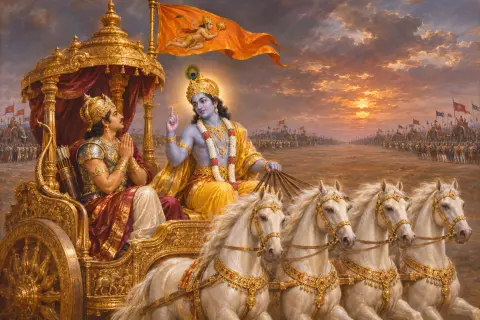
The commonly read Mahabharata adds a well loved episode. The sage Durvasa arrived with his many disciples after Draupadi had already eaten, and the vessel was empty. Draupadi prayed to Krishna. He came, found one leaf of greens stuck to the pot, and ate it. With that, Durvasa and all his disciples felt so full that they quietly left. Popular tradition links this akshaya patra, the inexhaustible vessel, to Akshaya Tritiya. The epic itself does not give a date.
Sudama's handful of rice and Annapurna
The Bhagavata Purana (tenth canto) tells of a poor brahmin, Krishna's old school friend, best known as Sudama. His wife urged him to visit Krishna in Dwaraka. Having nothing else, he carried a few handfuls of flattened rice tied in his cloth. Krishna welcomed him with great love, opened the bundle himself and ate the rice with delight. Sudama was too shy to ask for anything and went home empty handed, only to find his hut turned into a house full of plenty.
Many families tell this story on Akshaya Tritiya, and in some places it is said Sudama's visit happened on this day. That link is a popular one; the Bhagavata does not name the day. The same is true of the belief that the goddess Annapurna, who feeds the world, appeared on Akshaya Tritiya. Both stories still fit the day well: a small gift, given with love, does not stay small.
How the day is kept across India
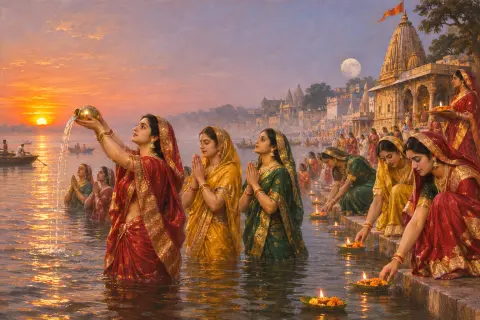
People bathe early, worship Vishnu and Lakshmi, and give in charity, often things that help in the summer heat: water pots, fans, umbrellas, sandals, grain and fruit. Jain families keep the day too: Jain tradition holds that Rishabhanatha, the first Tirthankara, broke his long fast on this day with sugarcane juice offered by King Shreyansa, and those who keep the year-long varshitap fast complete it now.
In Odisha, the chariots for Puri's Rath Yatra are begun and the Chandan Yatra starts at the Jagannath temple. Farmers mark Akhi Muthi Anukula, the ritual first sowing of the season. In Uttarakhand the Char Dham season opens as Gangotri and Yamunotri open their doors around this day; Kedarnath and Badrinath open soon after, on dates fixed separately each year. At the Banke Bihari temple in Vrindavan, devotees see the deity's feet only on this day.
Buying gold on Akshaya Tritiya is now one of the most visible customs, especially in cities. It grew out of the idea that what comes into the house on this day keeps growing. It is worth remembering that the old texts speak of giving on this day, not buying. In Karnataka the same day is often Basava Jayanti, the birth anniversary of the poet-reformer Basavanna.
Every story tied to Akshaya Tritiya is about something that does not run out: a vessel of food, a handful of rice, the merit of a gift. The Gita (17.20) describes the purest kind of giving: given because it is right to give, at the right place and time, to someone who needs it, with nothing expected back. That kind of giving is what the day was named for. Gold can be lost. A gift made in that spirit is the part that stays.