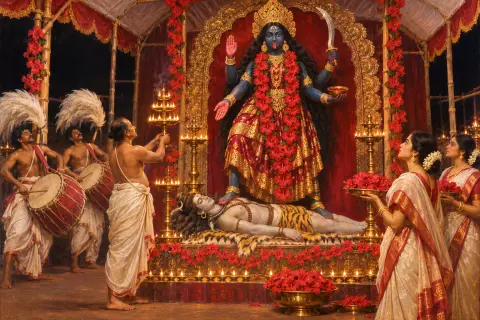
Durga is the great mother goddess of Hinduism, the warrior who rides a lion and kills the buffalo demon Mahishasura. Her full story is told in the Devi Mahatmya, thirteen chapters of the Markandeya Purana, where she is born from the combined power of all the gods and promises to return whenever the world is in danger. She is also known as Chandika, Ambika and Mahamaya, and many traditions see her as Parvati, Shiva's wife. She is worshipped for nine nights twice a year at Navaratri, in nine forms called the Navadurga, in Bengal's Durga Puja, and on Vijayadashami.
Also called: Mahishasuramardini (crusher of Mahishasura), Chandika or Chandi (the fierce one), Ambika (mother), Mahamaya (the great power of illusion), Bhagavati (the blessed goddess), Bhavani, Katyayani, Shakti (power), Simhavahini (who rides the lion), Vindhyavasini (who lives in the Vindhya hills), Narayani, Uma and Gauri (as Shiva's wife), Jagadamba (mother of the world)
Origin: in the Devi Mahatmya she is born from the light of all the gods together, and has no parents
As Parvati or Uma: daughter of Himavan (the Himalaya) and Mena
Husband: Shiva, in the traditions that see her as Parvati
Children: Ganesha and Kartikeya; in Bengal, Lakshmi and Saraswati are also called her daughters
Forms that come from her: Kali (Chamunda), who springs from her brow, and the seven Matrikas in the Devi Mahatmya (chapter 8)
Mount: a lion; often a tiger in north and west India
Home: Kailash with Shiva; as Vindhyavasini, the Vindhya hills
या देवी सर्वभूतेषु मातृरूपेण संस्थिता ।
नमस्तस्यै नमस्तस्यै नमस्तस्यै नमो नमः ॥
To the goddess who lives in every being as the mother: we bow to her, we bow to her, we bow to her, again and again we bow.
Stories
Durga's name is old. The Taittiriya Aranyaka of the Yajurveda (book 10) already prays to "Durga, the goddess, the colour of fire" to carry the worshipper across difficulties, and gives a Durga Gayatri. Hymns to her appear in some versions of the Mahabharata and in the Harivamsha, which tells of the goddess of the Vindhya hills born as Krishna's sister. Her full story comes in the Devi Mahatmya, chapters 81 to 93 of the Markandeya Purana, usually dated to around the fifth or sixth century. It is read in full during Navaratri and is also called the Durga Saptashati or the Chandi. Later texts add to her: the Devi Bhagavata Purana, the Kalika Purana, the Navadurga list in the Devi Kavacha, and, in Bengal, the Ramayana of Krittibas and the songs that welcome Uma home.
Born From the Light of the Gods
The light of all the gods joins into one goddess (Devi Mahatmya, chapter 2).
The Devi Mahatmya (chapter 2) begins this story with a defeat. For a hundred years the gods fought Mahishasura, the buffalo demon, and lost. He took Indra's place in heaven and drove the gods out to wander the earth. They went to Vishnu and Shiva and told them everything.
As they listened, Vishnu and Shiva grew angry, and a great light came out of their faces. Light came out of Brahma, Indra and every other god too. It all flowed together into one blaze, like a mountain on fire, filling every direction. Then the light took the form of a woman.
Each god gave her something of his own. Shiva drew a trident out of his trident, Vishnu a discus out of his discus. Varuna gave a conch, Agni a spear, Vayu a bow and arrows, Indra a thunderbolt and a bell. The Ocean gave her jewels and a garland of unfading lotuses, and Himavan gave her a lion to ride. She laughed aloud, and the earth shook.
This is why Durga is so often called the power of all the gods together. She is not a helper sent by one of them. She holds what each of them has, and she fights alone.
The Buffalo Demon
Mahishasura sent his generals first, and the goddess and her lion destroyed their armies (Devi Mahatmya, chapter 3). Then he came himself, as a huge buffalo, tearing up the ground with his hooves and throwing mountains with his horns.
She threw her noose over him, and he became a lion. She cut off the lion's head, and he became a man with a sword. She cut him down, and he became an elephant, and then a buffalo again. At last she drank from a cup of wine, laughed, and told him to roar while he could. She leapt on him, pressed his neck down with her foot and pierced him with her trident. As he came half out of the buffalo's mouth in his true form, she cut off his head.
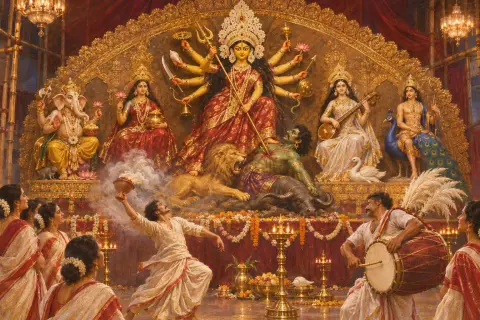
The gods praised her in a long hymn (chapter 4). She told them to ask for a boon, and they asked only this: that whenever they called on her in trouble, she would come. She promised and vanished. This is the scene in every Durga Puja pandal, and the reason she is called Mahishasuramardini.
The Goddess No One Could Marry
In the third part of the Devi Mahatmya (chapters 5 to 10), two demon brothers, Shumbha and Nishumbha, took over the three worlds. The gods went to the Himalaya and sang the hymn "Ya Devi Sarvabhuteshu", bowing to the goddess who lives in every being as consciousness, as sleep, as hunger, as forgiveness, as mother. Parvati came to bathe in the Ganga, and from her body came Ambika, beautiful beyond words.
Shumbha's servants saw her and told their master that she should be his. He sent a messenger with a proposal. She answered politely: long ago, without thinking, she had made a vow that she would marry only the one who defeated her in battle. Shumbha sent armies to drag her to him. She burned his general Dhumralochana to ash with one sound, "hum". From her brow, dark with anger, came Kali, who killed Chanda and Munda. Then came Raktabija, whose every drop of blood became a new demon, until Kali drank his blood before it could fall.
When only Shumbha was left, he mocked her for leaning on the strength of other goddesses. She answered (chapter 10, verse 3): "I am alone in this world. Who else is there besides me? See, these powers of mine are entering back into me." All the goddesses melted into her, and she killed him alone. Before leaving, she promised the gods (chapter 11) that she would come back in age after age, and that she would kill a demon named Durgama and be known as Durga.
Krishna's Sister
The Harivamsha and the Bhagavata Purana (Book 10, chapters 2 and 4) tell a quieter story. When Krishna was about to be born to Devaki in Kamsa's prison, Vishnu asked Yogamaya, his own power, to be born at the same moment to Yashoda in Gokul. Vasudeva carried the baby Krishna across the river to Gokul, laid him beside Yashoda, and brought her newborn daughter back to the prison.
Kamsa came to kill Devaki's eighth child. He seized the little girl by the feet and swung her at a stone. She slipped out of his hands, rose into the sky and appeared as a goddess with eight arms holding a bow, a trident, arrows, a shield, a sword, a conch, a discus and a mace. She told Kamsa that the one who would kill him had already been born elsewhere, and vanished.
The Bhagavata (10.2.11 to 12) says that on earth people would worship her under many names: Durga, Bhadrakali, Vijaya, Vaishnavi, Kumuda, Chandika, Krishna, Madhavi, Kanyaka, Maya, Narayani, Ishani, Sharada and Ambika. This is why the goddess of the Vindhya hills, Vindhyavasini, is honoured as Krishna's sister.
Prayers Before Battle: Arjuna and Rama
In many manuscripts of the Mahabharata, just before the Bhagavad Gita, Krishna sees the Kaurava army drawn up and tells Arjuna to purify himself and pray to Durga for victory (Bhishma Parva, chapter 23 in the common editions). Arjuna steps down from the chariot and praises her as Kumari, Kali, Kapali, Bhadrakali, Mahakali and Katyayani. She appears in the sky and promises him victory. The Pune Critical Edition treats this hymn as a later addition and leaves it out of its main text, so the Gita there begins at chapter 23.
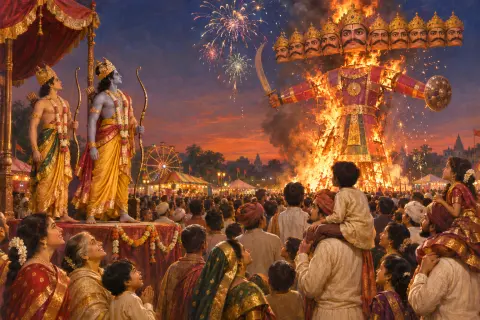
Rama's story has a similar prayer. The Devi Bhagavata Purana (Book 3, chapter 30) says that when Rama was grieving for Sita, the sage Narada taught him the Navaratri vow, and Rama kept it for nine days before marching on Lanka. The goddess appeared on her lion and blessed him.
Bengal tells it in its own way. In the fifteenth century Bengali Ramayana of Krittibas Ojha, Rama wakes the goddess in autumn, out of her season (akal bodhon), and offers her 108 blue lotuses. She hides one to test him, and he is ready to offer his own lotus-like eye in its place before she stops him. This story is not in Valmiki's Ramayana, but it is the reason Bengal worships Durga in autumn.
The Nine Durgas and the Daughter Who Comes Home
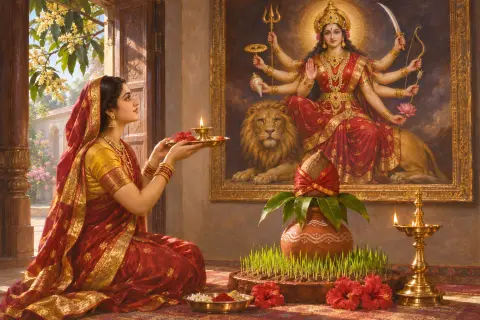
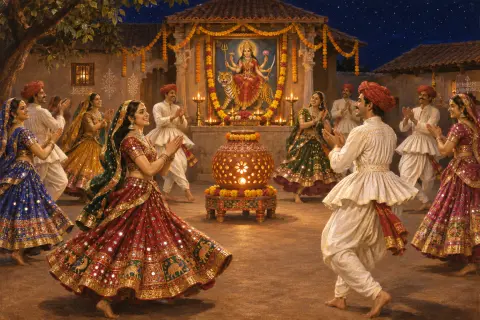
The Devi Kavacha, the protective hymn recited before the Durga Saptashati, names nine forms of Durga: Shailaputri, Brahmacharini, Chandraghanta, Kushmanda, Skandamata, Katyayani, Kalaratri, Mahagauri and Siddhidatri. These are the Navadurga. In north and west India each night of Navaratri is given to one of them, in this order, and many people fast and pray to that form on her day.
Bengal holds a different and very tender picture. There Durga is also Uma, the daughter of the Himalaya and Mena, married to Shiva and living far away on Kailash. Once a year, in autumn, she comes home to her parents for a few days with her four children. The agomani songs welcome her as a mother would welcome a married daughter, and on Dashami the bijoya songs cry as she leaves.
So the same goddess is two things at once in the festival year: the warrior who holds the weapons of every god, and the daughter whose short visit home everyone waits for.
How to recognise
•Golden skin, three eyes and a calm face. Most paintings and clay images give her a red sari, a tall crown and heavy gold jewellery. Bengal's images often have large, long eyes painted on the day of chokkhu daan.
•Ten arms, each holding a weapon. In the Devi Mahatmya (chapter 2) every god gives her one: Shiva a trident, Vishnu a discus, Varuna a conch and a noose, Agni a spear, Vayu a bow and arrows, Indra a thunderbolt and a bell, Yama his staff, Kala a sword and shield, Brahma a rosary and a water pot. Some images show eight arms, and the dhyana of the Devi Mahatmya's middle part describes eighteen.
•Her mount is a lion, given to her by Himavan, the Himalaya, in the same chapter. In north and west Indian posters and at many Navaratri shrines she rides a tiger instead; both are hers.
•As Mahishasuramardini she stands with one foot on the lion and one on the buffalo demon. Mahishasura is shown half out of the buffalo's body, her trident in his chest, while the lion bites him.
•One hand is often raised palm outward (abhaya, "do not fear"). Painters keep her face serene even in battle. Many teachers read this as a sign that she fights without hatred, but that is an interpretation, not something the text says.
•In a Bengal pandal she stands in one frame (ekchala) with her four children: Lakshmi and Ganesha on her right, Saraswati and Kartikeya on her left, each with their own mount, and a painted arch (chalchitra) behind.
•Each of the Navadurga has her own look in today's pictures: Shailaputri on a bull with a trident and lotus, Brahmacharini with a rosary and water pot, Chandraghanta with a half moon like a bell on her forehead, Skandamata with the child Skanda on her lap, Kalaratri dark and fierce, Mahagauri white on a bull, and Siddhidatri seated on a lotus.
Verily, this divine illusion of Mine, made up of the (three) qualities (of Nature) is difficult to cross over; those who take refuge in Me alone, cross over this illusion.
The Gita does not name Durga. But Krishna's words here, "this divine maya of mine, made of the three gunas, is hard to cross; those who take refuge in me cross it", echo the Devi Mahatmya, which calls the goddess Mahamaya, the power that binds even the wise and alone sets them free. The link is one that Devi worshippers and later commentators draw, not one the Gita makes itself.