The Story
The oldest full account of the goddess Durga is the Devi Mahatmya, thirteen chapters (81 to 93) of the Markandeya Purana, usually dated to around the fifth or sixth century and known in Bengal as the Chandi and elsewhere as the Durga Saptashati. It tells how the goddess, born from the combined power of all the gods, killed Mahishasura and other demons, and how she promised to return whenever the world is in danger. Later texts such as the Kalika Purana describe her worship in autumn, and Bengal's own reason for the autumn date comes from the Bengali Ramayana of Krittibas Ojha, in which Rama wakes the goddess out of season to ask for her help against Ravana. Durga Puja is kept to welcome her, worship her for these days with the Chandi, and send her off with love.
Mahamaya: a king, a merchant and a sage
The Devi Mahatmya opens not on a battlefield but in a forest hermitage. King Suratha has lost his kingdom to enemies and his own ministers. In the forest he meets a merchant, Samadhi, whose wife and sons threw him out for his money. Both men are puzzled by the same thing: they have been wronged, yet they cannot stop worrying about the very people who wronged them. They ask the sage Medhas why.
Medhas answers that this is the work of Mahamaya, the goddess as the great power of illusion. She seizes the minds of even the wise and draws them into attachment, and when she is pleased, she is also the one who sets them free. Then he tells them three stories of her. In the first, she is Yoganidra, the sleep of Vishnu, who wakes him so he can kill the demons Madhu and Kaitabha.
This frame matters for Durga Puja. The goddess worshipped in the pandal is not only a warrior. She is the power that binds every creature in the world and the only power that can release it. At the end of the text Suratha and Samadhi worship her for three years, and she grants each of them what he asks: the king gets his kingdom back, and the merchant asks for knowledge that frees him.
Born from the light of the gods
The second story is the one shown in every pandal. Mahishasura, the buffalo demon, defeated the gods and took over heaven. The gods went to Vishnu and Shiva, and as they told what had happened, a great blaze of light came out of their anger and out of the bodies of all the gods. The light joined into one, and became a woman. Each god gave her a weapon: Shiva his trident, Vishnu his discus, Varuna his conch, Indra his thunderbolt, and the Himalaya gave her a lion to ride.
She fought Mahishasura's armies alone and destroyed them. Mahishasura kept changing shape, from buffalo to lion to man to elephant and back. In the end she pinned him under her foot and pierced him with her trident, and as he came half out of the buffalo's body she cut off his head. This is why Durga is called Mahishasuramardini, crusher of Mahishasura.
In the third story she kills the demon brothers Shumbha and Nishumbha. From her forehead, dark with anger, comes Kali, who kills the generals Chanda and Munda and so is called Chamunda; then Raktabija, from whose every drop of blood a new demon rose, until Kali drinks the blood before it falls. Before she leaves, the goddess makes a promise (Devi Mahatmya, chapter 11): whenever trouble rises from demons, she will come down and destroy the enemies.
Akal Bodhon: Rama's untimely call, and Uma coming home
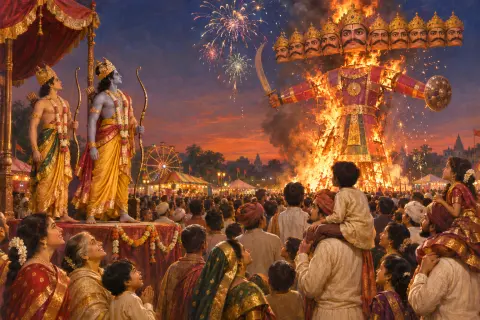
In Bengal's telling, the goddess's proper season was spring, the Basanti Puja of Chaitra, which King Suratha was the first to keep. Why autumn, then? The Bengali Ramayana of Krittibas Ojha, from the fifteenth century, gives the answer that Bengal loves. Before his last battle with Ravana, Rama decided to worship Durga for her blessing. Since autumn was the time when the gods sleep, he had to wake her out of season. This is the akal bodhon, the untimely awakening, and every Durga Puja in Bengal begins with a bodhon on Shashthi to repeat it.
Rama gathered 108 blue lotuses for the worship. The goddess, to test him, hid one. When Rama found one missing, he remembered that people called him lotus-eyed and took up an arrow to offer one of his own eyes. The goddess appeared, stopped his hand, and blessed him with victory. This story is not in Valmiki's Ramayana; it is Krittibas's, and through him it became Bengal's own.
Alongside the warrior, Bengal keeps another picture of Durga: Uma, the daughter of the Himalaya and Menaka, married to Shiva and living far away on Kailash. Once a year she comes home to her parents for these few days, bringing her children Ganesha, Lakshmi, Saraswati and Kartikeya. The agomani songs welcome her; the bijoya songs on Dashami cry as she leaves. That is why the last day feels like seeing a daughter off after a short visit.
The days of Pujo in Bengal
The season begins on Mahalaya, the new moon that ends Pitru Paksha, when people offer tarpan to their ancestors on the Ganga ghats at dawn and listen to Mahishasuramardini on the radio. In Kumartuli, Kolkata's potters' quarter, the artisans paint the goddess's eyes, the chokkhu daan, around this time. On Shashthi the goddess is awakened (bodhon) and invited into a bel tree (bilva nimantran). On Saptami morning a bundle of nine plants, the nabapatrika or kola bou, is bathed in the river, wrapped in a red-bordered sari and placed beside Ganesha as a form of the goddess.
Maha Ashtami is the heart of the festival. People fast, offer flowers in the morning pushpanjali, and in many places, like Belur Math, a young girl is worshipped as the goddess in the Kumari Puja. At the meeting of Ashtami and Navami comes the Sandhi Puja, forty eight minutes in which 108 lamps are lit and 108 lotuses are offered, for the moment Chamunda killed Chanda and Munda. Navami brings the great bhog of khichuri, vegetables and sweets shared with everyone.
On Vijaya Dashami the goddess is shown a mirror and her reflection is immersed in water (darpan visarjan). Married women offer her sweets and sindoor and then smear sindoor on one another in the sindoor khela. The images are carried to the river to the beat of the dhak and immersed, and people go home to touch elders' feet, embrace friends and say "Shubho Bijoya". Through these days Kolkata turns into one long walk from pandal to pandal, through old family pujas in north Kolkata houses and huge community (barowari) pandals with new themes each year. In 2021 UNESCO added Durga Puja in Kolkata to its list of the Intangible Cultural Heritage of Humanity.
Durga Puja in Bihar and across the east
In Bihar, Durga Puja is the year's great festival, and it blends the nine-day Navaratri of north India with the image worship of Bengal. Families set up the kalash on Pratipada, sow barley (jayanti) beside it, fast and read the Durga Saptashati for nine days. In Mithila, on the evening of Shashthi, people go in procession to a bel tree and invite the goddess (belnoti), tying a pair of twin bel fruits with red cloth; on Saptami morning the fruits are brought to the temple in a palanquin (beltodi). Then the cloth over the goddess's face is removed, the moment everyone calls pat khulna, and from that day the crowds pour in. Many of these pujas are in temples and village sthans that have kept the same rites for generations.
Patna fills with pandals from the old city to the Dak Bungalow crossing, lit up through the nights, with melas of swings, sweets and toys. The city's Bengali families have kept their own pujas for more than a century; the puja at the Bengali Akhara has run for well over a hundred years with Bengali rites. On Ashtami and Navami, in Bhojpur and across Bihar, married women fill the goddess's khoincha, the fold of her sari, with rice, turmeric, durva grass, sweets and a coin, the way a daughter is sent back to her in-laws, and on Dashami the images go to the Ganga or the local pond while Ravana is burned at Gandhi Maidan in Patna. Towns such as Muzaffarpur and Samastipur also have Bengali-style pujas, complete with sindoor khela.
Further east and south, the festival takes other local shapes. In Assam the pujas fill Guwahati and every small town. In Odisha it is Durga Puja and Dussehra together, and Cuttack is known for decorating its goddesses in silver filigree (chandi medha). In Tripura the Durgabari puja in Agartala carries on a tradition begun by the Manikya kings. Jharkhand's cities, Ranchi above all, have large pandals. In Bangladesh it is the largest festival of the Hindu community, with the Dhakeshwari temple in Dhaka at its centre and a public holiday on Bijoya Dashami.
The Devi Mahatmya says the goddess is Mahamaya: she draws even the wise into delusion, and she alone, when pleased, sets them free. Krishna says the same of his own power in the Gita (7.14): this divine maya made of the three gunas is hard to cross, but those who take refuge in me cross it. Suratha and Samadhi came to the sage confused by the very attachments they could not drop. Durga Puja, behind its drums and lights, makes that same turn every year: away from fighting our own confusion alone, and towards the mother who binds and frees, with refuge in her.