The Story
The oldest text behind Chaitra Navratri is the Devi Mahatmya, also called the Durga Saptashati, a part of the Markandeya Purana (chapters 81 to 93 in the common numbering). It tells how the sage Medhas taught King Suratha and the merchant Samadhi about the goddess, and how the two worshipped her on a riverbank and each received what he asked for. The Devi Mahatmya does not fix a season. The vow of nine nights in both spring and autumn is set out in the Devi Bhagavata Purana (Book 3, chapter 26), and the spring vow ends on Ram Navami, the day of Rama's birth in the Valmiki Ramayana (Bala Kanda, sarga 18).
A king and a merchant in the forest
The Devi Mahatmya, the text recited in homes and temples during both Navratris, opens with two broken men. King Suratha has lost his kingdom to enemies and his own ministers. The merchant Samadhi has been thrown out by his wife and sons, who wanted his money. They meet in the forest at the hermitage of the sage Medhas.
Both ask the sage the same question. We have been betrayed, they say, so why do we still worry about the kingdom and the family that pushed us out? Medhas answers that this pull of attachment is the power of the goddess Mahamaya, who binds the world and who also sets it free. Then he tells them her stories: how she woke Vishnu to kill Madhu and Kaitabha, how she defeated Mahishasura, and how she destroyed Shumbha and Nishumbha.
At the end, Suratha and Samadhi go to a riverbank, make an image of the goddess from clay and worship her for three years. She appears to them. Suratha asks for his kingdom back and receives it. Samadhi, who has lost interest in the world, asks for knowledge and receives that. The same goddess gives each what he truly asks for.
Why there are two Navratris
The Devi Bhagavata Purana (Book 3, chapter 26) describes the Navratri vow for both spring and autumn. It calls these two seasons the teeth of Yama, because many people fall ill and die in them, and says that worshipping the goddess for these nine days protects people. It asks for the vow in spring with devotion and names autumn as its special season. So the autumn Navratri is the bigger one in most places, but the spring vow grows from the same root.
Bengal keeps a memory of this in its own way. Basanti Puja, the spring worship of Durga, is traditionally traced to King Suratha, while the autumn Durga Puja is called akal bodhan, the untimely awakening, because in the Krittivasi Ramayana Rama called on the goddess out of season before his battle with Ravana. Traditions differ on these details, but they agree that the spring worship is very old.
Nine days, nine forms
Each day is given to one form of Durga, the Navadurga. Shailaputri, daughter of the mountain, comes first, then Brahmacharini, the goddess in penance, then Chandraghanta, Kushmanda, Skandamata, Katyayani, Kalaratri and Mahagauri, and finally Siddhidatri, the giver of every accomplishment. The order is the same as in autumn.
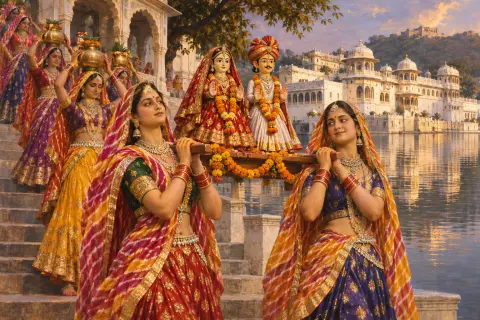
Other festivals fall inside these nine days. The third day is Gauri Tritiya, which Rajasthan celebrates as Gangaur. The fifth is Lakshmi Panchami, and the eighth is Durga Ashtami, also kept as Annapurna Ashtami. In the Sindhi community, the second day is Cheti Chand, the festival of Jhulelal.
Ghatasthapana and Kanya pujan
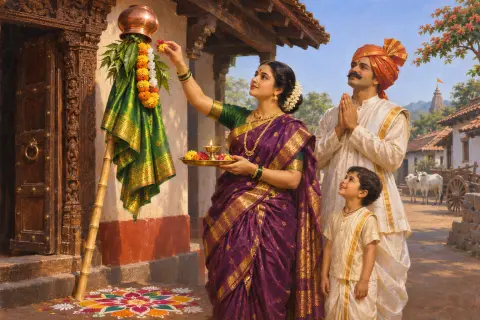
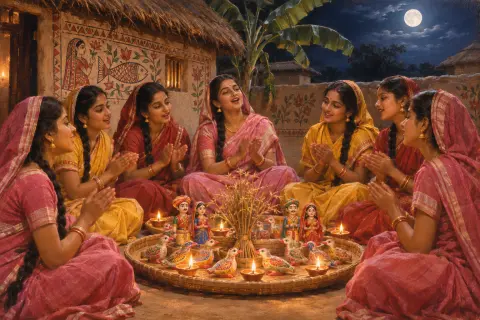
On the first morning, families perform Ghatasthapana. A pot of water, the kalash, is placed on a bed of soil, topped with mango leaves and a coconut wrapped in red cloth, and barley is sown in the soil around it. Many homes light an akhand jyoti, a lamp kept burning for all nine days. Over the days the barley shoots up green, and its growth is read as a sign of the year to come.
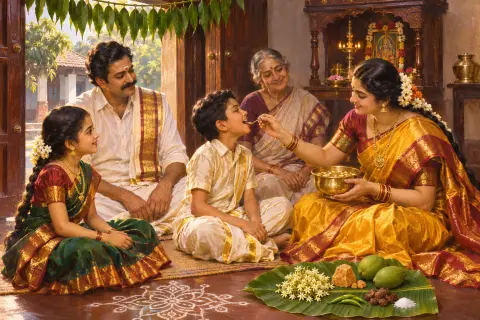
Many people fast for the nine days, or on the first and last days. They skip grain and eat fruit, milk and fasting foods made from buckwheat, water chestnut flour or sago. Some read the whole Devi Mahatmya, also called the Durga Saptashati, during the festival.
On Ashtami or Navami, families invite young girls, often nine, and sometimes a small boy who stands for Bhairav. They wash their feet, mark their foreheads with kumkum, tie a red thread, and serve them halwa, puri and black chickpeas. The girls are honoured as the goddess herself. Kanya pujan is often the moment children remember most.
Ending on Ram Navami
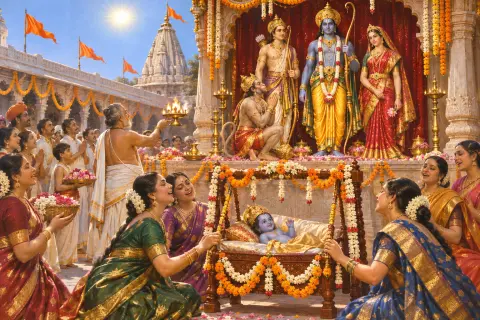
The last day of Chaitra Navratri is Ram Navami. The Valmiki Ramayana (Bala Kanda, sarga 18) says Rama was born to Queen Kausalya and King Dasharatha in Ayodhya on the ninth day of the bright half of Chaitra. Tulsidas's Ramcharitmanas places the birth at midday, so temples celebrate it at noon, with a cradle, songs and sweets. Ayodhya fills with pilgrims, and at Bhadrachalam in Telangana the wedding of Sita and Rama is celebrated on this day.
Many households of Rama's devotees read the Ramcharitmanas of Tulsidas over the nine days in the Navahna Parayan, a reading divided into nine parts so that it ends on Ram Navami. So the festival carries two kinds of worship together: the goddess for eight days and Rama on the ninth. The fast is broken with prasad, and the kalash and barley are given back to water.
The pilgrimage seasons swell at the same time. Pilgrims climb to Vaishno Devi in Jammu, and the Shakti temples of Himachal Pradesh, such as Naina Devi, Chintpurni and Jwalaji, hold their Navratri fairs.
Suratha wanted his kingdom, Samadhi wanted wisdom, and the goddess gave each what he was really asking for. In the Gita (4.11) Krishna says: in whatever way people come to me, in that same way I receive them, and everyone, in one way or another, is walking on my path. Chaitra Navratri comes at the start of a new year. It is a good time to ask yourself what you are really seeking, and to bring it to the goddess honestly, the way you set up the kalash: with patience, with care and with nine days of attention.