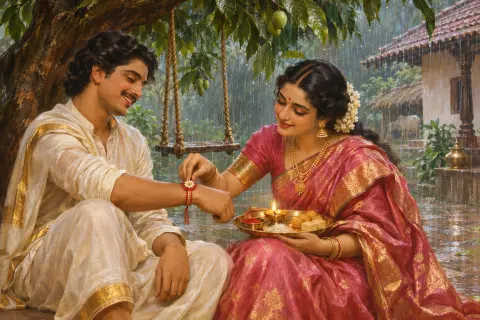
Mahabali, or Bali, is the generous asura king who won all three worlds and gave them away to Vishnu, who came to him as Vamana, a small brahmin boy asking for three steps of land. He was the grandson of the great devotee Prahlada. His story is told in full in the Bhagavata Purana (Book 8, chapters 15 to 23), and it grows out of much older Vedic hymns about Vishnu's three strides. In Kerala he is Maveli, the good king of a golden age, whose yearly visit to his people is the reason for Onam. In Maharashtra, Karnataka and Gujarat the day after Diwali is Bali Pratipada, kept in his honour, and the Raksha Bandhan mantra remembers him as the king bound by his own word.
Also called: Bali, Mahabali (Bali the great), Maveli (the Malayalam form of Mahabali), Bali Raja, Bali Chakravarti (emperor Bali), Vairochana (son of Virochana), Daityendra and Danavendra (king of the daityas and danavas)
Father: Virochana, son of Prahlada
Grandfather: Prahlada, the great devotee of Vishnu; great-grandfather: Hiranyakashipu
Wife: Vindhyavali
Son: Bana (Banasura), the thousand-armed king whose story is told in Book 10 of the Bhagavata
Guru: Shukracharya, teacher of the asuras
Realm: Sutala, a world below the earth, where Vishnu sent him to rule (Bhagavata 8.22)
Counted among the seven chiranjivis, the ones who live on through the ages, in a well known traditional verse
na hy asatyāt paro 'dharma iti hovāca bhūr iyam,
sarvaṃ soḍhum alaṃ manye ṛte 'līkaparaṃ naram.
There is no wrong greater than untruth. The Earth herself once said: I can bear any weight except a man given to lies.
Stories
The seed of Bali's story is older than Bali. The Rigveda (1.154 and 1.22) praises Vishnu, who measured out the worlds in three strides. The Shatapatha Brahmana (1.2.5) tells how the gods, losing to the asuras, sent Vishnu as a dwarf (vamana) and won back as much ground as he could cover. The Ramayana (Bala Kanda, sarga 29) names Bali, son of Virochana, as the king Vamana went to, and the Mahabharata has Bali talk with Indra about the turning of fortune. The full story, with Bali's generosity and Vishnu's love for him, is in the Bhagavata Purana, Book 8. Kerala added the rest: Maveli as a just king of a golden age when all people were equal, and his yearly return at Onam. Through all of these Bali changes from a defeated enemy of the gods into one of the most loved figures in the Puranas, a king who lost everything and kept his word.
Grandson of Prahlada
Bali was the son of Virochana and the grandson of Prahlada, the boy who loved Vishnu even when his father Hiranyakashipu tried to kill him for it. Bali grew up as the leader of the asuras, strong, brave and generous, and devoted to his teachers, the sages of the Bhrigu family.
In the Bhagavata Purana he leads the asuras when the gods and asuras churn the Ocean of Milk together for amrita (Book 8, chapters 6 to 11). When Vishnu, as Mohini, gives all the amrita to the gods, war breaks out. Indra strikes Bali down with his thunderbolt, and Shukracharya, guru of the asuras, brings him back to life with his knowledge of revival.
The king of three worlds
Bali served the Bhrigu sages with great devotion, and they performed the Vishvajit sacrifice for him (Bhagavata 8.15). Out of the fire came a golden chariot, horses, a lion banner, a divine bow and armour. With these he marched on Amaravati, Indra's city. Brihaspati, the gods' teacher, told Indra that Bali could not be beaten now and that the gods should leave and wait for their time. They hid, and Bali ruled heaven, earth and the worlds below. The Bhrigus then had him perform a hundred horse sacrifices.
Aditi, mother of the gods, grieved to see her sons homeless. Her husband, the sage Kashyapa, taught her the payovrata, a twelve day vow of living on milk and worshipping Vishnu (8.16). Vishnu appeared to her and promised to be born as her son. He was born on the twelfth day of the bright half of Bhadrapada, under the star Shravana, at noon (8.18.5 to 6), and at once became a small brahmin boy, Vamana.
Three steps of land
Bali pours the water that seals his gift to Vamana.
At his thread ceremony the boy received gifts from the gods: Brihaspati gave the sacred thread, the Earth a deerskin, the sky an umbrella, Brahma a water pot (8.18). Then he went to Bhrigukaccha on the north bank of the Narmada, where Bali was holding a sacrifice. The whole assembly rose when he walked in, glowing like a small sun. Bali washed his feet, sprinkled the water on his own head, and told him to ask for anything at all: villages, elephants, a wife, food, gold.
Vamana asked for three steps of land, measured by his own feet. Bali laughed. You talk like an old man, he said, but you are a child; ask for enough to live on. Vamana answered that a man who is not content with three steps will not be content with an island or with the whole earth (8.19).
Shukracharya saw who the boy really was and warned Bali: this is Vishnu, and he will take everything. Bali thought and then refused to go back on his word, with the verse at the top of this page: there is no wrong greater than untruth (8.20). He said that if this was Vishnu, he could not ask for a better person to give to. Shukracharya cursed him to lose his fortune for disobeying his guru. Bali, with Vindhyavali beside him, washed Vamana's feet and poured water to seal the gift.
The third step
At once the boy began to grow. As Trivikrama he filled the sky, and in him the asuras saw all the worlds. With one step he covered the earth, and with the second the heavens up to Brahma's world. Brahma washed the foot that reached him, and the Bhagavata says that water became the Ganga (8.21.4). There was nowhere left for the third step.
Bali's followers attacked and were driven off. Garuda bound Bali with the noose of Varuna, the sea god (8.21.26), and Vamana told him he had broken his promise. Bali answered calmly: place your third step on my head (8.22.2). Prahlada, his grandfather, arrived and praised Vishnu for taking away Bali's wealth, since it had been leading him into pride. Vindhyavali folded her hands and prayed for her husband.
Vishnu was moved. He told Brahma that he takes away the wealth of those he wants to bless, and that Bali, stripped of everything and bound, had not given up the truth. He sent Bali to rule Sutala, a world below richer than heaven, promised he would be the Indra of a future age, and said: I will always be with you there and protect you, and you will see me (8.22.35). Bali bowed and went down to Sutala with his family (8.23).
Bali and Indra on the turning of fortune
The Mahabharata's Shanti Parva has a quieter scene. Long after his fall, Bali is found living in an empty house in the form of a donkey. Indra comes to gloat. Bali is not ashamed. Fortune and loss, he tells him, are brought by time; you sit where I once sat, and time will move you too. Then the goddess of fortune, Shri, is seen leaving Bali's body and going to Indra, explaining that she stays only where truth, generosity and dharma are kept.
Many readers find in this scene the same Bali as in the Bhagavata: a king who knows that what is given can be taken back, and who does not lose himself when it is.
Maveli at Onam, Bali Raja at Diwali
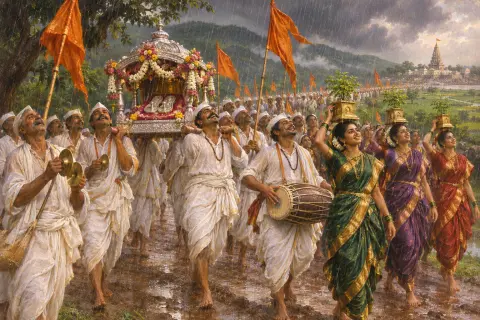
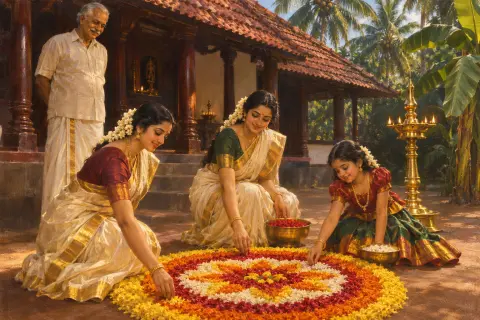
In Kerala, Mahabali is Maveli, and the best known Onam song begins: when Maveli ruled the land, all the people were one, and there were no lies, no cheating and no theft. Kerala's tradition says that before he went below, Mahabali asked to visit his people once a year, and that he comes on Thiruvonam to see that they are happy. Homes lay flower carpets (pookalam) to welcome him, and the feast, the boat races and the new clothes are all for his visit. This yearly return is Kerala's own tradition; the Bhagavata does not mention Kerala. The temple at Thrikkakara near Kochi, dedicated to Vamana, is the traditional centre of Onam.
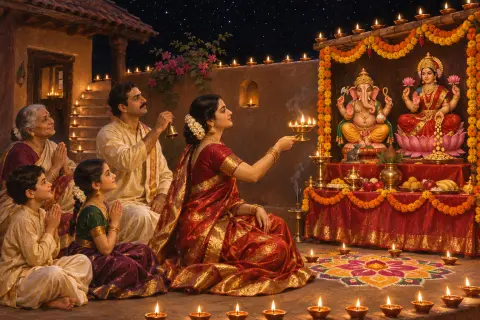
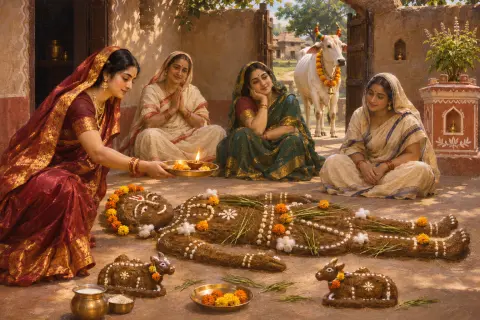
In Maharashtra, Karnataka and Gujarat, the day after Diwali is Bali Pratipada (Bali Padyami in Karnataka), the first day of Kartika. Families draw a figure of Bali Raja and worship him, and in Maharashtra people say ida pida javo, Balicha rajya yevo: may troubles and sorrows go, and may Bali's kingdom come. For farmers there especially, Bali is a just king of the past, remembered with love.
Not everyone tells the story the same way. Some in Kerala see Vamana as a trickster and Mahabali as the people's king who was wronged. Most devotees follow the Bhagavata, where Vishnu humbles Bali only to bless him. Both readings agree on one thing: Bali kept his word.
How to recognise
•A crowned king with two arms, in royal dress, usually shown kneeling with folded hands or bowing his head while Vamana or Trivikrama places a foot on it. This is the moment almost every image of him shows.
•Pouring water from a spouted vessel (kindi or kalasha) into Vamana's hands, the gesture that seals a gift. His queen Vindhyavali often stands beside him, and his guru Shukracharya protests in the background.
•Vamana, the dwarf brahmin boy beside him, carries a small umbrella, a water pot and a staff, wears a deerskin and the sacred thread, and has dark blue skin as Vishnu. As Trivikrama he is a giant with one leg raised to the sky, as in the great carved panels at Badami, Ellora and Mamallapuram.
•In Kerala he is Maveli, with a tall crown, gold ornaments, a mundu with a gold border and a palm-leaf parasol (olakuda) over his head. The cheerful, pot-bellied Maveli of Onam posters and street costumes is a modern popular image, not an old temple one.
•In Maharashtra and Karnataka, families draw or shape a small figure of Bali Raja on Bali Pratipada and worship it, often with his queen Vindhyavali.
Among the (twelve) Adityas, I am Vishnu; among luminaries, the radiant sun; I am Marichi among the (seven or forty-nine) Maruts; among stars the moon am I.
Krishna says: among the Adityas, the sons of Aditi, I am Vishnu. The Gita does not name Vamana or Bali, but in the Bhagavata Vamana is born to Aditi, and commentators such as Sridhara Swami and Madhva read this Vishnu as Vamana, the form in which Vishnu came to Bali.
And, I am Prahlada among the demons, among the reckoners I am time; among beasts I am the lion, and Vainateya (Garuda) among birds.
Krishna says: among the daityas I am Prahlada. Prahlada is Bali's grandfather, and in the Bhagavata (8.22 and 8.23) he comes to Bali's side at the third step and praises Vishnu for humbling him. The verse is about Prahlada, not Bali, but it honours the family of devotees Bali belongs to.