The Story
The Puranas are the oldest written sources for this day. The Narada Purana (Purva Bhaga, chapter 120), in its account of the Ekadashi vows through the year, speaks of Vishnu's sleep and gives the prayer quoted above. The Bhavishyottara Purana, in a conversation between Krishna and Yudhishthira, names this Ekadashi Padma or Devshayani and tells the story of King Mandhata, whose kingdom was saved from drought by keeping its fast. On this day Vishnu is said to lie down on the serpent Shesha in the ocean of milk, and he sleeps until Dev Uthani Ekadashi in Kartika. So people fast, worship him and take on vows for the four months of Chaturmas. In Maharashtra the day has a second life of its own: it is the day the great walk to Vitthal of Pandharpur ends.
Vishnu lies down to sleep
Hindu tradition pictures Vishnu resting on the coils of Shesha, the many-headed serpent, floating on the ocean of milk, with Lakshmi at his feet. On Devshayani Ekadashi, which literally means the Ekadashi when God lies down, he is said to enter his yoga nidra, a sleep that is really a deep rest of awareness. He wakes four months later on Dev Uthani or Prabodhini Ekadashi, in the bright half of Kartika.
These four months are Chaturmas. They fall in the rains, when travel was hard, food spoiled easily and illness spread. Many families avoid weddings, griha pravesh and other big beginnings during this time. Monks and serious practitioners stay in one place, eat more simply and take extra vows, like giving up certain foods or eating once a day.
A popular tradition gives another reason for the sleep. When Vishnu as Vamana took back the three worlds from King Bali, he was so pleased with Bali's generosity that he agreed to stay with him in the underworld, and these four months are said to be that stay. This is a folk telling, not a Puranic one, but it is widely loved.
King Mandhata and the drought
The Bhavishyottara Purana tells this story through Krishna, speaking to Yudhishthira. Mandhata was a righteous king of the solar dynasty, and his people were happy. Then for three years no rain fell. Crops failed, food ran out, and the people came to the king in despair.
Mandhata went into the forest looking for an answer and met the sage Angiras. The sage first named a harsh remedy, which the king refused, because he would not harm a man who had done him no wrong. So Angiras told him of the Ekadashi of the bright half of Ashadha, and asked him to keep its fast with his whole kingdom.
The king went home and did as he was told. His people fasted and worshipped Vishnu with him, and the rains came. The fields turned green again. Accounts of this story differ in their details, but they agree on its point: a ruler who would not do wrong even in a crisis was shown a better way.
Vitthal waits on a brick
In Maharashtra and north Karnataka, Ashadhi Ekadashi belongs above all to Vitthal, also called Vithoba or Pandurang, a form of Krishna worshipped at Pandharpur on the Chandrabhaga river, with his wife Rukmini, whom devotees call Rakhumai. He stands on a brick with his hands on his hips, and the story of that brick is told in Marathi tradition.
A young man named Pundalik was so devoted to his old parents that he served them day and night. One day Krishna himself came to his door. Pundalik was pressing his father's feet and did not want to stop halfway. So he tossed a brick outside and asked the Lord to stand on it and wait until he was done.
The Lord was pleased, not offended. He stood on the brick, hands on his hips, and waited. Marathi tradition says he is still standing there, waiting for his devotees. Pundalik's choice is the heart of the warkari path: serving the people in front of you is itself worship, and God is happy to wait for it.
The Wari to Pandharpur
Each year in the weeks before Ashadhi Ekadashi, hundreds of thousands of people from Maharashtra and beyond walk to Pandharpur. This pilgrimage is the Wari, and those who walk it are warkaris. The two largest processions carry the silver padukas, the sandals, of two great saints in decorated palanquins: Sant Dnyaneshwar's from Alandi and Sant Tukaram's from Dehu, both near Pune. Palkhis of other saints, such as Eknath from Paithan and Nivruttinath from Trimbakeshwar, come from other directions.
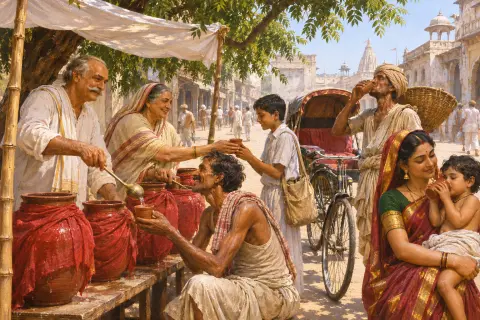
The warkaris walk in groups called dindis. Men often wear white with a Gandhi cap, many women carry a tulsi plant in a brass pot on their heads, and saffron flags fly above them. They sing the abhangas of Dnyaneshwar, Namdev, Tukaram and other saints, play cymbals and drums, and chant "Dnyanba Tukaram" and "Vitthal Vitthal" mile after mile, in sun and rain. Along the way there are ringans, where horses run in circles through the crowd, and villages that feed the pilgrims for free.
The palkhis reach Pandharpur just before Ekadashi. Pilgrims bathe in the Chandrabhaga and stand in queues for many hours for a glimpse of Vitthal, and many simply bow to the temple spire from afar. Before dawn on Ashadhi Ekadashi the Chief Minister of Maharashtra performs the official puja of Vitthal and Rukmini, joined by an ordinary warkari couple chosen from the queue.
One Ekadashi, many names
In Andhra Pradesh and Telangana the day is Tholi Ekadashi, the first Ekadashi, because it is seen as starting the year's cycle of festivals. Families fast, visit Vishnu temples, and eat pelala pindi, a sweet of roasted flour and jaggery. In Odisha it is Harishayan Ekadashi, and in Puri it falls during Rath Yatra: on this day Jagannath and his siblings are dressed in gold on their chariots, the Suna Besha.
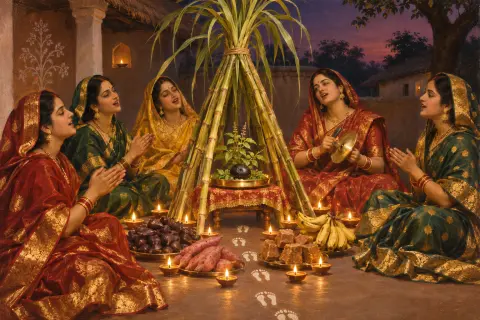
In Gujarat, young girls begin Gauri Vrat on this Ekadashi, a five-day vow in which they fast, sow grains in small pots and pray for a good husband. In Bihar and Uttar Pradesh many families keep the Harishayani fast, and from this day until Dev Uthani Ekadashi they put off weddings, mundan, griha pravesh and other big ceremonies.
ISKCON and other Vaishnava communities around the world keep the day as Shayana Ekadashi, with a full fast, kirtan and reading. Wherever it is kept, the shape is the same: a fast on Ekadashi, worship of Vishnu, and a quieter, more careful way of living for the four months that follow.
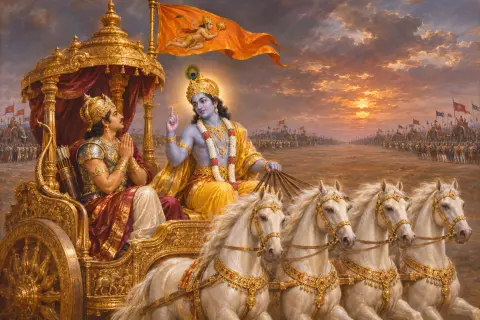
In the Gita (9.14) Krishna describes his devotees: always singing my glory, striving, firm in their vows, bowing to me, they worship me with love, always steady. It reads like a description of the warkaris on the road to Pandharpur, and of every family that keeps the fast. Ashadhi Ekadashi teaches that devotion is not one grand act. It is singing, walking and keeping small promises, day after day, until the Lord who waits on his brick is reached.