The Story
The oldest written accounts of Govardhan Puja are in the Vishnu Purana (book 5, chapters 10 to 12) and the Bhagavata Purana (book 10, chapters 24 to 27). Both tell how Krishna persuaded the cowherds of Vraja to stop their yearly offering to Indra and honour Govardhan hill and their cows instead, and how, when Indra sent a storm in anger, Krishna lifted the hill and kept everyone safe under it for seven days. The day is kept to repeat that first offering to the hill. Here is the story as the Bhagavata tells it.
A sacrifice for Indra
Every year the cowherds of Vraja held a large offering for Indra, king of the gods and lord of rain. One year Krishna, still a boy, saw his father Nanda and the elders busy with the preparations and asked what it was all for. Nanda explained that Indra sends the rain, the rain grows the grass, and the grass feeds the cows. So they thanked Indra with a sacrifice, as their fathers had done.
Krishna questioned this. Each being lives and dies by its own actions, he said. Clouds pour rain because that is their nature. We are cowherds. Our life comes from the cows, the forest and this hill, which gives grass, water and shelter. Why not honour them instead? He suggested they cook the same food, feed the brahmins, the poor and even the dogs, give grass to the cows, and walk around Govardhan in worship.
The elders loved the boy and agreed. The Bhagavata says that as the people made their offerings, Krishna took on a huge form, announced "I am the hill," and ate what they had brought, while also standing among them in his usual form and bowing to the hill with everyone else. This is why the food offered on this day is called Annakut, a mountain of food.
Indra's anger and the storm
Indra heard that his sacrifice had been dropped on the word of a talkative child, and he was furious. He saw it as an insult from people who did not know their place. He called the Samvartaka clouds, the clouds said to be kept for the end of the world, and sent them over Vraja.
Rain came down in sheets, with lightning, hail and a freezing wind. Low land flooded. The cows and calves shivered, and the people, soaked and scared, ran to Krishna with their animals. "Krishna, you alone can protect us from Indra's anger," they said. They did not go back to Indra to apologise. They went to the boy who had changed their worship.
The hill held up for seven days
Krishna understood that Indra was doing this out of wounded pride. He walked to Govardhan, pulled it up from the ground and held it up with one hand. The Bhagavata compares it to a child holding up a mushroom. In the popular telling, and in many paintings, he holds it on the little finger of his left hand.
He called everyone under it: the families, the cows, the carts and all their belongings. For seven days the storm went on, and for seven days Krishna stood in one spot holding the hill, without moving. The people under it forgot their hunger and thirst, and simply watched him.
In the end Indra was stunned. His strongest clouds had done nothing. He called them back, the sky cleared, and the sun came out. Krishna asked everyone to step out with their cattle and belongings, and then set the hill back in its place just as it had been.
Indra asks forgiveness
Later Indra came to Krishna alone, ashamed of what he had done. He bowed and praised him, and admitted that his position had made him proud and that he had forgotten whose power he held. Krishna told him he had stopped the sacrifice on purpose, so that Indra would remember him. People drunk on power, he said, forget that they can fall, and he takes that pride away from those he wants to help. He sent Indra back to his work, this time without the conceit.
Then Surabhi, the mother of cows, came with her family to thank Krishna for protecting the cows. Surabhi bathed him with her milk, and Indra, at the gods' request, bathed him with water from the heavenly Ganga carried by his elephant Airavata. They gave him a new name, Govinda, the protector and lord of the cows. That name is still one of the most loved names of Krishna.
How the day is kept
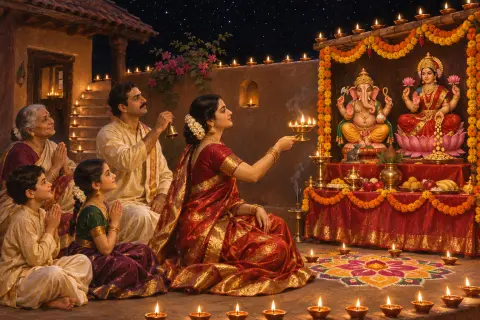
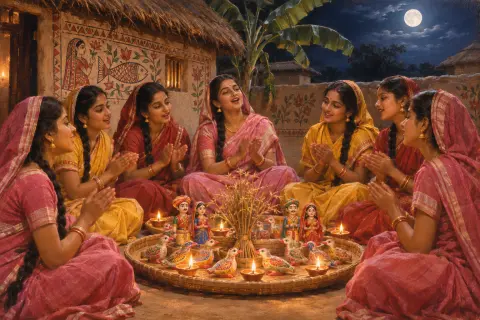
Govardhan Puja keeps the first offering alive. Temples and homes cook a huge number of dishes and stack them into a hill in front of the deity. Many temples make chhappan bhog, fifty six dishes. One popular explanation is that Krishna, who usually ate eight times a day, went seven days without food while holding the hill, so the people made up all fifty six meals at once.
In many villages of Uttar Pradesh, Haryana and Rajasthan, families shape a small Govardhan from cow dung in the courtyard, decorate it with flowers and grass, and walk around it. In Bihar, Jharkhand and eastern Uttar Pradesh the cow dung figure is called Godhan, and its best known rite, Godhan kutai, when sisters pound it with a pestle and pray for their brothers, comes the next morning on Bhai Dooj. Cows are bathed, painted and fed. Near Mathura, pilgrims walk the parikrama of the real Govardhan hill, a path of about twenty one kilometres, some of them bowing full length on the ground the whole way.
The same day is Bali Pratipada or Padwa in Maharashtra and Karnataka, which honours the generous demon king Bali, and it is New Year's Day for many Gujarati families. The names change from region to region, but most of them mark a fresh start the morning after Diwali.
The people of Vraja had no plan when the storm came. They simply went to Krishna, and he carried them. In the Gita (9.22) he makes the same promise in words: to those who turn to him with their whole heart, he brings what they lack and protects what they have. Govardhan Puja asks for two things together: be grateful for the ordinary things that feed you, and let go of the pride that makes you think you are holding up the sky alone.