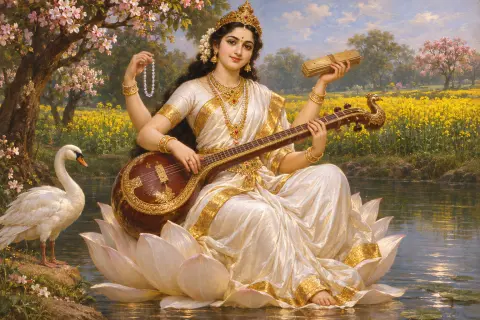
Saraswati is the Hindu goddess of learning, speech, music and the arts. In the Rigveda she is first a great river, praised as the best of mothers, rivers and goddesses, and already linked to inspired thought; the later Vedic texts make her one with Vak, sacred speech. In the Puranas she is the consort of Brahma, the creator, and she is shown in white on a white lotus with a veena, a book and prayer beads, a swan at her side. Students and artists worship her on Vasant Panchami, and in Bengal and Bihar her puja is one of the great festivals of the year.
Also called: Sharada (a name often linked to sharad, autumn), Vagdevi and Vagishvari (goddess of speech), Vani, Bharati, Vidyadayini (giver of learning), Brahmi, Hamsavahini (who rides the swan), Veenapani (with the veena in hand), Pustakadharini (holder of the book), Mahavidya, Shatarupa and Savitri (in some Puranas), Benzaiten (in Japan)
Consort: Brahma, the creator; some Puranas call her his daughter as well, born from his mind
Other accounts: in the Brahma Vaivarta and Devi Bhagavata Puranas she is first one of Vishnu's three wives, with Lakshmi and Ganga, and after a quarrel goes to Brahma
In Bengal: the daughter of Durga, who comes home with her mother at Durga Puja
Mount: the swan (hamsa); sometimes a peacock
Home: Brahmaloka; on earth, the river that bears her name
Also identified with: Vak, sacred speech; Gayatri and Savitri, in some Puranas
maho arṇaḥ sarasvatī pra cetayati ketunā,
dhiyo viśvā vi rājati.
Saraswati, by her light, makes the great flood known; she shines through every thought.
Stories
Saraswati is one of the very few Rigvedic goddesses still worshipped on a large scale. In the Rigveda she is a mighty river and a goddess at the same time, praised in three hymns of her own (6.61, 7.95 and 7.96) and in many verses besides, and already called the one who inspires thought. The Brahmanas identify her again and again with Vak, speech. The Mahabharata describes the holy places along her banks and the spot where the river vanishes into the desert. The Puranas make her Brahma's consort and the goddess of learning, and the Devi Bhagavata Purana gives Vasant Panchami as her day. The stories below follow this path from river to goddess.
The River of the Rigveda
Vedic sages praise Saraswati, river and goddess at once.
For the poets of the Rigveda, Saraswati was a real river, and the greatest they knew. Hymn 7.95 says she alone among rivers flows pure from the mountains to the sea. Hymn 6.61, by the sage Bharadvaja, says she breaks the mountain ridges with her strong waves, like someone digging up lotus roots, and calls her the one with seven sisters. Hymn 2.41 calls her ambitame, naditame, devitame: best of mothers, best of rivers, best of goddesses.
She was also a goddess who gave more than water. The verse at the top of this page, Rigveda 1.3.12, says that she makes the great flood known and shines through every thought. The verses just before it call her the one who inspires true words and wakes good thoughts. From the start, the river of the Vedic land was also the river of inspired speech.
The Manusmriti (2.17) names the land between the Saraswati and the Drishadvati as Brahmavarta, the land made by the gods. The Mahabharata (Shalya Parva) follows Balarama on a pilgrimage to the many holy places on her banks, and says that at Vinashana she disappears into the sand. Many scholars identify her with the Ghaggar-Hakra, a now mostly dry river bed in Haryana, Rajasthan and Pakistan, though this is still debated. Tradition also says she flows unseen underground to join the Ganga and Yamuna at the Triveni Sangam in Prayagraj.
Saraswati Becomes Speech
In the Rigveda, Vak (speech) has her own famous hymn, 10.125, in which she speaks in the first person: I move with the Rudras and the Vasus, I am the queen who gathers treasures, whom I love I make powerful, a sage, a seer. The hymn does not name Saraswati.
The Brahmanas bring the two together. The Shatapatha Brahmana says again and again vag vai sarasvati, Saraswati is speech (for example in 3.9.1.7 and 5.5.4.16). From then on the river goddess is above all the goddess of the word: of the Vedas, of poetry, of grammar and of every kind of learning.
That is why her names are Vagdevi, Vani and Bharati, all meaning speech or eloquence, and why poets, scholars and students call on her before they begin.
Brahma's Companion
In the Puranas, Saraswati becomes Brahma's consort, because creation needs a voice and a mind to shape it. The Matsya Purana (chapter 3) tells that Brahma made a goddess from himself, called Shatarupa, Savitri, Saraswati and Gayatri, and was so taken by her that he grew a face in each direction to keep looking at her. The story makes her both his daughter and his wife, and later tellers were often uneasy with it.
A different story is told in the Brahma Vaivarta Purana (Prakriti Khanda) and the Devi Bhagavata Purana (Book 9). There Saraswati, Lakshmi and Ganga are all wives of Vishnu in Vaikuntha. After a quarrel, they curse each other to become rivers on earth, and Vishnu sends Saraswati to live with Brahma. The tale explains why the goddess of learning is also a river, and why she is Brahma's companion.
A popular story, told widely but not tied to one text, says that when Brahma made the world, it was silent and lifeless. Saraswati appeared, played her veena, and the world found sound, speech and meaning (the Vasant Panchami page tells this).
Vasant Panchami and the First Letters
The Devi Bhagavata Purana (Book 9, chapter 4) says that Krishna was the first to worship Saraswati, and that he told her she would be worshipped everywhere every year on the fifth day of the bright half of Magha, the day when learning is begun. The Brahma Vaivarta Purana tells the same. This is Vasant Panchami, which the calendar also counts as the first day of spring.
On this day many children write their first letters, often om or the alphabet, with an elder guiding their hand. Books, pens and instruments are placed before the goddess and not used until the next day. People wear yellow, the colour of the mustard fields in bloom, and offer yellow sweets.
In Kerala and parts of the south, the same rite of first letters, Vidyarambham, is done on Vijayadashami at the end of Navaratri, after books are placed before Saraswati on Navami.
Saraswati Puja in Bengal and Bihar
In West Bengal, Saraswati Puja is kept in nearly every home with school children, and in every school and college. Students fast in the morning, offer flowers, and leave their books at her feet. Girls wear yellow saris and boys yellow panjabis. A popular rule says not to eat kul (jujube) until it has been offered to Saraswati on this day. Small children have their hate khori, when a priest or elder guides their hand to write their first letters.
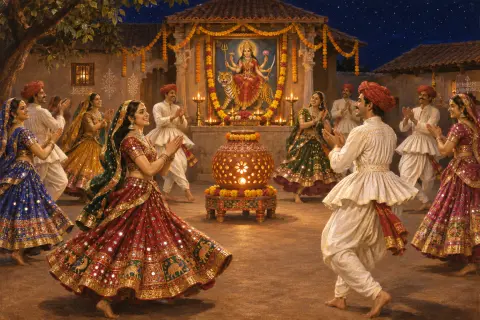
In Bihar and Jharkhand, Saraswati Puja is one of the biggest festivals of the year, and it belongs mostly to students. Weeks before, school and college groups and youth clubs collect money and order a clay image from local artisans. On the day, almost every lane has a pandal with music, flowers, ber, sweet potato and boondi as prasad. The next day the images are carried in processions to a river or pond and immersed.
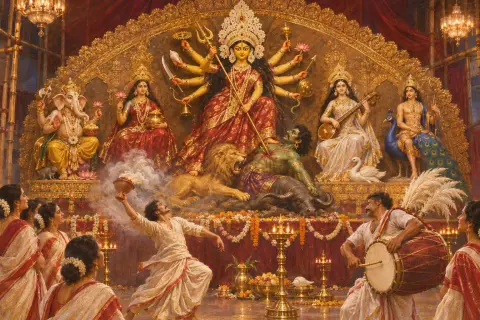
In Bengal she also comes home at Durga Puja as one of Durga's children, standing beside her mother in the pandal with her swan, opposite Lakshmi.
Her Temples, and Saraswati Beyond India
Temples just for Saraswati are few but well loved. At Basar in Telangana, on the Godavari, the Gnana Saraswati temple is a favourite place for a child's first letters. Koothanur in Tamil Nadu has one of the few temples to her in the south, and at Sringeri in Karnataka she is worshipped as Sharadamba in the matha founded in Adi Shankara's tradition. Sharada Peeth, an ancient temple and centre of learning in Kashmir, now stands in ruins across the Line of Control.
Jains also worship Saraswati as the goddess of the teachings, and one of the most beautiful images of her, a white marble Jain Saraswati from Pallu in Rajasthan, is in the National Museum in New Delhi. Buddhists know her too, and she travelled with Buddhism to Japan, where she is Benzaiten, goddess of water, music and eloquence, playing a lute.
How to recognise
•She is white or fair, dressed in a white sari, often with a thin gold border, and wears little jewellery: pearls, white flowers, a small crown. White is the colour of clarity and of the moon, snow and jasmine in the verses sung to her.
•She usually has four arms. Two hands play the veena, the stringed instrument that stands for music and all the arts. The other two hold a book or palm-leaf manuscript, for learning and the Vedas, and a string of beads (akshamala), for steady practice and prayer. Some images give her a water pot instead.
•She sits on a white lotus, often beside flowing water, which recalls her first life as a river.
•Her mount is a white swan (hamsa). Poets say the swan can separate milk from water, and so it stands for the power to tell the true from the false. In some images, especially in Bengal and in Ravi Varma's famous painting, a peacock stands nearby.
•The best known verse sung to her, beginning ya kundendu tushara hara dhavala, describes her as white like the kunda flower, the moon and a garland of snow, dressed in white, her hand on the veena, seated on a white lotus, honoured by Brahma, Vishnu and Shiva.
•In Bengal and Bihar she is made each year as a clay image, seated or standing on a swan, worshipped for a day or two and then immersed in a river or pond.
And I am the all-devouring Death, and the prosperity of those who are to be prosperous; among the feminine qualities (I am) fame, prosperity, speech, memory, intelligence, firmness and forgiveness.
Among feminine qualities, Krishna says, I am fame, fortune, speech (vak), memory, intelligence, steadiness and forgiveness. The Gita does not name Saraswati, but the Brahmanas say again and again that Saraswati is speech, so vak here is her oldest identity.