The Story
The oldest written praise of Saraswati is in the Rigveda (2.41.16), which calls her the best of mothers, the best of rivers and the best of goddesses. The date comes from the Devi Bhagavata Purana (Book 9, chapter 4). There Krishna is the first to worship Saraswati, and he tells her that every year, on the fifth day of the bright half of Magha, the day when learning is begun, she will be worshipped everywhere. The Prakriti Khanda of the Brahma Vaivarta Purana tells the same account. That is why students honour her on this day and why so many children write their first letters on it. The old calendar also counts it as the first day of spring.
Saraswati, river and speech
Saraswati first appears in the Rigveda as a mighty river. One hymn (Rigveda 2.41.16) calls her the best of mothers, the best of rivers and the best of goddesses. Over time she came to be identified with Vak, sacred speech, and so with everything that speech makes possible: learning, poetry, music and clear thought.
In later tradition she is usually shown dressed in white, seated on a white lotus or with a swan beside her, holding a veena, a book and a string of prayer beads. The white stands for purity of mind. The book is knowledge, the veena is the arts, and the beads are steady practice. She is honoured as the companion of Brahma, the creator, because creation needs a voice and a mind to shape it.
Why this day
A widely told story says that after Brahma made the world, it was silent and lifeless. Saraswati appeared and played her veena, and the world found sound, speech and meaning. This story is very popular, but its details differ from telling to telling and it is not tied to one fixed text.
The Devi Bhagavata Purana (Book 9, chapter 4) gives the reason for the date. It says that Krishna himself was the first to worship Saraswati, and that he blessed her that every year, on Magha Shukla Panchami, the day when learning is begun, everyone would worship her. So the day is both her festival and, for students, a day of starting fresh.
Vasant Panchami is also the first day of spring in the old reckoning. In classical poetry Vasanta, the spring, is the friend of Kamadeva, the god of love, and some traditions remember Kama and his wife Rati on this day too. In Braj and much of Bihar, people throw the first abir and gulal of the year and start singing Holi songs, because the Holi season is said to begin here.
Saraswati Puja in Bihar and Jharkhand
In Bihar, Saraswati Puja is one of the biggest festivals of the year, and it belongs mainly to students. Weeks before, groups of school and college students, youth clubs and hostel residents collect contributions from the neighbourhood and order a clay image of the goddess from local artisans. On the day, almost every mohalla, school, college and coaching centre in towns like Patna, Gaya, Bhagalpur and Muzaffarpur has its own pandal, with lights, music and a crowd of young people looking after it.
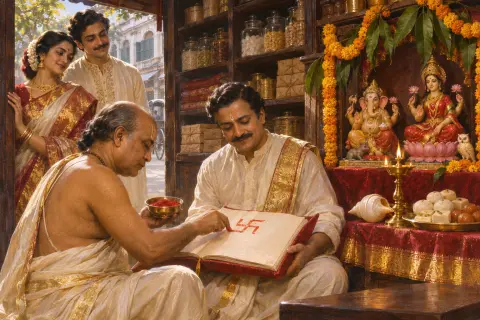
Students place their books, notebooks and pens before the goddess and, by custom, do not study that day. After the puja everyone receives prasad, usually ber (Indian jujube), sliced carrot, sweet potato and boondi. Then the next day, or a day or two later, the images are carried in processions with drums and dancing to a river or pond for immersion. Many towns now set up special ponds for this so the rivers stay cleaner.
Jharkhand keeps the festival in much the same way, with pandals in Ranchi, Dhanbad, Jamshedpur and the smaller towns. In Mithila there is one more custom: devotees travel to Baba Baidyanath Dham in Deoghar to offer tilak to Shiva on Vasant Panchami, the rite by which a bride's family confirms a marriage, ahead of his wedding to Parvati which is celebrated on Maha Shivaratri.
Bengal, Odisha and the east
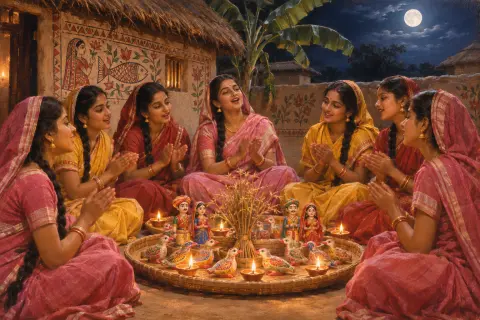
In West Bengal, Saraswati Puja is kept in nearly every home with school children, and in every school and college. Students fast in the morning, offer flowers in pushpanjali, and leave their books before the goddess. Young girls wear yellow saris and boys yellow panjabis. A popular rule says not to eat kul (jujube) until it has been offered to Saraswati on this day. Small children have their hate khori, where a priest or elder guides their hand to write their first letters.
In Odisha the same first writing is called khadi chuan, done with a piece of chalk on a slate, and schools hold their own Saraswati Puja. Tripura and Assam also keep Saraswati Puja in schools and homes. In Nepal the day is Shree Panchami, a national holiday, and children often begin their schooling then.
Basant in the north
In Punjab and Haryana the day is often called Basant. People wear yellow, cook yellow rice with saffron or turmeric, and fly kites from the rooftops. Across north India many families also treat Vasant Panchami as a naturally auspicious day for new starts, such as a child's first lesson, a housewarming or a wedding, without looking for a separate muhurat.
The forms change from region to region: a quiet prayer at home, a school function, a loud neighbourhood pandal, a sky full of kites. What connects them is respect for learning and a sense that the hard part of winter is over.
On Saraswati Puja students put their books at the goddess's feet and do not open them for a day. It is a way of saying that knowledge is not just a tool for passing exams. It is something sacred that you receive. In the Gita (4.38) Krishna says that nothing in this world purifies like knowledge, and that a person who keeps up steady practice finds it within, in time. Vasant Panchami asks for both halves of that verse: honour learning, and be patient with it, the way spring arrives slowly and then all at once.