Arjuna is the third of the five Pandava brothers in the Mahabharata, the son of Kunti and Pandu, born by the blessing of Indra, king of the gods. He is the greatest archer of the epic, the wielder of the bow Gandiva, the husband who won Draupadi, and the close friend of Krishna, who drives his chariot at Kurukshetra. The Bhagavad Gita is a conversation between the two of them: it begins with Arjuna refusing to fight and ends with him ready to act. He is remembered on Gita Jayanti, on Dussehra through the shami tree that hid his bow, and wherever the Gita is read.
Also called: Partha (son of Pritha, that is Kunti), Kaunteya (son of Kunti), Dhananjaya (winner of wealth), Gudakesha (master of sleep), Savyasachi (who draws the bow with either hand), Kiritin (the crowned), Shvetavahana (whose horses are white), Bibhatsu (who never fights in an ugly way), Vijaya (the victorious), Phalguna (born under the Phalguni stars), Jishnu (the unconquerable), Kapidhvaja (whose banner bears the monkey), Brihannala (his name in disguise at Virata's court)
Mother: Kunti (Pritha); father: King Pandu; divine father: Indra
Brothers: Yudhishthira and Bhima, sons of Kunti; Nakula and Sahadeva, sons of Madri; Karna, Kunti's first son, whom he learned was his brother only after Karna's death
Wives: Draupadi, shared with his brothers; Ulupi, a naga princess; Chitrangada, princess of Manipura; Subhadra, Krishna's sister
Sons: Shrutakirti (also called Shrutakarman) with Draupadi, Iravan with Ulupi, Babhruvahana with Chitrangada, Abhimanyu with Subhadra
Grandson: Parikshit, Abhimanyu's son, who became king after the Pandavas
Teacher: Drona; friend, cousin and charioteer: Krishna
Bow: Gandiva; conch: Devadatta (Gita 1.15); banner: the monkey
Almost everything we know about Arjuna comes from the Mahabharata, the epic traditionally credited to Vyasa. Its first book, the Adi Parva, tells of his birth, his training and his marriages; the Vana Parva follows him to the Himalayas for divine weapons; the Virata Parva shows him in disguise; and the Bhishma Parva holds the Bhagavad Gita, where Krishna teaches him on the battlefield. The section numbers below follow K. M. Ganguli's English translation, which follows the commonly read Sanskrit text, unless the Critical Edition prepared at Pune is named. Later works, like the Bhagavata Purana and regional retellings, add more stories, but the Arjuna people know best is the one in the epic: brilliant, proud, deeply loyal, and for one morning at Kurukshetra, completely lost.
The son Indra promised
King Pandu had been cursed never to touch his wives. Kunti told him of a mantra the sage Durvasa had once given her, with which she could call any god to give her a child. After Yudhishthira, the son of Dharma, and Bhima, the son of the wind god, Pandu wanted a son who would be greater than all. He stood on one leg doing austerities for a long time, and Indra, pleased, promised him such a son (Adi Parva, section 123).
Kunti called Indra, and Arjuna was born. At once a voice from the sky spoke to her so that everyone in the forest hermitage could hear: this child would be equal to Kartavirya in energy and to Shiva in prowess, would bring her great joy, would feed the fire god with the Khandava forest and would win divine weapons. Later, in the Virata Parva, Arjuna says his father named him Krishna, the dark one, out of love for his dark-skinned boy.
Drona's best student
The Kuru princes learned archery from Drona. To test them, Drona had a toy vulture placed on a tree top and asked each prince in turn to aim at it. Before letting them shoot, he asked: what do you see? Yudhishthira said he saw the tree, the bird, his teacher and his brothers. Drona sent him aside, and so with the others (Adi Parva, sections 134 and 135).
Then he called Arjuna. Arjuna said he saw only the bird. Describe it, said Drona. I see only its head, Arjuna answered. Drona told him to shoot, and the arrow took the head off cleanly. Soon after, when a crocodile seized Drona's leg in the Ganga, Arjuna struck it with five arrows while the others stood frozen. Drona then gave him the Brahmashira weapon, warning him never to use it against a human enemy.
This is the root of the well known saying about Arjuna's focus. The epic does not hide the harder side of the same story: Drona promised that no student would ever equal Arjuna, and when he met the tribal boy Ekalavya, who had taught himself to shoot as well, he asked for Ekalavya's right thumb as his fee.
Winning Draupadi
While the Pandavas were hiding after escaping the house of lac, they lived as poor Brahmins. King Drupada of Panchala, who secretly hoped to give his daughter to Arjuna, had a very stiff bow made and set a target high above a machine. Whoever strung the bow and shot the target would marry Draupadi (Adi Parva, section 187). The popular picture of a turning fish whose eye must be hit by looking at its reflection in water comes from later retellings.
King after king failed even to string the bow. Then a young man rose from among the Brahmins. Some Brahmins worried he would make them a laughing stock; others said he looked strong enough. Arjuna strung the bow in a moment and brought the target down (section 190). Draupadi placed the garland on him.
When the brothers came home and called out that they had brought alms, Kunti, without looking, told them to share it among themselves (section 193). That is how, after Vyasa explained to Drupada that it was ordained, Draupadi became the wife of all five brothers.
The hunter on the mountain
Arjuna faces Shiva, disguised as a mountain hunter.
During the forest exile, on Vyasa's advice that the Pandavas would need divine weapons, Arjuna went alone to the Himalayas and did hard penance to please Shiva. One day a demon named Muka came at him in the form of a boar. As Arjuna shot it, a hunter, a Kirata, shot it at the same moment. It was Shiva in disguise, with Parvati beside him dressed as a hunter woman (Vana Parva, section 39).
Arjuna, angry, said the hunter had broken the rules of the chase. They fought. Arjuna's arrows did nothing, his inexhaustible quivers ran empty, the hunter took his bow, and when they wrestled Arjuna was crushed and fell senseless. When he came round he made a clay image of Shiva, offered it a garland, and saw the garland on the hunter's head. Then he knew who it was, and fell at his feet.
Shiva, pleased, told him he had been the sage Nara in an earlier life, the companion of Narayana, gave back Gandiva, and granted him the Pashupata weapon (section 40). The other guardian gods then gave him their own weapons, and Indra took him to heaven, where he stayed five years learning weapons, music and dance. There, the Vana Parva says (section 46), he refused the apsara Urvashi, honouring her as an ancestor of his line, and she cursed him to live as a dancer among women. Indra reduced it to one year, the very year the Pandavas would have to spend in disguise.
The morning he could not fight
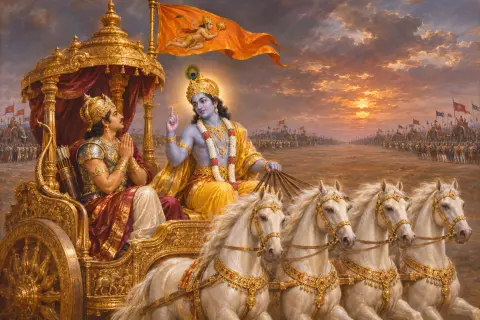
On the first morning of the war at Kurukshetra, Arjuna asked Krishna to drive his chariot between the two armies so he could see whom he had to fight. He saw grandfathers, teachers, uncles, brothers, sons and friends. His limbs gave way, his mouth went dry, Gandiva slipped from his hand, and he sat down in the chariot and said he would not fight (Gita 1.21 to 1.47, 2.9).
What follows is the Bhagavad Gita, chapters 25 to 42 of the Bhishma Parva in the common text. Arjuna asks Krishna to teach him as a student (2.7). Krishna speaks of the self that is never born and never dies, of action without attachment to its fruit, of the steady mind, of devotion, and shows him the universal form (chapter 11). Arjuna is terrified and asks to see his friend's gentle face again.
At the end Krishna asks whether his confusion is gone. Arjuna answers (18.73): my delusion is destroyed, I have got back my memory by your grace, I stand firm, free of doubt, and I will do as you say. Then he picks up his bow.
After the war
Arjuna won the war's great duels. He brought Bhishma down from behind Shikhandi, and on the tenth day, when Bhishma lay on his bed of arrows asking for a pillow, Arjuna made him one out of three arrows (Bhishma Parva, section 122). Later he killed Karna, not knowing that Karna was his eldest brother. The victory brought little joy: his son Abhimanyu and all of Draupadi's sons were dead.
Years later, after Krishna's death, Arjuna led the women and children of the Yadavas away from Dwaraka. On the way, cowherd robbers attacked. He could barely string Gandiva, his divine weapons would not come to mind, and many of the women were carried off (Mausala Parva, section 7). Vyasa told him gently that his weapons had done their work and gone back where they came from: everything rises and falls with time (section 8).
The Pandavas then set out on their last journey to the Himalayas. Arjuna fell on the way. Yudhishthira said it was because he had boasted he would destroy all their enemies in one day and looked down on other archers (Mahaprasthanika Parva, section 2). Even the greatest archer, the epic seems to say, is human to the end.
How to recognise
•A young warrior prince with a crown (kirita) and earrings, often in armour. Kiritin, the crowned one, is one of his ten names; in the Virata Parva he says Indra placed the crown on his head when he fought the demons for the gods.
•The bow Gandiva in his hand and a quiver on his back. The Adi Parva says Varuna gave him Gandiva and two quivers that never empty, at Agni's request, before the burning of the Khandava forest.
•Seated in a chariot drawn by white horses with Krishna as charioteer, the scene printed on countless Gita covers. The Gita itself (1.14) says the chariot was yoked with white horses.
•A flag with a monkey flying over the chariot. The Gita (1.20) calls him kapidhvaja, the one with the monkey banner, and the Mahabharata says Hanuman promised Bhima to sit on that flag.
•Kneeling or sitting with folded hands, his bow laid down, while Krishna teaches him. This is the Arjuna of Gita 2.7, who says: I am your student, teach me.
•Sometimes shown with long braided hair and bangles as Brihannala, the dance teacher he became in the year of hiding at Virata's court.
Then, seeing the people of Dhritarashtra’s party standing arrayed and the discharge of weapons about to begin, Arjuna, the son of Pandu, whose ensign was a monkey, took up his bow and said the following to Krishna, O Lord of the earth.
Sanjaya first shows Arjuna as kapidhvaja, the Pandava with the monkey banner, lifting his bow as the weapons are about to fly.
Sanjaya said: Having thus spoken in the midst of the battlefield, Arjuna, casting away his bow and arrow, sat down on the seat of the chariot with his mind overwhelmed with sorrow.
The first chapter ends with Arjuna throwing down his bow and arrows and sitting down in the chariot, overwhelmed with grief.
My heart is overpowered by the taint of pity; my mind is confused as to duty. I ask Thee: Tell me decisively what is good for me. I am Thy disciple. Instruct me who has taken refuge in Thee.
The turning point of the Gita. Arjuna admits he does not know what is right and says: I am your student, teach me, I have come to you for refuge.
Therefore, stand up and obtain fame. Coner the enemies and enjoy the unrivalled kingdom. Verily by Me have they been already slain; be thou a mere instrument, O Arjuna.
After the universal form, Krishna calls him savyasachin, the one who draws the bow with either hand, and tells him to be only the instrument.
Arjuna said: Destroyed is my delusion as I have gained my knowledge (memory) through Thy grace, O Krishna. I remain freed from doubts. I will act according to Thy word.
Arjuna's last words in the Gita: his delusion is gone, his memory restored, and he will do as Krishna says.
Wherever is Krishna, the Lord of Yoga; wherever is Arjuna, the wielder of the bow; there are prosperity, victory, happiness and firm policy; such is my conviction.
The Gita's final verse. Sanjaya says that wherever Krishna and Partha the archer are, there is fortune, victory and right conduct.