Kali is the dark goddess of Hinduism, the fierce form of the Great Mother who destroys evil and, for her devotees, also takes away fear. In the Devi Mahatmya (Markandeya Purana) she springs from the brow of the goddess Ambika, kills the demons Chanda and Munda, and drinks the blood of Raktabija. Tantric tradition counts her first of the ten Mahavidyas. In Bengal she is Shyama Ma, worshipped on the new moon night of Diwali, at Kalighat and Dakshineswar, and in the songs of Ramprasad Sen and the life of Sri Ramakrishna.
Also called: Mahakali (great Kali), Kalika, Shyama (the dark one), Chamunda (slayer of Chanda and Munda), Bhadrakali (the gracious Kali), Dakshina Kali, Bhavatarini (who carries across the sea of worldly life), Adya Shakti (the first power), Shmashan Kali (Kali of the cremation ground), Kali Ma
Origin: born from the brow of Ambika in the Devi Mahatmya (chapter 7); in the Linga Purana (Book 1, chapter 106) from Shiva's third eye, with Parvati's power
Seen as: a form of Durga, Parvati or Sati, the same Great Mother in her fierce form
Consort: Shiva, often called Mahakala in her worship
Companions in battle: the seven Matrikas and Shivaduti (Devi Mahatmya, chapter 8)
Place among the Mahavidyas: first of the ten, followed by Tara
Mount: usually none; she stands on Shiva
Home: the cremation ground in Tantric hymns; in Bengal, her temples at Kalighat, Dakshineswar and Tarapith
यस्माच्चण्डं च मुण्डं च गृहीत्वा त्वमुपागता ।
चामुण्डेति ततो लोके ख्याता देवि भविष्यसि ॥
yasmāc caṇḍaṃ ca muṇḍaṃ ca gṛhītvā tvam upāgatā,
cāmuṇḍeti tato loke khyātā devi bhaviṣyasi.
Because you have come to me bringing Chanda and Munda, O goddess, you will be known in the world as Chamunda.
Stories
The name Kali is old. The Mundaka Upanishad (1.2.4) lists Kali, "the black", as the first of the seven flickering tongues of the sacred fire, and the Mahabharata's Sauptika Parva speaks of Kalaratri, the dark night of death. Her great story comes in the Devi Mahatmya (chapters 7 and 8), where she is the goddess's own anger given a body. The Linga Purana (Book 1, chapter 106) has Shiva create her to kill the demon Daruka, the story Kerala tells of Bhadrakali. Later Shakta and Tantric texts, such as the Mahabhagavata Purana, make her the first of the ten Mahavidyas and the highest form of the goddess. From the sixteenth century, Bengal shaped the Dakshina Kali worshipped today, and its poets and saints turned the fearsome goddess into the mother they called Ma.
Born From the Goddess's Anger
In the Devi Mahatmya (chapter 7), the demon kings Shumbha and Nishumbha sent their generals Chanda and Munda with an army to seize the goddess Ambika, who sat smiling on her lion on a golden peak of the Himalaya. When they rushed at her with bows and swords drawn, her face darkened with anger until it was as black as ink.
From her frowning brow came Kali: gaunt, with a gaping mouth and lolling tongue, red sunken eyes, a garland of heads, a tiger skin, a sword and a noose in her hands. She roared, threw herself on the army and swallowed elephants, chariots and soldiers whole. Then she caught Chanda by the hair and beheaded him, and struck down Munda too.
She brought the two heads to Ambika and offered them to her. Ambika said: because you have brought Chanda and Munda, you will be known in the world as Chamunda. The shloka at the top of this page is that verse. Durga Puja's Sandhi Puja, at the moment between Ashtami and Navami, remembers this victory.
Raktabija, the Demon Who Multiplied
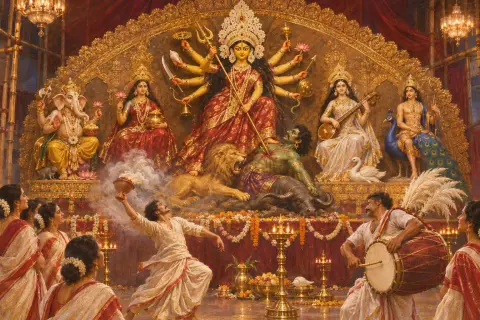
In chapter 8 the gods sent their own powers to help the goddess: Brahmani on her swan, Maheshvari on a bull, Kaumari on a peacock, Vaishnavi on Garuda, Varahi, Narasimhi and Aindri with Indra's thunderbolt. These are the seven Matrikas, the mothers. Shumbha sent the demon Raktabija against them.
Every drop of Raktabija's blood that touched the ground rose up as another Raktabija, as big and strong as the first. The more the goddesses wounded him, the more of him there were, until the world was full of him. The gods despaired.
Then Chandika laughed and told Kali to open her mouth wide and drink every drop before it fell. Kali roamed the battlefield doing just that, swallowing the new demons as they appeared, while Chandika struck. With no blood left to fall, Raktabija weakened and died. Many teachers read the story as a picture of the mind: anger and craving breed more of themselves when fought in the usual way, and end only when something takes them in completely.
Daruka and the Crying Child
The Linga Purana (Book 1, chapter 106) tells another story. A demon named Daruka, made strong by his penance, was killing gods and Brahmins, and only a woman could kill him. Parvati entered Shiva's body and shaped herself from the poison held in his throat. Shiva then opened his third eye, and Kali came out, blue-throated and with matted hair, and destroyed Daruka.
Her fury did not stop, and the worlds burned with it. To calm her, the Purana says, Shiva took the form of a baby and lay crying in the cremation ground. Kali picked him up, held him to her breast and fed him, and as he drank, he drank in her anger too. Then Shiva danced the Tandava with his ghosts at dusk, and Kali and the Yoginis danced with him in joy.
In Kerala this goddess is Bhadrakali, and the fight with Darika is the heart of her temple festivals. In Mudiyettu, a ritual dance drama of central Kerala, performers in huge painted headdresses act out the battle through the night.
First of the Ten Mahavidyas
The Mahabhagavata Purana (chapter 8), a late Shakta text from eastern India, tells how Sati wished to go to her father Daksha's sacrifice, though she had not been invited. Shiva forbade her. Sati grew angry and took on ten fearsome forms, one in each of the ten directions, so that wherever Shiva turned, a goddess stood in his way.
The first and foremost of them was Kali. The others were Tara, Tripura Sundari, Bhuvaneshvari, Chinnamasta, Bhairavi, Dhumavati, Bagalamukhi, Matangi and Kamala. Shiva asked who they were, Sati explained that they were all herself, and he let her go.
These ten are the Mahavidyas, the great wisdom goddesses of Tantric worship. Kali stands first among them because, in this tradition, she is the goddess in her most complete form, beyond time and beyond every other form.
Why She Stands on Shiva
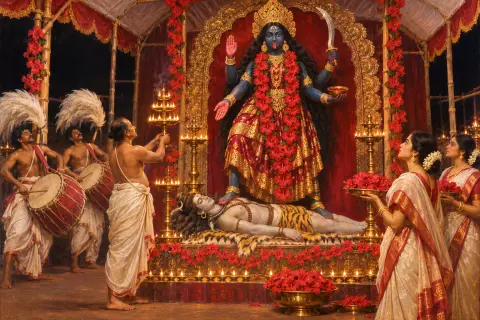
The best known picture of Kali in Bengal shows her standing on Shiva, who lies calmly beneath her, her tongue between her teeth. The Devi Mahatmya does not have this scene. It comes from later Bengali and Tantric tradition, and it is explained in two ways.
A popular folk telling says that after killing the demons, Kali danced in victory so wildly that the worlds began to shake. Shiva lay down in her path. When she stepped on him and saw who it was, she bit her tongue in surprise and shame, and her fury ended. This is folk storytelling, not scripture.
Tantric teachers read it differently. Shiva is pure consciousness, still and silent, and Kali is the power that moves the world. Without her he lies like a body without life; with her, everything acts and lives. The image shows the two as one reality, not a goddess trampling a god.
Ma of Dakshineswar
Sri Ramakrishna offers a hibiscus to Kali at Dakshineswar.
In eighteenth century Bengal the poet Ramprasad Sen of Halisahar sang to Kali as his own mother: he scolded her, pleaded with her, joked with her, and asked why she, the black one, made the world so bright. His songs, Shyama Sangeet, are still sung through the night of Kali Puja. Around the same time, King Krishnachandra of Nadia is credited with spreading the public Kali Puja of the Diwali new moon.
In 1855 Rani Rashmoni, a widow of Kolkata, opened a temple to Kali as Bhavatarini at Dakshineswar on the Ganga. Its young priest, Gadadhar Chattopadhyay, later known as Sri Ramakrishna, could not bear to treat the image as stone. He wept for days for the Mother to show herself. By his own later account, as told by his disciples, he was at last ready to end his life with the sword hanging in the shrine when the temple, the doors and everything around him vanished, and he saw a boundless shining ocean of consciousness, with the Mother present in it.
From then on he spoke to Kali as a child speaks to his mother, and his disciples, among them Swami Vivekananda, carried that devotion far beyond Bengal. For many people today, Kali is not a figure of terror but Ma: fierce towards what harms her children, and tender to the children themselves.
How to recognise
•Dark skin, black or deep blue. The Devi Mahatmya says Ambika's face turned "dark as ink" with anger before Kali came out of it. Her name means "the black one", and it is also the feminine of kala, time.
•In Bengal's Dakshina Kali she has four arms: a sword and a severed head in her left hands, and the gestures of fearlessness and blessing in her right. She takes life with one side and gives safety with the other. Many temple and pandal images replace the head with a small bowl.
•A garland of human heads and a skirt of severed arms in the old descriptions; the Devi Mahatmya (7.6) gives her a garland of heads, a skull-topped staff (khatvanga) and a tiger skin. Today she is usually also garlanded with red hibiscus (jaba), her favourite flower.
•Three eyes, loose hair falling to her feet, and a red tongue between her teeth. In the Devi Mahatmya the open mouth and tongue belong to the battle with Raktabija, when she drinks his blood.
•She stands with one foot on Shiva, who lies calm and white beneath her. This image is not in the Devi Mahatmya; it comes from later Bengali and Tantric tradition, and the two common explanations are told below.
•Bhadrakali of Kerala, the slayer of the demon Darika, is shown with many arms, a tall crown and a fierce but royal face, and is honoured in temple rituals such as Mudiyettu, which UNESCO listed in 2010.
The Blessed Lord said: I am the full-grown world-destroying Time, now engaged in destroying the worlds. Even without thee, none of the warriors arrayed in the hostile armies shall live.
Showing Arjuna his cosmic form, Krishna says, "I am Time (kala), grown mighty, the destroyer of the worlds." The Gita does not mention Kali, but her name is the feminine of kala, and later Tantric texts such as the Mahanirvana Tantra explain Kali as the power that swallows even Time. The link is drawn by that later tradition.
Among the letters of the alphabets, the letter 'A' I am and the dual among the compounds. I am verily the inexhaustible or everlasting time; I am the dispenser (of the fruits of actions) having faces in all directions.
"I am imperishable Time." Krishna names time among his own forms. Devotees who see Kali as Time itself read her in verses like this one, though the verse does not name her.