The Story
The oldest written instructions for this day are in the Padma Purana (Uttara Khanda, chapter 122). It says that on the fourteenth day of the dark half of Kartika a person should bathe before sunrise, turn a sprig of the apamarga plant over the head while saying the verse above, and give a lamp to Naraka, and that whoever bathes this way does not see the world of Yama. The story people tell on this day is older still: the Bhagavata Purana (Book 10, chapter 59) tells how Krishna, with his wife Satyabhama, killed the demon king Naraka and freed the people he held captive. The Bhagavata does not give a date for the battle. Linking that victory to this morning is later tradition, and it is why the day carries Naraka's name.
Naraka, Son of the Earth
In the Bhagavata Purana, Naraka is called Bhauma, the son of Bhumi, the Earth goddess. He ruled from Pragjyotishapura, a city that tradition places in present day Assam, and he grew so strong that even the gods could not stand against him.
He took the earrings of Aditi, the mother of the gods, the royal umbrella of Varuna, and a peak of the gods called Maniparvata. He also captured thousands of princesses from many kingdoms and kept them shut away in his palace. Indra, unable to fight him, went to Dwarka and asked Krishna for help.
His city was hard to reach. The Bhagavata describes walls of hills, rings of weapons, water, fire and wind, and the nooses of Naraka's general Mura laid all around it. Getting in was the first battle.
Krishna and Satyabhama Ride Out
Krishna mounted Garuda and took Satyabhama with him. With his mace he broke the hill walls, with his arrows he cut through the weapons, with his discus he passed the rings of fire, water and wind, with his sword he cut Mura's nooses, and the blast of his conch shook the hearts of the defenders. When Mura rose from the water to stop him, Krishna killed him, which is why Krishna is also called Murari, the enemy of Mura.
Then Naraka came out himself on an elephant. The fight was long, and at the end Krishna cut off Naraka's head with the Sudarshana discus. Bhumi, Naraka's mother, came forward with Aditi's earrings and Varuna's umbrella, praised Krishna and asked him to protect Naraka's young son Bhagadatta. Krishna gave the boy his protection and his kingdom.
In the palace Krishna found sixteen thousand princesses. The Bhagavata says that when they saw him, each one chose him in her heart as her husband. Krishna sent them to Dwarka and later married them all, giving them homes and honour. Later tellings add that their families would not have taken them back, which is why this mattered so much. Many people see this, more than the battle, as the real victory of the story: people who had been shut away were brought back into the light.
Why Satyabhama Matters
In the Bhagavata, Satyabhama rides beside Krishna and sees the battle. In tellings that are popular in Andhra Pradesh, Telangana and Karnataka she does more. Naraka had a boon that only his mother could kill him. Satyabhama is said to be a form of Bhumi, so when Krishna falls back wounded or pretends to faint, she takes the bow and shoots Naraka herself.
These are regional tellings, not the Bhagavata's own account, and families keep both. In many southern homes the image of Satyabhama with a bow is part of the day, and plays and Harikatha performances often tell it her way.
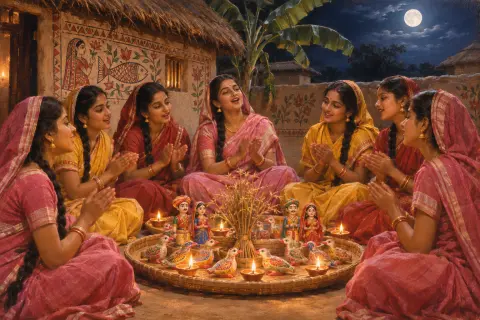
A widely told detail is that Naraka, dying, asked that the day of his death be remembered not with grief but with lamps and happiness. That request is folk tradition rather than Purana, but it explains the mood of the day: the end of a cruel king is marked with light, new clothes and sweets.
Deepavali in the South, Choti Diwali in the North
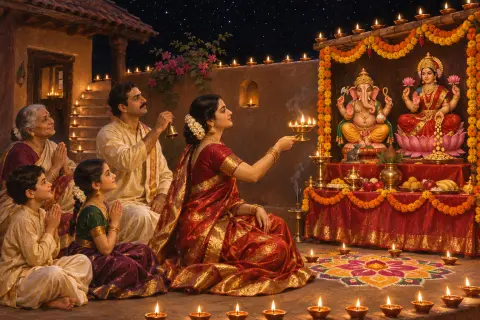
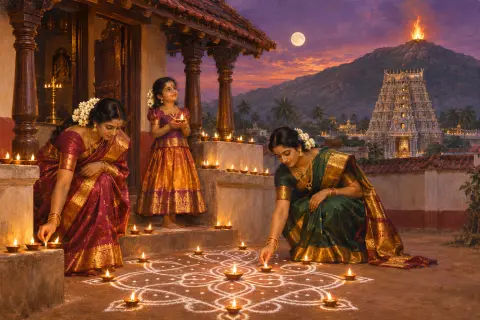
In Tamil Nadu, Karnataka, Andhra Pradesh, Telangana, Kerala and Goa, this morning is the main Deepavali. Families wake in the dark, an elder puts warm sesame oil on everyone's head, and everyone bathes before sunrise. In Tamil homes the bath is called Ganga snanam, and people greet each other with 'Ganga snanam aacha?', 'Have you had your Ganga bath?' New clothes, a spoon of Deepavali marundhu (a ginger and herb paste for digestion), sweets and crackers follow. Newly married couples spend their first Deepavali, the Thalai Deepavali, at the bride's home.
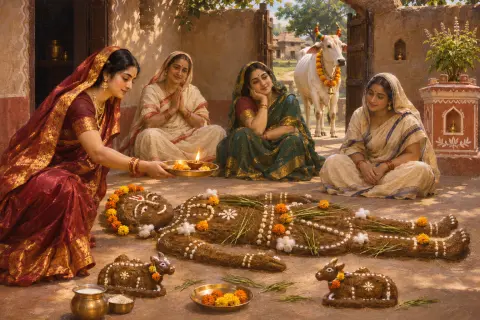
In Goa, young people build large Narakasura effigies for weeks, parade them through the streets at night and burn them before dawn. After the bath families eat many kinds of poha. In Maharashtra and Goa, after the abhyanga snan with ubtan, many people crush a small bitter fruit called karit under the foot, as a sign of Naraka being crushed.
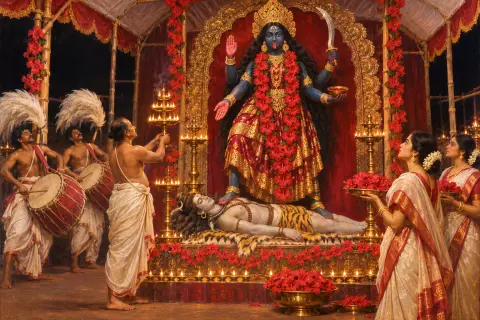
In north India the day is Choti Diwali, the small Diwali before the big night. In Rajasthan and Gujarat it is also Roop Chaudas, when people use ubtan of gram flour and turmeric to look their best. In Gujarat it is Kali Chaudas, when many families pray to Kali or Hanuman for protection. In Bengal the night is Bhoot Chaturdashi, when families eat fourteen kinds of greens and light fourteen lamps for their ancestors. In some north Indian traditions, including temples in Ayodhya, Hanuman Jayanti is kept on this day too.
The Lamp for Yama in Bihar and Uttar Pradesh
In Bihar, across Bhojpur, Magadh, Mithila and Anga, and in eastern Uttar Pradesh, the evening of Choti Diwali has its own small ritual: the Yam ka diya or Jam ke diya. An elder of the house lights a clay lamp with four wicks, often using old mustard oil, and sets it outside the house facing south, the direction of Yama, frequently near the drain or the rubbish heap. The family prays that no one in the house meets an untimely death, and many do not go back to look at the lamp once it is placed.
This matches the Padma Purana's instruction to give a lamp to Naraka on this day, and puja manuals give a verse for a lamp 'with four wicks' offered for the removal of all sins. Some families light the Yama lamp on Dhanteras instead, a day earlier. Both customs are old, and families follow what their elders did.
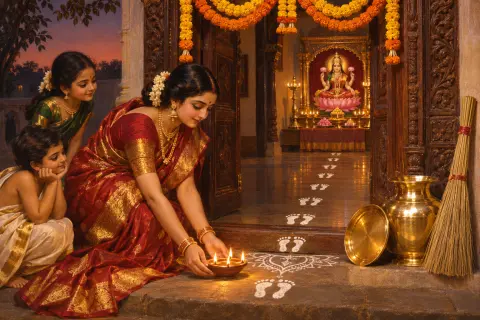
Choti Diwali in Bihar is also the last big cleaning day. Corners are swept, old and broken things are thrown out, and the house is made ready for Lakshmi. The cleaning leads into the daliddar custom: before dawn after the Diwali night, women go through the house beating an old soop (winnowing fan) with a stick, calling for good fortune to come in and daliddar, poverty and bad luck, to go out, and then carry the soop out beyond the house.
Naraka held what was not his and kept people locked away in the dark. Gita 5.16 says that for those whose ignorance is destroyed by knowledge, that knowledge shines like the sun. The oil bath in the dark, the lamp for Yama at the door and the cleaning of every corner all ask the same thing: before the big night of lights, clear out what keeps you in the dark, and let the light reach the places you usually leave closed.