The Story
Bonalu has no Purana story of its own. The goddess at its centre, Mahakali, is the fierce mother of the Devi Mahatmya (Markandeya Purana, chapters 81 to 93), who takes form to destroy demons and promises to protect the world whenever it calls on her. The festival itself comes from Telangana's folk worship of grama devatas, the village mother goddesses, carried down in families and temples rather than in books. People keep it to thank the goddess for protecting them through the monsoon, when disease used to spread, and to keep vows made in hard times. Its best known temple story, at the Ujjaini Mahankali temple in Secunderabad, goes back to the early nineteenth century.
The Mother who protects the village
Long before big temples, every Telangana village had its own goddess: Pochamma, Maisamma, Peddamma, Yellamma, Poleramma and many more. She lives at the edge of the village and guards it from disease, drought and harm. People see her as a fierce and loving mother at the same time, and they bring her their fears and their thanks.
Ashada falls at the start of the monsoon. In older times this was the season when fevers and epidemics spread. Bonalu grew out of this worry. Families offered the goddess a meal and asked her to keep their children and animals safe through the rains. Many people still say they carry a bonam to fulfil a vow made in a hard time.
In the cities this village goddess is worshipped above all as Mahakali, the fierce form of the Mother described in the Devi Mahatmya, who destroys demons to protect the world. In Hyderabad and Secunderabad, Bonalu is above all a festival of Mahakali.
A daughter visiting home
A popular belief says that in Ashada the goddess goes back to her parents' home, just as many newly married women in Telangana spend this month with their own families. So devotees welcome her the way a family welcomes a daughter who has come home: with good food, new clothes and attention.
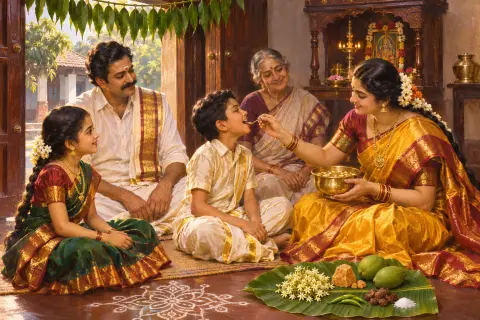
This is why the bonam is cooked at home, in the family's own kitchen, and carried by the women of the house. It is not bought or ordered. It is the same kind of meal a mother would make for her child, offered back to the Mother of everyone.
Golconda, Secunderabad and the Old City
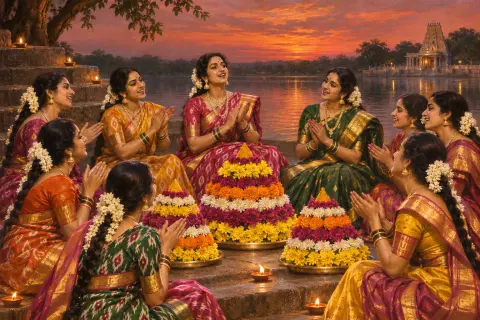
The season opens at the Jagadamba Mahankali temple inside Golconda Fort. Processions climb the fort with bonalu and tottelu, small colourful towers of paper and bamboo, and the state government offers silk clothes to the goddess. Puja continues at Golconda on Thursdays and Sundays through the month.
The biggest single day is usually Lashkar Bonalu at the Ujjaini Mahankali temple in Secunderabad. The temple's own tradition says that in the early nineteenth century, when cholera struck the city, a man from Secunderabad named Suriti Appaiah was posted with an army unit in Ujjain. He prayed to Mahakali at Ujjain and promised to set up her image at home if the people were spared. When he returned he kept that promise, and the goddess has been called Ujjaini Mahankali ever since.
The following Sunday belongs to the Old City, with the Simhavahini Mahankali temple at Lal Darwaza at its centre and many other temples, such as the Akkanna Madanna temple at Haribowli, joining in. Decorated ghatams, copper pots that carry the goddess's presence, are taken out in procession towards the Musi river, and the season ends with the last puja at Golconda.
Potharaju and Rangam
Leading many processions is Potharaju, believed to be the goddess's brother and guardian. He is played by a man with a bare chest smeared with turmeric, a small red dhoti, bells on his ankles and a whip in his hand. He dances in front of the bonalu to clear the way, and crowds watch him with a mix of fun and awe.
The day after Lashkar Bonalu at Secunderabad comes Rangam. A woman, believed to speak for the goddess, stands on a pot of unbaked clay and answers questions about the year ahead: the rains, the crops, the health of the city. People listen closely, and her words are reported in the next day's papers.
How the day is kept
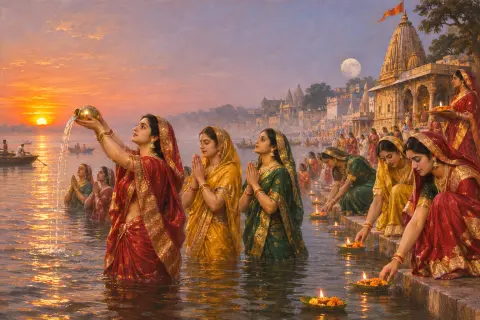
The day starts early. Women bathe, wear new or festive clothes and cook the bonam. Then the family walks with the pot to the temple, often with drums and dancing. The bonam is offered to the goddess along with a sari, bangles, turmeric and vermilion, and part of the food comes home as prasad.
In some homes and villages the offering is not vegetarian. A rooster or goat may be offered as part of the old folk worship, while many other families keep their offering to rice, sweets and fruit. Across Telangana, villages and towns hold their own Bonalu for their own goddess, and Telugu communities abroad now gather for it too.
Soon after Telangana became a separate state, its government declared Bonalu a state festival. The state funds temple arrangements, gives a public holiday, and ministers present silk clothes at the main shrines.
The bonam is just rice, milk and jaggery from an ordinary kitchen. What makes it holy is that it is cooked and carried for the Mother. In the Gita (9.27) Krishna says the same about all of life: whatever you do, whatever you eat, whatever you offer or give, do it as an offering to me. Bonalu shows what that looks like on a busy street. The daily work of feeding a family becomes worship when it is done with love and handed over with thanks.