Karna is the great warrior of the Mahabharata who was born to Kunti and the sun god Surya before her marriage, with golden armour and earrings grown on his body. Set afloat on a river as a baby, he was raised by the charioteer Adhiratha and his wife Radha, became Duryodhana's closest friend and king of Anga, and fought against his own brothers, the Pandavas, without them knowing who he was. He is famous for never refusing anyone who asked, for giving away his armour to Indra, and for his loyalty even after he learned the truth. The Gita names him among the warriors facing Arjuna, and Bihar remembers him as a worshipper of the sun at Chhath.
Also called: Radheya (son of Radha), Sutaputra (son of a charioteer, often used as an insult), Vasusena (his childhood name, born with wealth), Vaikartana (the cutter, after he cut off his armour), Vrisha (the bull, the righteous one), Angaraja (king of Anga), Suryaputra (son of the sun), Kaunteya (son of Kunti, a name he learned only before the war)
Mother: Kunti, before her marriage; father: Surya, the sun god
Foster parents: the charioteer Adhiratha and his wife Radha
Half-brothers: Yudhishthira, Bhima and Arjuna, sons of Kunti, and through Pandu also Nakula and Sahadeva
Friend: Duryodhana, who made him king of Anga
Teacher: Parashurama, who cursed him when he learned Karna was not a Brahmin
Wives and sons: the Mahabharata gives him wives from the charioteer community and many sons; Vrishasena, the eldest, was killed by Arjuna in the war
Kingdom: Anga, in the region of present-day Bhagalpur and Munger in Bihar, with its capital at Champa
न ते जातु नशिष्यन्ति पुत्राः पञ्च यशस्विनि।
निरर्जुनाः सकर्णा वा सार्जुना वा हते मयि॥
na te jātu naśiṣyanti putrāḥ pañca yaśasvini,
nirarjunāḥ sakarṇā vā sārjunā vā hate mayi.
Your five sons will never be lost to you, glorious lady: either without Arjuna and with Karna, or with Arjuna, once I am slain.
Stories
Karna's story runs through the Mahabharata from beginning to end. The Adi Parva tells his secret birth and his entry into the arena; the Vana Parva tells, in its own section called the Kundalaharana, how he gave away his armour; the Udyoga Parva holds the two great conversations in which Krishna and then Kunti tell him who he is; the Karna Parva, named after him, tells of his command and death; and the Shanti Parva goes back to explain the curses that sealed his fate. The section numbers below follow K. M. Ganguli's English translation of the commonly read text, unless the Pune Critical Edition is named. Later poets loved him even more than the epic does: Bhasa's play Karnabharam and many regional retellings made him a tragic hero of generosity.
The child in the basket
As a girl, Kunti served the short-tempered sage Durvasa so well that he gave her a mantra to call any god she wished for a child. Curious, she tried it on the sun. Surya appeared and would not leave without giving her a son. Karna was born at once, with armour and earrings, and Surya gave Kunti back her maidenhood (Adi Parva, section 111).
Afraid of her family, Kunti put the baby in a basket and, weeping, set it on the river Ashva at night. It floated into the Charmanvati, then the Yamuna and the Ganga, as far as Champa. There Adhiratha the charioteer and his wife Radha, who had no children, found it. They raised the boy as their own and named him Vasusena, because he was born with wealth (Vana Parva, sections 306 and 307).
The stranger in the arena
When Drona showed off the Kuru princes' skill in a great tournament, Arjuna amazed everyone. Then a stranger in shining armour walked in, tall as a golden palm, bowed carelessly to Drona and Kripa, and said to Arjuna: I will do everything you have done, better (Adi Parva, section 138). He did. Then he challenged Arjuna to a duel. Kunti, recognising her son, fainted.
Kripa asked the stranger to name his parents and his royal line, since princes do not fight men of unknown birth. Karna's face fell. At once Duryodhana said that a hero could be a king, and had Karna crowned king of Anga on the spot. Then old Adhiratha came in, trembling, and Karna, his head still wet from the coronation water, bowed to touch his feet. Bhima laughed and told him to take up a charioteer's whip instead. Karna sighed and looked up at the sun (section 139). From that day he was Duryodhana's friend for life.
Two curses
The Shanti Parva (sections 2 and 3) tells why Karna's skill failed him at the end. Wanting the Brahmastra, he went to Parashurama, who taught only Brahmins, and said he was a Brahmin. One day Parashurama slept with his head on Karna's lap. A biting insect bored into Karna's thigh, but he did not move for fear of waking his teacher, and the blood flowed. Parashurama woke, saw the wound and said no Brahmin could bear such pain: you must be a kshatriya. Angry at the lie, he cursed Karna to forget the weapon at the moment he needed it most.
Another time, Karna killed a Brahmin's sacrificial cow by mistake while practising. Though he begged forgiveness and offered gifts, the Brahmin cursed him: in battle the earth would swallow the wheel of his chariot, and his enemy would cut off his head while he was helpless.
The armour and the earrings
Karna gives his armour and earrings to Indra, disguised as a Brahmin.
Indra, Arjuna's father, knew no one could kill Karna while he wore his armour. Surya came to Karna in a dream and warned him: Indra will come as a Brahmin to ask for your armour and earrings; do not give them. Karna answered that he had sworn never to refuse a Brahmin, and he would rather have fame than life (Vana Parva, sections 298 to 300).
So Surya told him to at least ask for Indra's unfailing dart in return. Indra came in disguise and asked. Karna asked for the dart, and Indra gave it on one condition: it would kill only one enemy and then return to him. Then Karna, smiling, cut the armour and earrings from his own body and handed them over, and the gods and men watching roared in wonder. Because he cut them off himself, the epic says, he came to be called Vaikartana, the cutter (section 308; Drona Parva, section 180). He later had to use the dart on Bhima's son Ghatotkacha, and so had nothing left for Arjuna.
Two offers before the war
When peace talks failed, Krishna took Karna aside in his chariot and told him the truth: you are Kunti's first son, and by right the eldest Pandava. Come with me, and you will be king, with Draupadi and all five brothers at your feet. Karna answered that Adhiratha and Radha had raised him, that his wives and sons were among the charioteers, and that Duryodhana had given him a kingdom and trusted him. He could not abandon them for any kingdom, but he asked Krishna to keep the secret, so that Yudhishthira would not refuse the throne (Udyoga Parva, sections 140 to 143).
Then Kunti came to him on the bank of the Ganga, where he was praying to the sun with his face to the east. Karna greeted her as I am Karna, son of Radha and Adhiratha. She begged him to join his brothers, and Surya's own voice from the sun told him to listen to his mother. Karna said she had abandoned him when it mattered, and he would not now abandon those who had stood by him. But he gave her a promise, the verse at the top of this page: he would not kill Yudhishthira, Bhima, Nakula or Sahadeva, only Arjuna, and either way she would still have five sons (sections 144 to 146).
The last day
On the night Bhishma fell, Karna went alone to his bed of arrows. Bhishma embraced him like a son, told him he knew he was Kunti's child, and said his harsh words had only been meant to keep the peace (Bhishma Parva, section 124). Karna became commander after Drona, and on the seventeenth day met Arjuna at last.
In the middle of the duel the earth swallowed one wheel of his chariot, as the Brahmin had cursed, and he could not recall the Brahmastra. He jumped down to lift the wheel and asked Arjuna, as a matter of dharma, to wait. Krishna answered with a list of questions: where was this dharma when Draupadi was dragged into the hall, when the boy Abhimanyu was surrounded and killed? (Karna Parva, sections 90 and 91). Arjuna shot, and Karna fell.
Only at the water rites after the war did Kunti tell her sons that Karna had been their eldest brother. Yudhishthira, heartbroken, performed his rites with Karna's family, and in his grief cursed all women that from then on they would not be able to keep a secret (end of the Stri Parva; Shanti Parva, section 6).
How to recognise
•A tall, handsome warrior shining like the sun, with golden armour (kavacha) and earrings (kundala) that were part of his body from birth. The Adi Parva describes him entering the arena tall as a golden palm tree, his face lit by the earrings.
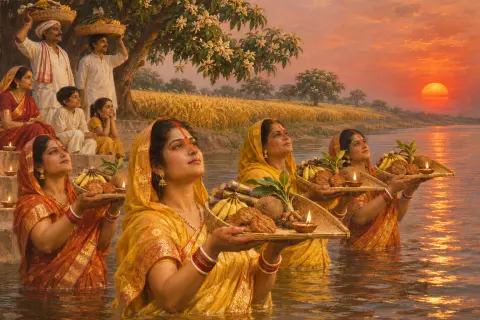
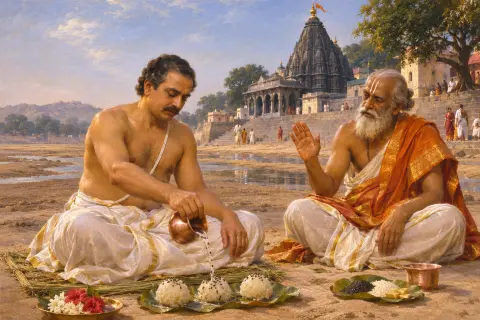
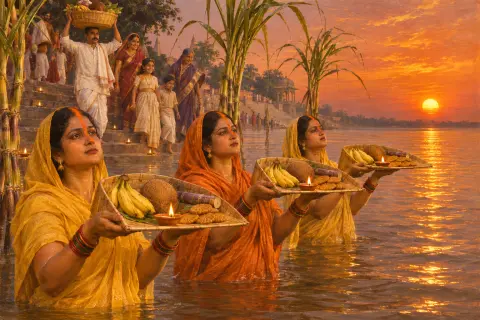
•Standing in a river at dawn with folded hands, praying to the sun. The Vana Parva says he worshipped Surya daily, and that at that time he refused nothing to any Brahmin who asked. The picture of him standing in the water to offer arghya comes from Bihar's tradition.
•Cutting off his armour and handing it to an old Brahmin, who is Indra in disguise. This is the scene behind his name Vaikartana and his fame as Daanveer Karna, the hero of giving.
•A great bow in his hand. In the Karna Parva (section 31) he says his bow is called Vijaya, made by Vishvakarma for Indra and given to him by Parashurama.
•His chariot with one wheel sunk in the earth on the last day, an image of a curse coming true.
Thyself and Bhishma, and Karna and also Kripa, the victorious in war, Asvatthama, Vikarna, and also Bhurisrava, the son of Somadatta.
Duryodhana lists the great warriors on his side for Drona: Bhishma, Karna, Kripa and others. It is the first of two verses that name Karna; the other is 11.34.
Drona, Bhishma, Jayadratha, Karna and other brave warriors these are already slain by Me: do thou kill; be not distressed with fear; fight and thou shalt coner thy enemies in battle.
Krishna names Drona, Bhishma, Jayadratha and Karna as already slain by him, and tells Arjuna to fight without fear. Arjuna does not know Karna is his brother.