The Story
The oldest hymn to the ancestors is in the Rigveda (10.15), which calls the pitrs to come, sit on the sacred grass and enjoy the offerings their descendants have made. The first shraddha is described in the Mahabharata (Anushasana Parva, chapter 91 in the Ganguly translation): the sage Nimi, of the line of Atri, grieving for his dead son Shrimat, offered him rice cakes on kusha grass, and the other sages took up the rite after him. The Puranas then fixed the dark fortnight of Ashwin as the ancestors' own time and named Gaya as the place where pinda frees them, above all in the Gaya Mahatmya of the Vayu Purana. So the fortnight is kept to feed and remember three generations on each side of the family, by name, every year.
Who the pitrs are, and why this fortnight
Pitrs are the ancestors, usually counted as three generations on each side: father, grandfather and great-grandfather, and mother, grandmother and great-grandmother. The scriptures describe them living in a world of their own, Pitru loka, under the care of Yama. The Vedas already speak of offering food and water to them, and the Dharma Shastras and Puranas set out how a shraddha should be done. The word shraddha comes from shraddha, faith: whatever is given to the ancestors with faith.
Tradition holds that during this dark fortnight, when the sun moves into Kanya (Virgo), the ancestors come close to the world of the living and wait for what their families will offer. That is why the fortnight is also called Mahalaya Paksha or Kanyagata (Kanagat in much of north India). Whatever else a family skips during the year, many keep these fifteen days.
The rule for which day to use is simple. Each person is honoured on the lunar day (tithi) on which they died, whatever the month. A grandfather who died on a Panchami gets his shraddha on the Panchami of this fortnight. Navami is set aside for mothers and married women who died before their husbands. Chaturdashi is kept for those who died by accident or violence. And the last day, Sarvapitri Amavasya, is for everyone: ancestors whose date is lost, those with no one left to remember them, and anyone a family might have missed.
Karna and the gold he could not eat
The most loved story about Pitru Paksha is about Karna, the great warrior of the Mahabharata who was known for never refusing anyone who asked. It is a popular tradition told across north India, not a passage from the Mahabharata itself, and the details vary from teller to teller.
In the usual telling, Karna dies at Kurukshetra and goes to heaven. When he is hungry, he is served gold and jewels instead of food. Puzzled, he asks Indra (in some versions Yama) why. He is told that in his life he gave gold freely to everyone, but never once offered food or water to his ancestors. Karna answers that he never knew who his ancestors were. He learned that Kunti was his mother only on the eve of the war.
Because the fault came from not knowing, he is allowed to return to earth for fifteen days. He offers food and water to his ancestors, and then goes back. Those fifteen days, the story says, are Pitru Paksha. The point is gentle but firm: giving to the world is good, and it does not replace feeding your own roots.
Gaya: Gayasura and the footprint of Vishnu
No place matters more for shraddha than Gaya, on the Phalgu river in Bihar. Its story is told in the Gaya Mahatmya, a section of the Vayu Purana. Gayasura was an asura who did such great penance that his body became holier than any shrine. Anyone who saw or touched him was freed from sin and went straight to heaven, so that even the realm of Yama stood empty. The gods were worried and asked Gayasura for his body as the ground for a great sacrifice. He agreed and lay down.
Even with the sacrifice done and a heavy stone, the Dharmashila, set on him, his body kept trembling. So Vishnu himself came and pressed the stone with his foot. Gayasura went still and asked one last boon: that the gods remain on his body forever, and that anyone who offers pinda for their ancestors at this place should free them. Vishnu granted it. The footprint, the Vishnupad, is worshipped to this day in the Vishnupad temple, a print about forty centimetres long set in rock inside a silver-plated basin. The present stone temple was built in the eighteenth century by Queen Ahilyabai Holkar of Indore.
Many Puranas and epics praise Gaya. A verse quoted in several of them says that a man should wish for many sons, so that at least one of them goes to Gaya. People still say that a shraddha done at Gaya satisfies the ancestors in a way no other can, and many families make the trip once in a lifetime, often after both parents have died.
The Phalgu, Sita's curse and the Akshayavat
The Phalgu is a strange river. For most of the year it looks like a wide bed of sand. Dig a little with your hands and water seeps up. A local tradition, retold in some regional Ramayanas, explains why. Rama, Lakshmana and Sita came to Gaya to offer pinda for King Dasharatha. While the brothers were away fetching what was needed, the time for the rite was passing, and Dasharatha's hands are said to have appeared asking for the offering. Sita made pindas from the sand of the riverbank and offered them, with the Phalgu, a cow, a ketaki flower, a tulsi plant, a brahmin and a banyan tree as witnesses.
When Rama returned and doubted her, all the witnesses except the banyan stayed silent or denied it. Sita cursed the Phalgu to flow hidden under the sand, and cursed the others too. The banyan told the truth, and she blessed it to stay green forever. That banyan is the Akshayavat, the undying tree, and the last pinda of a Gaya shraddha is offered at its foot. To this day many pilgrims offer pindas of sand at the Phalgu in memory of Sita. Tellings differ in which witnesses failed her, so treat the list as the local story rather than a fixed text.
A full Gaya shraddha follows a path of many vedis, sacred altars spread across the town and the hills. Tradition speaks of hundreds; a few dozen are used today. Pilgrims bathe in the Phalgu, offer at the Vishnupad, climb Pretshila hill for those who died untimely deaths, and finish at the Akshayavat. Many first make an offering on the Punpun river near Patna, which tradition treats as the gateway to Gaya. The hereditary priests of Gaya, the Gayawal pandas, keep handwritten family registers going back generations, so a pilgrim can often find the names of great-grandparents who came before. During the fortnight the Bihar government runs the Pitru Paksha Mela, and the town fills with lakhs of pilgrims, tents, boats and the steady murmur of names.
How families keep the fortnight
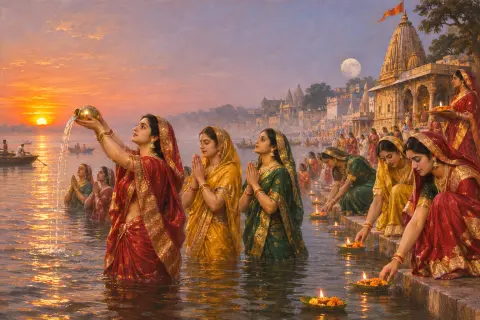
At home, the rite is short and plain. In the morning, the person doing it bathes, wears the sacred thread over the right shoulder, sits facing south, and offers water with black sesame through the gap between thumb and forefinger. This is tarpan. Pindas of rice, barley flour, sesame, ghee and honey are offered on kusha grass. A simple meal, often the dead person's favourite food, is cooked, and portions are set aside for a cow, a dog, ants and especially crows, who are seen as messengers of the ancestors. Brahmins or guests are fed, and many families give food to the poor. Most avoid new purchases, weddings and other new starts during these days.
In Bihar the fortnight runs deep. Besides Gaya, families in Mithila and Bhojpur do daily tarpan at ponds and rivers, and the Ashtami of this fortnight is Jitiya (Jivitputrika), the hard fast mothers keep for their children's long life. In Bengal, Mahalaya morning begins before dawn with tarpan on the Ganga ghats and the radio broadcast of Mahishasuramardini, a recital heard every year since the 1930s. Mahalaya also ends the fortnight of the ancestors and opens Devi Paksha, the fortnight of the goddess, so Durga Puja follows close behind. In Karnataka, Mahalaya Amavasya is a public holiday; in Tamil Nadu, families offer tarpanam on Mahalaya Amavasai at the seashore and river bathing ghats; in Maharashtra, families cook a special meal for the ancestors and feed crows before eating.
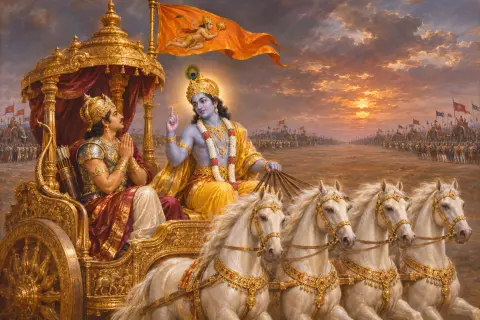
In the first chapter of the Gita, Arjuna's fear is partly about the ancestors: if families are destroyed, he says, no one will offer them pinda and water. Krishna's first real answer (2.20) is that the self is never born and never dies, and is not killed when the body is killed. Pitru Paksha holds both truths at once. The people we lost are not gone into nothing; they are on a road we cannot see. And while they walk it, we can still do the small, loving things a family does: say their names, set out food and water, and live in a way that would make them glad.