Manasa is the Hindu goddess of snakes, prayed to for protection from snakebite and poison, especially in the rainy months. She is called Bishahari or Vishahari, "she who takes away poison", in Bihar. The Mahabharata knows her as Jaratkaru, sister of the serpent king Vasuki and mother of Astika, who stopped King Janamejaya's snake sacrifice. The Devi Bhagavata Purana names her Manasa and gives her twelve names. Her best loved story, of the merchant Chand Sadagar and the brave bride Behula, comes from the Manasamangal poems of Bengal and the songs of Bihar's Anga region. She is worshipped on Nag Panchami, in the Bihula-Bishahari Puja of Bhagalpur, and in Mithila's Madhushravani.
Also called: Bishahari or Vishahari (who takes away poison), Jaratkaru, Jagadgauri (fair one of the world), Siddhayogini, Vaishnavi, Shaivi, Nagabhagini (sister of the serpents), Nageshvari (queen of the serpents), Jaratkarupriya (beloved of Jaratkaru), Astikamata (mother of Astika), Mahajnanayuta (full of great wisdom), Padmavati and Padma (in the Bengali and Assamese poems), Kani (the one-eyed, in Bengal)
Father: the sage Kashyapa, whose mind-born daughter she is (Devi Bhagavata Purana); Shiva, in the Bengali Manasamangal
Brothers: Vasuki, king of the serpents, and in the Mahabharata's account the other great nagas, children of Kadru
Husband: the sage Jaratkaru
Son: Astika, who saved the serpents at Janamejaya's sacrifice
Teachers: Shiva, who gave her yoga and wisdom, and Krishna, whom she worshipped for three ages (Devi Bhagavata Purana)
Companion: Neta or Netula, the washerwoman of the gods, in the Behula story
Mount: a swan, or a snake
जरत्कारुर्जगद्गौरी मनसा सिद्धयोगिनी ।
वैष्णवी नागभगिनी शैवी नागेश्वरी तथा ॥
जरत्कारुप्रियास्तीकमाता विषहरेति च ।
महाज्ञानयुता चैव सा देवी विश्वपूजिता ॥
Jaratkaru, Jagadgauri, Manasa, Siddhayogini, Vaishnavi, Nagabhagini, Shaivi and Nageshvari; Jaratkarupriya, Astikamata, Vishahari, and Mahajnanayuta: so is the goddess named, worshipped by the whole world.
Stories
The oldest story of this goddess is in the Mahabharata (Adi Parva, the Astika section), where she is Jaratkaru, sister of Vasuki, married to a sage of the same name, and mother of Astika. The epic does not call her Manasa or treat her as a goddess. The Devi Bhagavata Purana (Book 9, chapters 47 and 48) does both: she is Manasa, the mind-born daughter of the sage Kashyapa, a great yogini, worshipped by Krishna, Shiva and Indra, with twelve names that protect from snakes. Pala period sculptures show she was already worshipped in Bengal and Bihar by about the tenth century. From the late fifteenth century, Bengali poets such as Vijay Gupta and Bipradas Pipilai wrote the Manasamangal, the long poem of how she won the worship of Chand Sadagar through the courage of Behula, and the same story lives on in the Angika songs of Bhagalpur and the Ojapali singing of Assam.
A Bride Named Jaratkaru
The Mahabharata (Adi Parva, the Astika section) tells of an ascetic named Jaratkaru who wandered the earth with no home and no wife. One day he came upon his ancestors hanging head down in a pit, holding on to a single root that a rat was gnawing away. They told him they would fall because their line was ending: he had no son.
Jaratkaru agreed to marry, on three conditions: the bride must have his own name, she must be given freely, and he would not be expected to support her. The serpent king Vasuki had a sister called Jaratkaru, and he gave her gladly. The sage added one more condition: if she ever displeased him, he would leave.
One evening he fell asleep with his head in her lap as the sun was setting. Afraid that he would miss his evening prayers, she woke him. He was angry at being woken and prepared to go. As he left, he told her she was carrying his child. She was, and the boy was named Astika, from the word asti, "he is", which his father had spoken.
Astika and the Snake Sacrifice
Long before, Kadru, the mother of the serpents, had cursed her own children to die in a king's sacrifice when they refused to help her cheat in a wager. The time came when King Parikshit died of Takshaka's bite. His son Janamejaya, in grief and anger, began a great sacrifice in which snakes of every kind were drawn through the air and fell into the fire.
Vasuki remembered that his sister's son was meant to save them. Jaratkaru sent Astika to the sacrifice. The boy praised the king and his priests so wisely that Janamejaya offered him any boon. Takshaka, who had hidden with Indra, was at that moment being dragged towards the flames. Astika asked for one thing: that the sacrifice stop. The king, bound by his word, agreed, and the serpents were saved.
This is why snakes are said to spare those who remember Astika. The same story lies behind Nag Panchami, and it is why Manasa, Astika's mother, is prayed to for safety from snakebite.
Manasa in the Devi Bhagavata Purana
In the ninth book of the Devi Bhagavata Purana (chapters 47 and 48), Narayana tells Narada about Manasa. She is the daughter of the sage Kashyapa, born from his mind, and so she is called Manasa; the Purana adds that she is called so also because she meditates on the Supreme with her mind (manas) and delights in it.
She worshipped Krishna for three ages and grew thin with her austerities, so Krishna called her Jaratkaru, "worn body". Shiva taught her yoga and great wisdom, and she gained the power to bring the dead back to life. Krishna was the first to worship her, then Shiva, then Kashyapa and the gods. Her marriage to the sage Jaratkaru and the birth of Astika follow as in the Mahabharata, and through Astika, Indra and Takshaka are spared.
The Purana gives her twelve names, the shloka above, and says she should be worshipped on the Sankranti of Ashadha or on Nag Panchami, so that no one in the family need fear snakes.
The Goddess Who Wanted a Merchant's Worship
The Bengali Manasamangal tells her story from a different place. There Manasa is born of Shiva, and Chandi, Shiva's wife, treats her as a rival and strikes out one of her eyes, which is why she is called Kani. She has power over every snake, but she is not yet worshipped by people, and she cannot take her place among the gods until a great devotee of Shiva worships her too.
That devotee is Chand Sadagar of Champaknagar, a rich merchant who worships Shiva alone. When Manasa asks for his worship, he refuses and mocks her as a one-eyed goddess. She sinks his ships and kills his six sons by snakebite, and still he refuses. The Angika songs of Bhagalpur tell it with five sister goddesses, the Bishaharis, instead of one, but the quarrel is the same: a proud man and a goddess who will not rest until he bows.
Behula and the Left Hand
Chand Sadagar offers Manasa a flower with his left hand, and she accepts.
Chand's seventh son, Lakhindar, married Behula. To protect him, Chand built an iron bridal chamber with no gap for a snake, but Manasa had the builder leave a hole as fine as a hair, and on the wedding night a snake slipped in and bit the bridegroom.
Behula would not let him go. She set out on a raft of banana stems with his body and floated down the river for months, past every ghat, until she reached the washerwoman Neta, who led her to the gods. In the Bengali poems she danced before them; in the Anga songs she pleaded before Shiva. They granted her husband's life and the return of Chand's sons and ships, on one condition: Chand must worship Manasa.
Chand gave in, but on his own terms. His right hand was for Shiva alone, he said, so he offered a flower to Manasa with his left hand, and turned his face away. She accepted it. With that, the poems say, her worship began among people. The Behula story is told in more detail on the Bihula-Bishahari page.
Worship in the Rains
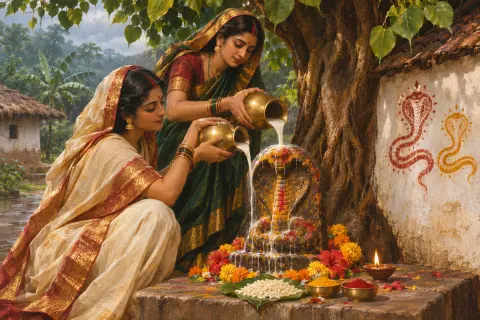
Manasa's season is the monsoon, when flooded burrows drive snakes into houses and fields. In Bengal, families worship her through the rainy months in a painted pot or a branch of the sij plant, and the Manasamangal is sung over many nights. In Bishnupur in Bankura, the Jhapan festival at the end of Shravan brings snake charmers in procession in her honour.
In the Anga region of Bihar, the Bihula-Bishahari Puja in August fills Bhagalpur with pandals, Manjusha paintings and songs, centred on the old temple at Champanagar. In Mithila, newly married women begin Madhushravani on Mauna Panchami by setting up clay figures of Bishahari and the nagas and worshipping them every morning for two weeks. In Assam, the Ojapali singers perform the Padma Purana, the Assamese telling of her story.
In all these places the prayer is simple and practical: keep the family safe from snakes through the rains, and keep the children well.
How to recognise
•Fair skinned. The meditation verse for her worship in the Devi Bhagavata Purana (Book 9, chapter 48) describes her as having the colour of a white champaka flower and wearing serpents as her sacred thread.
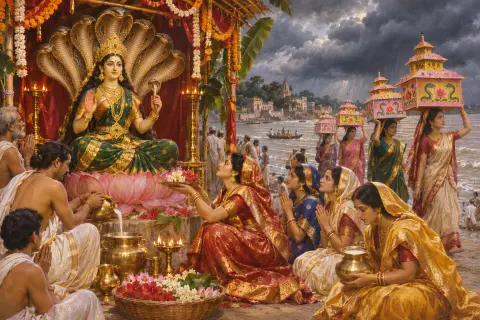
•A canopy of cobra hoods, most often seven, rises behind her head like an umbrella. She usually sits on a lotus and holds a snake in one hand, with the other raised in blessing or holding a pot.
•Her son Astika often sits on her lap. Stone images of this kind, the goddess under the hoods with a child, survive from the Pala period in Bengal and Bihar, about a thousand years old.
•A swan (hamsa) appears as her mount in many Bengal images; in others she rides a snake.
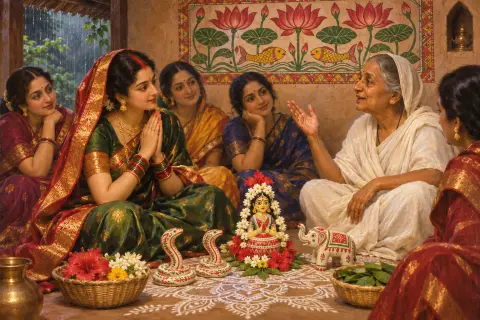
•Much of her worship needs no image at all. In Bengal she is worshipped in a pot painted with snakes or in a branch of the sij plant, which people call the manasa tree. In Mithila she is a small clay figure set beside clay snakes for Madhushravani, and in Bhagalpur her story is painted on the temple-shaped Manjusha boxes.
•In the Bengali poems she is called Kani, the one-eyed, because Chandi, Shiva's wife, struck out one of her eyes in jealousy. Most images do not show this.
Among weapons I am the thunderbolt; among cows I am the wish-fulfilling cow called Kamadhenu; I am the progenitor, the god of love; among serpents I am Vasuki.
"Among serpents I am Vasuki." The Gita does not mention Manasa, but in the Mahabharata she is Vasuki's sister, the one he gave in marriage so that her son could save the serpents. The link is through her brother.
I am Ananta among the Nagas; I am Varuna among water-deities; Aryaman among the Manes I am; I am Yama among the governors.
"Among the nagas I am Ananta." Ananta, or Shesha, is the eldest of the serpent brothers born to Kadru, of whom Vasuki is one. Krishna names the serpent race among his glories; Manasa, their sister and protector, is not named.