The Story
The oldest written account of Nag Panchami is in the Bhavishya Purana. In the Panchami Kalpa of its Brahma Parva, the sage Sumantu tells King Shatanika that the fifth lunar day is dear to the nagas. Their mother Kadru had cursed them to burn in King Janamejaya's snake sacrifice when they refused to help her cheat in a wager. Brahma then promised them that a sage named Astika would save them, and both that promise and Astika's rescue fell on a Panchami. So on this day people bathe the nagas with milk, to soothe the burning of that curse, and the nagas in turn keep their families free from the fear of snakes. The Uttara Parva of the same Purana (chapter 36) tells the curse again and gives the prayer above. Over the centuries the day also gathered other serpent stories, from Krishna and Kaliya to the snake goddess Manasa.
Who the nagas are
In the Mahabharata, the nagas are children of the sage Kashyapa and his wife Kadru. Some are fearsome, like Takshaka. Others are holy. Shesha, also called Ananta, gave himself to austerity and was asked by Brahma to hold up the earth. Vishnu rests on his coils on the cosmic ocean. Vasuki served as the rope when the gods and asuras churned the ocean, and Shiva wears a serpent around his neck.
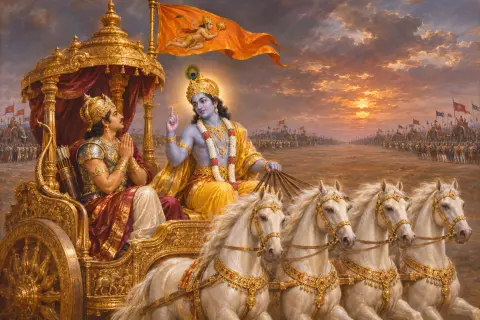
So a snake in Hindu thought is more than a dangerous animal. It stands for the earth, for water and fertility, and for a power that can harm or protect. In the Bhagavad Gita, when Krishna lists the best of each kind in which he can be seen, he says that among serpents he is Vasuki and among the nagas he is Ananta (10.28 and 10.29).
Krishna and Kaliya
The tenth canto of the Bhagavata Purana (chapters 16 and 17) tells of Kaliya, a many-headed serpent who had made his home in a deep pool of the Yamuna near Vrindavan. His poison was so strong that the water boiled, birds flying over it fell dead, and cows and cowherd boys who drank from it collapsed.
Krishna, still a boy, climbed a kadamba tree on the bank and jumped into the pool. Kaliya wrapped him in his coils, and the people of Vraja ran to the bank in grief. Then Krishna slipped free, climbed onto Kaliya's hoods and danced on them, pressing down each hood that rose, until the serpent was spitting blood and close to death.
Kaliya's wives came forward with folded hands and begged for their husband's life. Krishna spared him. He told Kaliya to take his family to the island of Ramanaka in the ocean, and promised that Garuda, the serpent's old enemy, would not touch him, because Krishna's footprints were now on his hoods. In parts of north India people link Nag Panchami with this victory, and pictures of Krishna dancing on Kaliya are common on the day.
Janamejaya's snake sacrifice and Astika
The Mahabharata opens with another serpent story, in the Astika Parva of its first book, the Adi Parva. King Parikshit, grandson of Arjuna, was killed by the bite of the naga Takshaka. His son Janamejaya, grieving and angry, set up a great fire sacrifice to destroy every snake in the world. As the priests chanted, serpents of every size were pulled from all directions and fell into the fire.
The Mahabharata explains that this had been coming for a long time. Kadru had once cursed her own sons to burn in such a fire, when they refused to help her cheat in a wager. To protect his race, the naga king Vasuki had given his sister in marriage to a sage named Jaratkaru, and their son Astika grew up to be a young scholar. Vasuki now sent Astika to the sacrifice.
Astika praised the king and his sacrifice so beautifully that Janamejaya offered him any gift he wanted. Astika asked for the sacrifice to stop. The king tried to persuade him to ask for something else, but in the end he kept his word, and Takshaka and the remaining nagas were saved. The Mahabharata says that whoever recites the story of Astika need not fear snakes. The Bhavishya Purana says Astika saved the nagas on a Panchami, and that is why the day is kept. The Mahabharata itself does not give a date.
One festival, many regional forms
In Maharashtra, women draw nagas with sandalwood or turmeric paste on the walls and worship clay or metal images with milk, flowers and puffed grain. Many homes avoid digging, ploughing, cutting and frying on this day, so that no snake is hurt by accident. Village women sing and play on swings. The village of Battis Shirala in Sangli was once known for catching live cobras for the day, but courts and wildlife law have stopped that, and people now worship images instead.
In Karnataka the day is Nagara Panchami. People pour milk on snake stones under trees and on anthills, where snakes are thought to live, and in many families sisters pray for their brothers. In Nepal, pictures of the nagas are pasted above house doors to keep the home safe. In Bengal the goddess of snakes is Manasa, worshipped through the rainy months, and her story of Behula and Lakhindar is sung and acted. Kerala has its own old tradition of sarpa kavu, sacred serpent groves kept beside family homes, with the big serpent festival at Mannarasala on another day.
In Gujarat the festival is called Nag Pancham and comes about two weeks later, on the fifth day of the dark half of Shravana by the Gujarati calendar. The day before is Bol Choth, when cows and calves are worshipped.
Nag Panchami in Bihar
In Mithila, in north Bihar and the Terai of Nepal, the serpents open one of the region's most loved festivals. On Mauna Panchami, the fifth day of the dark half of Shravana, newly married women worship the snake goddess Vishahari and clay images of a naga and nagin, and this begins Madhushravani, a fortnight of worship, songs and stories that ends on the third day of the bright half. Madhushravani has its own page on this site.
In the Anga region around Bhagalpur, the snake goddess is Bishahari, the same goddess Bengal knows as Manasa. Her festival falls in August, close to Nag Panchami. Pandals are put up across the region, her main temple is at Champanagar, and the story of Bihula, who won back her husband's life from the snake goddess, is told and painted in Manjusha art on temple-shaped boxes made for the puja. Across Bihar, families also keep Nag Panchami itself with milk, flowers and prayers at snake images and anthills, asking for safety through the rains.
Krishna does not kill Kaliya, and Astika does not let Janamejaya burn the last of the nagas. Both stories end in mercy for a creature that had caused real harm. In the Gita (10.29) Krishna says, "I am Ananta among the nagas," and lists the serpent among the places he can be seen. Nag Panchami asks us to look at the thing we fear most in the rainy season and to see the divine in it too. Respect, not cruelty, is what keeps both the snake and the family safe.