The Story
The oldest written mention of this goddess is in the Mahabharata (Adi Parva, Astika Parva), which tells of Jaratkaru, sister of the serpent king Vasuki, whose son Astika stopped King Janamejaya's sacrifice that was burning the snakes. The Devi Bhagavata Purana (Skandha 9, chapters 47 and 48) calls her Manasa and gives her twelve names, one of them Vishahari, "she who takes away poison". The story of Bihula is not in any Sanskrit text. It comes from the Manasamangal poems of Bengal (the earliest known poet, Kana Haridatta, is lost; surviving versions include those of Vijay Gupta, Bipradas Pipilai and Narayan Dev) and from the Angika songs of the Anga region, where Champanagar in Bhagalpur is said to be the home of the merchant Chando Saudagar. People keep the puja to ask Bishahari for protection from snakebite in the rainy months, and to remember Bihula. The story below follows the Anga telling, with the Bengali differences noted.
The Goddess Who Wanted to Be Worshipped
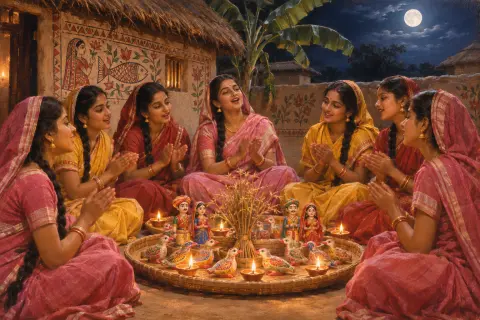
In the Angika telling, Shiva was bathing in a lake when five hairs from his matted locks fell into the water and became five lotuses. From the lotuses came five sisters, who asked Shiva to accept them as his daughters. They became known together as the Bishaharis. One of them, Jaya Bishahari, carried a pot of amrit, and when Parvati was bitten by a snake, she brought her back to life. Parvati then blessed the sisters with the power to take away poison.
The sisters wanted to be worshipped on earth. Vasuki, the serpent king, told them that in Champanagar, the capital of Anga, lived a rich merchant named Chando Saudagar, a firm devotee of Shiva. If he worshipped them, everyone else would follow.
Bengali poems tell it a little differently. There Manasa is one goddess, born of Shiva, and she needs worship from Chand Sadagar's right hand to take her place among the gods. But the heart is the same in both: a proud devotee of Shiva and a goddess who will not rest until he bows to her.
Chando Saudagar Says No
Chando refused. He said he did not know who the sisters were, and he worshipped only Shiva. The goddesses warned him that they would ruin his trade and his family. He still refused. In the Bengali poems his ships sink and his six sons die of snakebite. In the Angika songs his boat goes down and his six sons drown with it, and the sisters have Hanuman pull Chando himself out of the water, because a dead man cannot worship anyone.
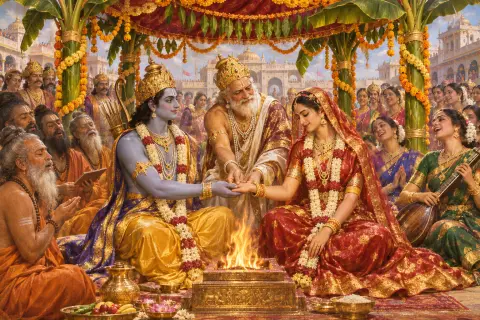
Chando would not bend. Then a seventh son was born to him and his wife Sonka, a boy called Bala Lakhendra (Lakhindar in Bengali). When the boy grew up, Chando looked for a bride strong enough to stand against the goddesses' curse. He chose Bihula of Ujjaini, a girl known for her intelligence and courage.
The Iron Room on the Wedding Night
To keep his last son safe, Chando had an iron bridal chamber built, with no gap for a snake to enter. The builder was Vishwakarma, the craftsman of the gods. But the goddesses persuaded him to leave a hole as thin as a hair in the wall. Guards and mongooses kept watch all around the house.
On the wedding night a snake slipped in through that tiny hole and bit Lakhendra. In the Anga songs the snake is Maniyar. In the Bengali poems it is Kalnagini, and Behula wakes in time to see it leave. By morning the bridegroom lay dead and Chando's house was full of grief.
Chando was about to have the body given to the river. Bihula stopped him. She said she would go with her husband herself and not come back until he was alive again.
Bihula's Journey on the River
Bihula asked Vishwakarma to build her a raft and a box to cover her husband's body. In the Anga telling this box is the first manjusha, and an artist painted on it her family, her story and the plants and animals of Anga. That is why the Manjusha art of Bhagalpur, which today carries a Geographical Indication tag, always tells this story.
She floated down the river for many days, past one ghat after another. The body decayed until only bones were left, and she tied them in a cloth and went on. Then she met Netula, the washerwoman who washed the clothes of the gods (Neta in the Bengali poems). Bihula watched her bring her own dead son back to life, and begged her for help. Netula led her to the gods.
In the Bengali Manasamangal, Behula dances before the gods in heaven and pleases them with her dance. In the Anga songs she stands before Shiva with her face veiled and asks for her husband's life, the return of her father-in-law's wealth and the happiness of her family. Her wishes were granted, on one condition set by the goddess: Chando Saudagar must worship her.
The Left Hand
Bihula came home with Lakhendra alive, and with Chando's lost sons and ships restored. Now she had to keep her promise. Chando still refused. In the Anga telling, he was ready to die rather than give in, until Shiva himself appeared and told him the goddess was his own daughter.
Chando made one last stand. His right hand, he said, was for Shiva alone. So he offered flowers to the goddess with his left hand, and she accepted. Both the Bengali and the Angika versions end this way, and that is how, the story says, the worship of Bishahari began in the world.
In Bhagalpur people say the old Manasa temple in Champanagar stands where Chando first worshipped her. During the puja, the wedding of Bihula and Lakhendra is acted out again with a night procession, as if the whole town were the wedding party.
Bihula had no power over snakes, gods or storms. What she had was a promise and the will to keep it, day after day, on a raft in the middle of a river. In Gita 6.40 Krishna tells Arjuna that a person who does good never comes to a bad end, in this world or the next. Bihula's story says the same thing in the language of a village song.