The Story
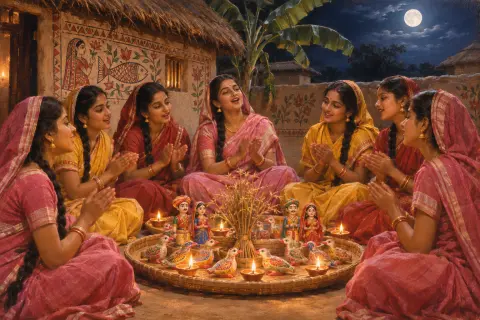
Madhushravani has no single scripture behind it. It is a Mithila folk vrata, and its oldest source is its own katha: the set of stories elder women tell the bride, one or more each day, over the days of the puja. The lists vary from family to family, but they usually include Mauna Panchami (also called Maina Panchami), Mangala Gauri, the birth of the Earth, the churning of the ocean, Sati, Gauri's penance, Shiva's wedding, the Ganga, Bishahari and Bihula, and Bal Basant. Mithila belief says Parvati herself first kept this vrata and was united with Shiva in every birth because of it. It is kept so that a new bride, in her first Shravan, learns through these stories what a long married life asks of both partners, and so that the bride and the snakes of the rainy season are both kept safe.
Flowers Picked the Evening Before
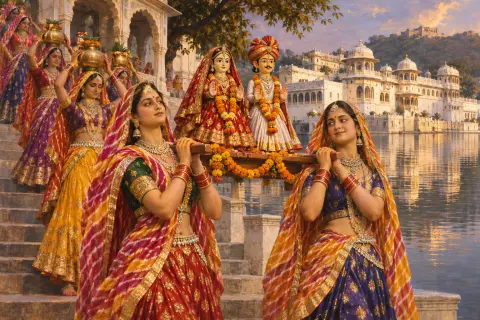
A Madhushravani day begins the evening before. In the late afternoon the bride, dressed in clothes from her in-laws, goes out with her friends and sisters to pick flowers and leaves. They carry a basket, sing as they walk, and come back with white, red and yellow flowers, betel leaves and the maina leaves the puja needs.
Those flowers are kept overnight and offered the next morning. Basi phool, flowers picked the day before, are usually not used in puja, but Madhushravani asks for exactly these. The evening walks, the songs and the giggling on the way back are a big part of what Maithil women remember about their own Madhushravani.
Everything the bride uses in these days comes from her in-laws' home: her saris and jewellery, the puja things, and the food. Most brides eat only once a day, a simple meal, and spend the days between puja, stories and the company of other women.
Bishahari and the Clay Snakes
On the first day, Mauna Panchami, small clay figures are set up for worship: Naga and Nagin, the snake pair, Bishahari, the snake goddess Mithila also calls Vishahari or Manasa, a little elephant and Gauri. Each morning the bride worships them with the flowers from the night before, milk, lava (puffed rice), sindoor and kajal. Milk and lava are offered to the Nag Devata morning and evening.
Shravan is the month of rain, when snakes come out of flooded burrows and into homes and fields. Asking Bishahari and the Naga for protection was, and in villages still is, a real prayer for safety. It is also a prayer for the marriage: that it be long, and that no poison, of any kind, enter it.
One of the katha stories, Bihula, belongs here. Bihula's husband is killed by a snake on their wedding night, and she does not give up. She sets off on a raft on the river with his body, and through her courage and devotion wins him back from the goddess. Mithila tells this story to its brides with great tenderness.
The Katha of Gauri and Shiva
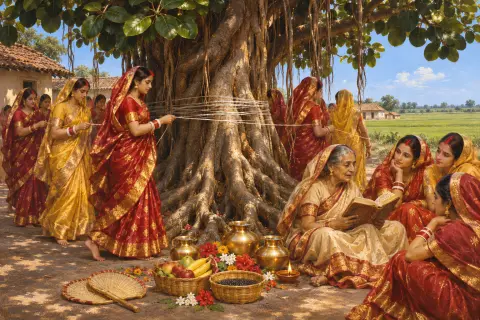
Most of the katha is about Shiva and Gauri. The bride hears how Sati, Daksha's daughter, gave up her life when her father insulted Shiva, and how she was born again as Parvati, daughter of the Himalaya. She hears of Gauri's long tapasya in the mountains, living on leaves and then on nothing, until Shiva came to test her and accepted her. The wider story is told in the Shiva Purana (Rudra Samhita, Parvati Khanda); the katha tells it in simple Maithili, for one listener.
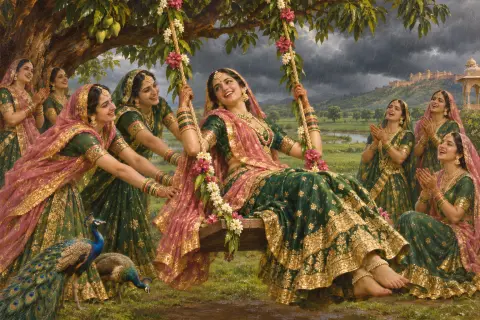
Then comes Shiva's wedding, with its strange wedding party of ghosts and ascetics, and Mena's shock at her son-in-law, and finally the wedding itself. Elder women tell these parts with a lot of laughter, and with small lessons tucked in.
The pundits and women who tell these stories say the point is practical: love, trust, patience, rusna and manana (sulking and making up), and how to live with a new family. A katha told by an aunt or a grandmother, with the bride's friends listening, does that teaching gently.
Kohbar, Aripan and Mithila Painting
Madhushravani comes a few months after the wedding, and the kohbar, the painted room where the couple first stay, is part of the same world. Mithila painting began on these walls. The kohbar is its best-known subject: a lotus pond, bamboo, fish, parrots, turtles, the sun and the moon, all signs of marriage, children and plenty, painted in strong reds, yellows and blacks.
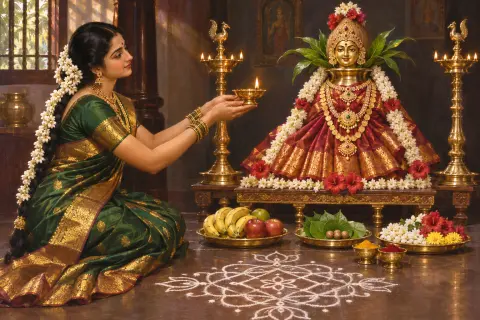
During Madhushravani the floor where the bride sits is drawn with aripan, the white rice-paste floor painting of Mithila, and the clay figures and puja baskets are painted in the same style. Mithila painters have also painted Madhushravani itself, the bride, the clay snakes and the circle of women, as a subject in its own right.
Temi on the Last Day
The last day, Shravan Shukla Tritiya, has the longest puja, as the first day did. After the puja the bride feeds kheer prasad to married women with her own hands and puts mehndi on them.
Then comes temi, the rite every Maithil woman remembers. A burning cotton wick, the temi, is touched to the bride's knees, and in some families her feet as well, often with a betel leaf in between. The marks are said to stand for the four aims of life, dharma, artha, kama and moksha, and are taken as a sign of her strength and of a long married life.
Many families now prefer sheetal temi, a cool temi, where the wick is not lit or a lamp is only brought close and taken away. The rite has always been about courage and blessing, not about pain, and families decide for themselves how to keep it.
In Gita 4.39 Krishna says that the person full of faith, who is devoted and keeps their senses in check, gains knowledge, and with knowledge quickly finds peace. Madhushravani is a long lesson in that kind of faith: a bride who listens every day to the women who have lived the life she is starting, offers yesterday's flowers with care, and keeps a simple discipline for two weeks. What she gains is not only blessings for her marriage but some of their hard-won understanding of it.