
Ravana
Ten-headed king of Lanka
Ravana is the ten-headed king of Lanka in the Ramayana, the son of the sage Vishrava and the rakshasa princess Kaikasi. He carried off Sita, Rama's wife, and was killed by Rama in the war that followed. The Ramayana also shows another side of him: a great devotee of Shiva who sang his praises under the weight of Mount Kailasa, a king of fabulous wealth and learning, and a warrior who had defeated the gods. His early life is told in the Uttara Kanda of the Valmiki Ramayana, his abduction of Sita in the Aranya Kanda and his death in the Yuddha Kanda. North India burns his effigy on Dussehra, while some communities in India and many people in Sri Lanka remember him with respect.
Also called: Dashanana, Dashagriva and Dashamukha (ten-headed), Lankeshvara and Lankesh (lord of Lanka), Ravan, Paulastya (descendant of the sage Pulastya), Rakshasendra (king of the rakshasas), Ravanan (in Tamil), Raavana (in Sri Lanka)
Parents: the sage Vishrava, son of Pulastya, and Kaikasi, daughter of the rakshasa chief Sumali
Brothers: Kumbhakarna and Vibhishana; half-brother: Kubera, the god of wealth
Sister: Shurpanakha
Chief queen: Mandodari, daughter of the asura architect Maya and the apsara Hema (Uttara Kanda, sarga 12)
Sons: Meghanada, called Indrajit after he defeated Indra; Akshakumara, Atikaya and others
Kingdom: Lanka, the golden city built by Vishwakarma, which he took from Kubera
Teacher and patron god: Shiva, who gave him the sword Chandrahasa and his name
अहो रूपमहो धैर्यमहो सत्त्वमहो द्युतिः। अहो राक्षसराजस्य सर्वलक्षणयुक्तता॥
aho rūpam aho dhairyam aho sattvam aho dyutiḥ, aho rākṣasarājasya sarvalakṣaṇayuktatā.
What beauty, what courage, what strength, what splendour! How the king of the rakshasas is endowed with every mark of greatness!
Stories
Ravana's story is spread across the Valmiki Ramayana. The Uttara Kanda, told by the sage Agastya to Rama, gives his birth, his penance, his conquests and the curses that will bring him down. The Aranya Kanda tells how he carried off Sita, the Sundara Kanda shows him through Hanuman's eyes, and the Yuddha Kanda tells of the war and his death. The sarga numbers below follow the southern text on sa.wikisource; the Critical Edition differs in places. Later works see him very differently. The Puranas make him a doorkeeper of Vishnu born as a demon under a curse, the Shiva Purana makes him a great devotee, Tulsidas's Ramcharitmanas has him pick a fight with Rama on purpose to be freed by Rama's arrow, and the Jain Ramayana of Vimalasuri makes him a tragic, learned king. Some communities in India and many Sri Lankans today honour him as their own.
The ten-headed son of a sage
In the Uttara Kanda, the rakshasa chief Sumali had lost Lanka to the gods and wanted a grandson strong enough to win it back. So he sent his daughter Kaikasi to the sage Vishrava, a son of Pulastya. Because she came to him at a fearful hour of the evening, the sage told her that her sons would be fierce. Her first child was born with ten heads, dark like a heap of collyrium, and was named Dashagriva, the ten-necked. After him came Kumbhakarna, the daughter Shurpanakha, and last of all the gentle Vibhishana (Uttara Kanda, sarga 9).
Seeing the splendour of his half-brother Kubera, Dashagriva swore to surpass him. The three brothers went into the forest to do penance. Dashagriva fasted for ten thousand years, and at the end of every thousand years he cut off one of his heads and offered it into the fire. When he was about to offer the tenth, Brahma appeared (Uttara Kanda, sarga 10). Dashagriva asked that no god, demon, Gandharva, Yaksha or serpent could kill him. He did not bother to ask about men, whom he despised. Brahma gave him back his heads and granted the boon.
The Shiva Purana tells a similar story with Shiva in place of Brahma, at the place now worshipped as Vaidyanatha in Deoghar. The Shravani Mela page tells that version.
Lifting Kailasa
With his boon Dashagriva drove Kubera out of Lanka and took his flying chariot Pushpaka. Flying home in it, he came over a mountain where the chariot would not go forward. Nandi, Shiva's attendant, told him that Shiva was there with Parvati and no one could pass. Dashagriva laughed at Nandi's monkey-like face. Nandi cursed him: monkeys like him would one day destroy his clan (Uttara Kanda, sarga 16).
In his anger Dashagriva put his arms under the mountain and began to lift it. The mountain shook, and Parvati clung to Shiva. Shiva, smiling, simply pressed the mountain down with his big toe. Dashagriva's arms were crushed beneath it, and he let out a roar that shook the three worlds.
His ministers told him that only Shiva could help him now. So, trapped under the mountain, he bowed and praised Shiva with many hymns, weeping, for a thousand years (sarga 16, verse 35). At last Shiva was pleased, set him free, and said: because you made the worlds cry out (ravita), you will be called Ravana. Shiva also gave him the sword Chandrahasa. Hindus remember this as Ravananugraha, Shiva's grace to Ravana. The Shiva Tandava Stotram, a fast and thundering hymn to Shiva's dance, is traditionally said to be the song Ravana sang, although Valmiki gives no text for it.
Curses he carried
The Uttara Kanda also tells of the women Ravana wronged, and of the curses that followed him. In the Himalayas he found Vedavati, a young woman doing penance to win Vishnu as her husband, and seized her by the hair. She cut off her hair, entered a fire and said she would be born again to bring about his death (Uttara Kanda, sarga 17). Many tellings say she was born again as Sita.
On another night he forced himself on the apsara Rambha, who was promised to Nalakuvara, Kubera's son. Nalakuvara cursed him: if he ever again took a woman against her will, his head would split into seven pieces (Uttara Kanda, sarga 26). This, the Ramayana suggests, is why Ravana kept Sita in the Ashoka grove for months and threatened her, but never forced her.
Carrying off Sita
When Rama and Lakshmana cut off his sister Shurpanakha's nose and ears in the Dandaka forest, Ravana resolved to take revenge by carrying off Rama's wife. His uncle Maricha warned him again and again, but at last agreed to take the form of a golden deer. While the brothers were drawn away, Ravana came to Sita's hut as a wandering ascetic, then showed his true form and carried her off through the sky in his chariot (Aranya Kanda, sarga 49). The old vulture Jatayu fought him and fell.
In Lanka he kept Sita in the Ashoka grove and came to her with promises of wealth. She answered him with a blade of grass between them. When Hanuman was brought before him, the vanara was amazed at what he saw, and the verse at the top of this page is his thought: what beauty, what courage, what splendour (Sundara Kanda, sarga 49). Then he added: if only this king were not so unrighteous, he could protect even the world of the gods.
His brother Vibhishana and the old rakshasa Malyavan, whom the Yuddha Kanda calls his maternal grandfather, begged him to return Sita. Even Kumbhakarna told him he had acted wrongly, though he fought for him anyway. Ravana would not give her up. Vibhishana left him and went over to Rama.
The last battle and his death
In the war that followed Ravana lost almost everyone: his brother Kumbhakarna, his son Indrajit and most of his army. At last he rode out himself. Rama fought him from the chariot of Indra, which Indra had sent down with his charioteer Matali. Rama cut off Ravana's heads again and again, and they grew back each time. Then Matali reminded Rama of the weapon of Brahma, and Rama, filling it with mantras, shot it into Ravana's chest. It split his heart and took his life (Yuddha Kanda, sarga 108).
Vibhishana wept over his brother and hesitated to perform his funeral rites. Rama told him: 'Enmity ends with death. Our purpose is done. Give him his last rites. He is as much mine as yours' (Yuddha Kanda, sarga 109). Mandodari came out onto the battlefield and mourned him as the husband who had conquered the gods and been brought down by his own desire (sarga 111). Vibhishana performed the rites, and Ravana was cremated as a king.
A popular story says that as Ravana lay dying, Rama sent Lakshmana to learn statecraft from him, since he was the most learned king of his time. This story is loved and often told, but it is not in the Valmiki Ramayana.
How Ravana is remembered
Other traditions see Ravana in their own ways. The Bhagavata Purana (Book 7, chapter 1) says Jaya and Vijaya, Vishnu's doorkeepers, were cursed to be born three times as his enemies, once as Ravana and Kumbhakarna, so his hatred of Rama was in the end a way back to Vishnu. Tulsidas's Ramcharitmanas has Ravana guess that Rama is God and decide to fight him so as to be freed by his arrow. The Jain Paumachariyam of Vimalasuri makes him a noble, learned Vidyadhara king; there it is Lakshmana who kills him, and his ten heads are explained as the reflections of his face in a necklace of nine gems.
Ravana is also remembered as a scholar. Works on astrology, medicine and music, such as the Ravana Samhita, are traditionally attributed to him, though their real authors and dates are unknown.
In some parts of India Ravana is not burned but honoured. These are local traditions: at Bisrakh near Greater Noida people say he was born there; in Mandore near Jodhpur, said to be Mandodari's home, a Brahmin clan that traces itself to him mourns on Dussehra; Kanpur has a Dashanan temple opened only on Dussehra; and at Mandsaur in Madhya Pradesh, also linked with Mandodari, people treat Ravana as the town's son-in-law. Some Gond communities in central India speak of him as a king of their own.
In Sri Lanka, where many people identify Lanka with their island, places such as the Ravana Ella waterfall and Ravana's cave are linked with him in local belief, and in recent decades some Sinhala writers have recast him as a great native king. When Sri Lanka launched its first satellite in 2019, it named it Raavana-1. None of these places or claims can be dated to the Ramayana itself; they show how alive he still is.
How to recognise
- •Ten heads and twenty arms. The Valmiki Ramayana calls him Dashagriva, the ten-necked, from birth (Uttara Kanda, sarga 9), and describes him with twenty arms (Aranya Kanda, sarga 32). Painters usually set the heads in a row, the middle one largest.
- •A dark complexion: at his birth the Uttara Kanda compares him to a heap of black collyrium. In paintings he wears a tall crown on every head, red and gold silk and heavy jewels.
- •Lifting Mount Kailasa with Shiva and Parvati seated on top: the scene called Ravananugraha, Shiva's grace to Ravana. The great panel in the Kailasa temple at Ellora (Cave 16) is the most famous carving of it.
- •Holding a veena, because later tradition makes him a great musician. The Ravanahatha, a bowed folk fiddle of Rajasthan, is named after him by popular belief. Neither detail is in Valmiki.
- •In Kathakali he wears the green-and-red katti (knife) make-up of proud, powerful kings, and in Yakshagana and Ramlila he is the loudest, most splendid figure on stage. North Indian Ravana effigies for Dussehra are built ten-headed and many metres tall.
- •His sword Chandrahasa, the moon-laughing blade that Shiva gave him (Uttara Kanda, sarga 16), and the flying chariot Pushpaka, which he took from his half-brother Kubera.
Festivals
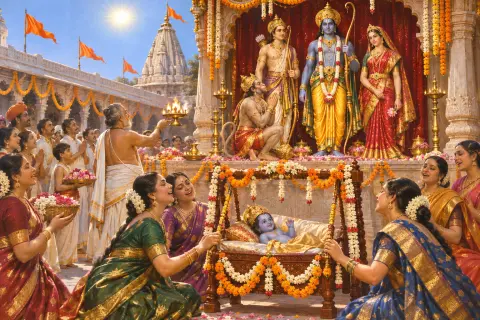 Ram NavamiApr 15, 2027Brahma's boon that no god or demon could kill him is why Vishnu is born as a man, as Rama.
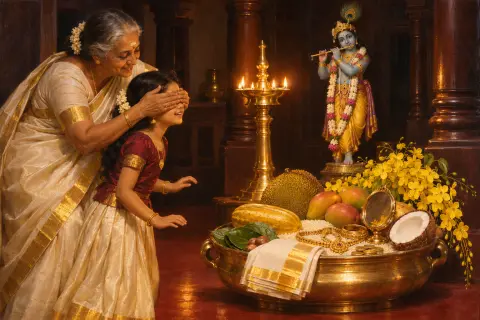 VishuApr 15, 2027A Kerala folk story says that while Ravana ruled, the sun could not rise straight in the east, and that Vishu marks the first true sunrise after his fall.
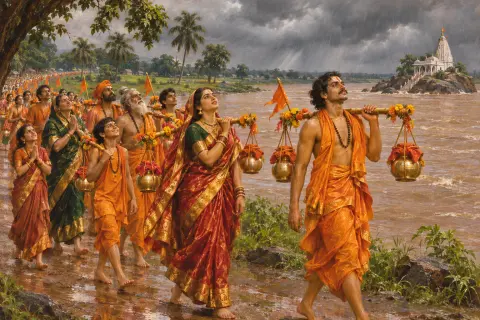 Shravani MelaJul 19 - Aug 17, 2027In the Shiva Purana he wins Shiva's linga by his penance but cannot carry it home, and it stays at Vaidyanatha in Deoghar.
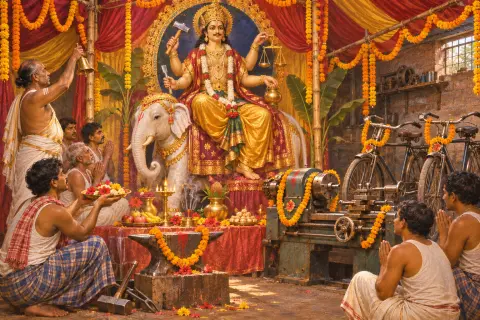 Vishwakarma PujaSep 17, 2027He ruled from Lanka, the golden city that the Uttara Kanda says Vishwakarma built long before him.
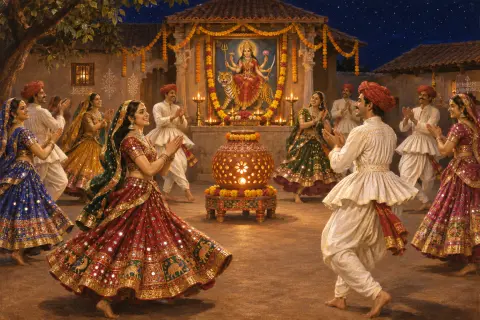 NavaratriSep 30 - Oct 9, 2027The Devi Bhagavata Purana says Rama kept the Navaratri vow before going to war with him.
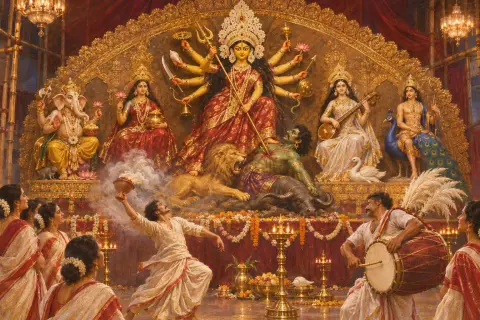 Durga PujaOct 5 - Oct 10, 2027In Krittibas's Bengali Ramayana, Rama wakes the goddess out of season to win her help against him.
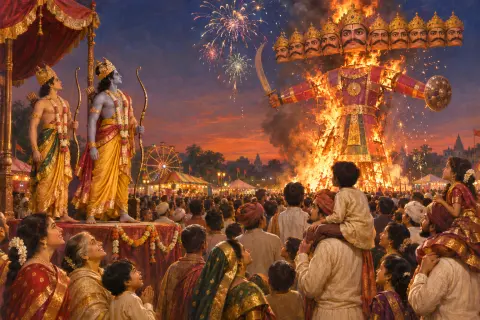 DussehraOct 9, 2027His effigy, with those of Kumbhakarna and Meghnad, is burned on Dussehra evening to mark Rama's victory in the Ramlila tradition.
Paintings
2 paintingsAsk about Ravana
Ask Gita Chat about Ravana and what their story can teach you.