The Story
The oldest written source behind the Shravani Mela is the Shiva Purana (Koti Rudra Samhita, chapter 28). It tells how Ravana won a linga of Shiva and tried to carry it to Lanka, and how it became fixed in the ground at the place now worshipped as Vaidyanatha, one of the twelve jyotirlingas. The Purana does not describe the kanwar walk itself. That grew up as a living custom: in Shravana, the month that belongs to Shiva, devotees carry Ganga water to his linga and pour it over him. Deoghar in Jharkhand is the best known claimant of the Vaidyanatha jyotirlinga, and the walk from Sultanganj on the Ganga to Deoghar is what people in Bihar and Jharkhand mean by the Shravani Mela.
Ravana and the Linga That Would Not Move
The Shiva Purana says Ravana first worshipped Shiva on Mount Kailasa for a long time, but Shiva was not pleased. So Ravana went to the southern slopes of the Himalaya, dug a pit, lit a fire and did harsh penance: standing among five fires in summer, sleeping on bare ground in the rains and standing in water in winter. When even that did not move Shiva, he began to cut off his own heads and offer them one by one. He had offered nine, and was about to offer the last, when Shiva appeared, put his heads back without pain and granted him great strength.
Ravana asked to take Shiva's linga to Lanka. Shiva agreed, but with one warning: wherever the linga was set down on the ground, there it would stay. On the way, by Shiva's own maya, Ravana felt an urge to relieve himself that he could not hold back. He handed the linga to a cowherd and went aside. He was gone a long time, the linga grew too heavy, and the cowherd put it down. It stayed fixed in the earth.
The Purana says Brahma, Vishnu and the other gods came, worshipped the linga there and named it Vaidyanatha. Folk tellings in Deoghar add their own details, such as who the cowherd really was, and these vary from family to family. The word vaidya means healer, and many people take the name to mean Shiva the healer, the one who made Ravana whole again.
Why Water: Neelakantha and the Poison
The second story people tell on the road is from the Bhagavata Purana (Book 8, chapter 7). When the gods and the asuras churned the ocean of milk for nectar, using Mount Mandara as the churning rod and the serpent Vasuki as the rope, the first thing that rose was not nectar but a terrible poison called halahala. It spread in every direction and the worlds began to burn.
The gods ran to Shiva. Out of compassion for every living being, and with Parvati's consent, he gathered the poison in his palm and drank it. He held it in his throat, which turned dark blue, and from then on he is called Neelakantha, the blue-throated one. The Bhagavata says a few drops spilled, and that is why snakes, scorpions and some plants carry poison.
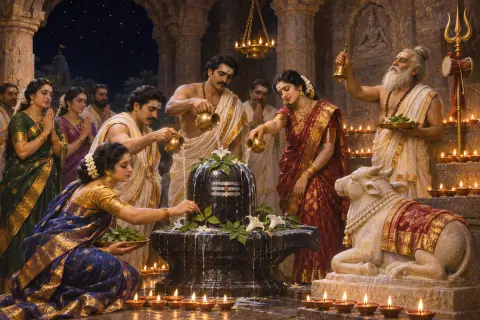
The Purana itself does not link this to water offerings. The link is a popular belief: devotees say the poison still burns in Shiva's throat, and cool Ganga water poured on the linga soothes him. Many also believe the churning took place in Shravana, which is one reason the month belongs to him. Whatever the reason a family gives, the act is the same: water from the Ganga, carried with care, poured with love.
From Sultanganj to Deoghar
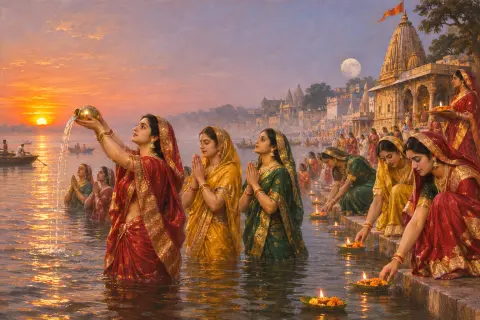
The walk starts at Sultanganj in Bhagalpur district, Bihar. Here the Ganga turns and flows north for a stretch, which people consider especially holy, and the temple of Ajgaibinath stands on a rocky island in the river. Pilgrims bathe, fill two small pots with Ganga water, tie them to the two ends of a decorated bamboo pole called a kanwar, and first offer water at Ajgaibinath.
Then they set out for Deoghar, about 105 km away, mostly barefoot, through villages, fields and the hills of Jharkhand. They call each other Bam, and the road rings with Bol Bam and Har Har Mahadev. Along the way there are rest camps, free food stalls, medical tents and special stands to hang the kanwar on, because by custom the kanwar should not touch the ground. Most pilgrims take three or four days.
Some go further. The Dak Bam carry their water without stopping at all, walking fast or running, usually aiming to finish within about a day. In Deoghar, pilgrims bathe in the Shivganga pond and wait in long queues to pour their water on Baba Baidyanath. Many then go on to Basukinath in Dumka district to offer water there too, saying the pilgrimage is not complete without it.
Sawan Across North India
The same custom is kept across north India under the name Kanwar Yatra. In western Uttar Pradesh, Uttarakhand, Haryana and Delhi, kanwariyas fetch Ganga water from Haridwar, and some from Gaumukh or Gangotri higher up, and carry it home to pour on Shiva in their own town or at temples like Pura Mahadev near Meerut. There the high point is usually Sawan Shivaratri, the fourteenth night of the dark half of Shravana.
In Bihar there are other well loved routes as well. Many people carry water from Pahleja Ghat at Sonepur to Baba Garibnath in Muzaffarpur. Across towns and villages, people who cannot walk far still keep the month: they fast on Sawan Mondays, offer water, milk and bel leaves at the nearest Shiva temple, and avoid meat and alcohol for the whole month.
What the Walk Asks of a Pilgrim
The kanwar walk has simple rules that most pilgrims keep strictly. Bathe before setting out. Wear saffron. Eat only simple vegetarian food, with no meat, alcohol or tobacco. Keep celibacy for the journey. Do not put the kanwar on the ground, and if you need to rest, hang it on a stand. Speak kindly and do not quarrel on the way.
Nobody pretends the road is easy. Feet blister, the monsoon heat is heavy, and the crowds are huge. Yet pilgrims come back year after year, often in groups from the same village, and many say the hardship is the point. The body does the praying, step by step, and the water reaches Shiva because someone carried it all the way.
In Gita 17.14 Krishna lists the austerities of the body: worship of the gods and the wise, purity, straightforwardness, celibacy and not harming anyone. The kanwar walk is almost exactly that list put on the road for a hundred kilometres. The pot of Ganga water is small. What makes it an offering is the care, the discipline and the kindness that carried it there.