The Story
No Purana or epic tells a story of Vishu. Its oldest root is the solar calendar: the name comes from the Sanskrit vishuva, the equinox, and the festival falls when the sun enters Mesha, called Medam in Malayalam, which Kerala treats as the start of the solar year. Its customs, above all the Vishukkani, were passed down in Malayali homes rather than written in a scripture, and the stories people tell about it are folk tradition. Families keep the day so that the first thing they see in the new year is something good, and to begin the year with blessings from their elders.
The sun turns the year
Vishu falls when the sun enters Mesha, called Medam in Malayalam. The name comes from the Sanskrit vishuva, the equinox, when day and night are of equal length. Long ago the sun's entry into Mesha came close to the spring equinox. Over many centuries the two have drifted apart, but the name stayed.
The official Malayalam calendar, the Kollavarsham, starts its year in Chingam, in August or September. Even so, many Malayalis think of Vishu as the true new year, the one that follows the sun. It is also the start of the farming year. In the old village calendar, the first seeds were sown around Vishu, before the monsoon rains.
Setting up the kani
Kani means the first thing you see. The idea is simple: whatever you see first on the new year's morning sets the tone for the year. So families make sure it is something full and beautiful.
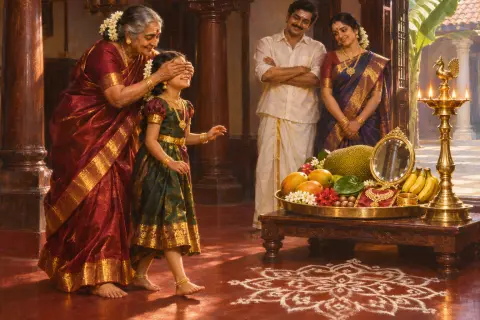
The kani is arranged in an uruli, a wide bell-metal vessel. Common items are raw rice, a golden cucumber (kani vellari), jackfruit, mangoes, coconut, betel leaves and areca nut, gold ornaments and coins, a folded kasavu cloth, a metal mirror, and a holy book such as the Ramayana or the Bhagavata. Above all there are bunches of konna flowers, the bright yellow blossoms of the Indian laburnum, which flower in Kerala just at this time. A nilavilakku, the tall brass oil lamp, stands beside it, and an image of Krishna watches over everything.
Exactly what goes in changes from family to family and region to region. Some families put the kani in the prayer room, others in the main hall. What does not change is the care that goes into it.
Waking to the kani
Before sunrise, the person who set up the kani lights the lamp. Then she wakes the others and leads them, with their eyes closed or covered by her hands, to stand in front of it. When they open their eyes, the first things they see are the lamp, the gold, the fruit, the flowers and Krishna's face reflected in the light.
In many homes the kani is then carried to those who could not come to it: the elderly, the sick, and in some villages even the cows in their shed. At the Guruvayur temple, crowds wait through the night to see Vishukkani before Guruvayurappan, as Krishna is known there, in the early hours. Sabarimala also opens its doors for Vishu.
Kaineetam, crackers and the feast
After the kani comes Vishu kaineetam. The elders of the family give money, often coins and new notes, to children and younger relatives, and many households also give it to the people who work for them. It is a small blessing for a prosperous year, and children look forward to it all year.
Then the noise begins. Firecrackers, called padakkam, go off from early morning, and children burst them all through the day. Later the family sits down to the Vishu sadya, a meal served on banana leaves. Different parts of Kerala have their own Vishu dishes, such as Vishu kanji (a rice gruel with coconut milk), Vishu katta (rice set with coconut milk), and mampazha pulissery, a tangy curry of ripe mango and yoghurt. In some places an astrologer reads out the Vishuphalam, the forecast for the year ahead.
Stories people tell
Because no Purana gives Vishu a fixed story, families tell different ones. Many link the day to Krishna, which is why his image sits at the centre of the kani. Some say Vishu remembers Krishna's victory over the demon Narakasura, which other parts of India remember at Diwali.
Another folk story says that while Ravana ruled, he did not let the sun rise straight in the east, and that Vishu marks the first morning the sun rose in its proper place after Ravana fell. These are popular beliefs, not scripture, and Malayalis hold them lightly. The heart of the day is the kani: beginning the year by looking at something good.
Nothing in the Vishukkani is costly or rare. It is rice, fruit, a few flowers, a lamp and a little gold, set down with love before Krishna. In the Gita (10.21) Krishna says: among the Adityas I am Vishnu, and among the lights I am the radiant sun. Vishu holds both in one morning. The sun turns the year, and the first face the family sees by lamplight is Krishna's. The day asks us to begin the year by offering what we have, and by looking first at what is good.