Jagannath, Lord of the world, is the form of Krishna and Vishnu worshipped at the great temple of Puri in Odisha. He is a carved and painted wooden image with a dark face, huge round eyes and short arms, enshrined beside his elder brother Balabhadra, his sister Subhadra and the Sudarshana pillar. His worship is told in the Skanda Purana and the Brahma Purana and, above all, in Odia tradition. He is known for the Rath Yatra, when the three deities ride huge chariots through Puri, for the Mahaprasad cooked in his kitchen, and for Nabakalebara, when the wooden images are replaced with new ones. For Odisha he is the centre of its religious and cultural life.
Also called: Jagannatha (Lord of the world), Jagabandhu (friend of the world), Purushottama (the Supreme Person, also the old name of Puri), Nilamadhava (the blue Madhava, as he was first worshipped in the forest), Kalia (the dark one, an Odia name of love), Chaka Akhi or Chakadola (the round-eyed one), Darubrahma (God in wood), Patitapavana (purifier of the fallen), Mahaprabhu (the great Lord)
Who he is: Krishna as worshipped at Puri; also Vishnu as Purushottama
Elder brother: Balabhadra, identified with Balarama
Sister: Subhadra
Wives: Lakshmi, who has her own shrine inside the temple complex, and Bhudevi
Weapon: Sudarshana, worshipped as a pillar at his side
Home: the Shri Mandira at Puri, on the eastern sea; once a year he stays at the Gundicha temple
Servants: the daitapatis, said to descend from the Shabara chief Vishvavasu, and the Gajapati king of Puri, his first servant
कदाचित्कालिन्दीतटविपिनसङ्गीततरलो
मुदाभीरीनारीवदनकमलास्वादमधुपः।
रमाशम्भुब्रह्मामरपतिगणेशार्चितपदो
जगन्नाथः स्वामी नयनपथगामी भवतु मे॥
Sometimes, in the groves on the bank of the Yamuna, he is lost in music; like a bee he delights in the lotus faces of the cowherd women; his feet are worshipped by Lakshmi, Shiva, Brahma, Indra and Ganesha. May Jagannath, my Lord, come before my eyes.
Stories
Jagannath's story comes from three kinds of sources. The Sanskrit Puranas tell of King Indradyumna founding his worship at Purushottama Kshetra, the old name of Puri: the Brahma Purana in its chapters on that holy place, and the Purushottama Kshetra Mahatmya in the Vaishnava Khanda of the Skanda Purana. Odia literature adds much more, above all the fifteenth century Odia Mahabharata of Sarala Das, which ties Jagannath directly to Krishna's death. And the temple itself keeps a living tradition of rituals, festivals and stories handed down by its servants. The present temple was begun in the twelfth century under King Anantavarman Chodaganga of the Eastern Ganga dynasty. Jayadeva's Gita Govinda has been sung there for centuries, and Chaitanya Mahaprabhu spent his last years in Puri. Historians also debate older roots in the worship of Odisha's forest peoples, and some see Buddhist or Jain traces; devotees see simply Krishna.
Nila Madhava, the log and the unfinished images
The Skanda Purana tells how Indradyumna, a devout king of Avanti, longed to see Vishnu in bodily form and came to the shore of the eastern sea to build a great temple. Vishnu told him in a dream that a log would float in from the sea, and that his image should be made from it.
Odia tradition adds that the king's priest Vidyapati first found a blue deity, Nila Madhava, worshipped in secret in the forest by Vishvavasu, a chief of the Shabara people. Vidyapati married Vishvavasu's daughter Lalita and through her was led to the shrine. By the time the king arrived, Nila Madhava had vanished, and the sacred log, the daru, appeared on the shore instead.
No craftsman could cut it until an old carpenter came, said to be Vishwakarma or Vishnu himself, who would work alone behind closed doors for twenty one days. When the sound of the chisel stopped, Queen Gundicha persuaded the king to open the doors early. The carpenter was gone, and the three images stood unfinished, with round eyes, no feet and no hands. A voice told the king that the Lord wished to be worshipped exactly so. The Rath Yatra page tells this part of the story in more detail.
Krishna's heart in the wood
The fifteenth century Odia Mahabharata of Sarala Das links Jagannath to the end of Krishna's life. In the Sanskrit Mahabharata, a hunter named Jara shoots Krishna in the foot, taking it for a deer, and Krishna leaves the world. Sarala Das goes on: when Krishna's body was placed on the funeral pyre, it would not burn completely, and what remained was given to the sea.
Long afterwards, in this telling, that remnant came to the shore at Puri as the daru, the sacred log, and the Shabara hunter Jara, whose arrow had ended Krishna's life, became a worshipper of the Lord in the forest. The daitapatis, the temple servants who care for the deities during their illness and the chariot festival, are said to descend from that Shabara line.
Many devotees connect this story with the brahma padartha, the sacred substance at the heart of each image that is moved from the old images to the new ones during Nabakalebara. What it is, nobody outside the few servants who carry it knows, and they do so blindfolded.
Why there are three of them
The temple worships Krishna with his elder brother Balarama, here called Balabhadra, and their sister Subhadra, not with his wives, which is unusual for a Krishna temple. The three are the children of Vasudeva, the family of the Mahabharata, and Subhadra stands between her brothers as they protect her.
A popular devotional story explains their form. In Dwaraka, Krishna's queens asked his foster mother Rohini to tell them about Krishna's childhood in Vrindavan. Subhadra was set to guard the door. Krishna and Balarama came and stood beside her, listening, and as Rohini spoke of Vraja they were so overcome that their eyes grew wide and their arms and legs drew into their bodies. The sage Narada saw them so and prayed that the Lord would show himself in this form on earth. This story is told by devotees, especially in the Gaudiya tradition, and is not in the old Puranas.
Some in Odisha also see a meeting of traditions in the three: Balabhadra linked with Shiva, Subhadra with the Goddess and Jagannath with Vishnu. Inside the temple complex there are shrines to Lakshmi, Vimala (a form of the Goddess) and many others, and the temple's food is offered to Vimala before it becomes Mahaprasad.
The year of the Lord at Puri
Jagannath's year is full of festivals. On Akshaya Tritiya, building of the new chariots begins and the Chandan Yatra starts, when festival images are taken out on boats in the Narendra tank. On Snana Purnima, the full moon of Jyeshtha, the three are bathed with one hundred and eight pots of water, after which they are said to fall ill and are hidden from view for about two weeks, the anasara.
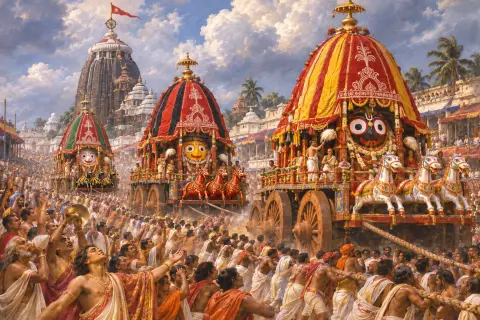
Then comes Rath Yatra: the deities ride three new chariots, Taladhwaja, Darpadalana and Nandighosha, to the Gundicha temple, the Gajapati king sweeps the chariots with a gold-handled broom, and anyone at all may pull the ropes. They return on the Bahuda Yatra, are dressed in gold on the chariots for the Suna Besha, and go back in on Niladri Bije, when Lakshmi first shuts the door on Jagannath and lets him in only after he offers her rasagola.
Every day the temple kitchen, said to be one of the largest in the world, cooks rice, dal, vegetables and sweets in clay pots over wood fires. After it is offered, the food becomes Mahaprasad and is sold in the Ananda Bazaar inside the temple. People of every caste sit and eat it together, which in Puri has long been a sign that before Jagannath all are equal.
Nabakalebara, the new body
Temple servants worship the chosen neem tree before cutting it for Jagannath's new body.
Because the images are made of wood, they are replaced from time to time in a great ritual called Nabakalebara, the new body. It is held in a year with an extra month of Ashadha in the lunar calendar, which comes every twelve to nineteen years. The most recent ones were in 1977, 1996 and 2015.
A team of daitapatis and priests sets out from Puri in search of the right neem trees, the Banajaga Yatra. They stop at the temple of the goddess Mangala at Kakatpur, who, it is believed, shows them in dreams where the trees are. Each tree must carry signs: for Jagannath, a dark bark, four main branches and the marks of a conch and a discus; an anthill nearby and a snake guarding the roots are counted as good signs. The tree is worshipped, cut and carried to Puri, where the new images are carved in secret.
At midnight, in total darkness, a few senior daitapatis move the brahma padartha from each old image to the new one. The old images are then buried in a place inside the temple grounds called Koili Baikuntha, and the Lord appears again in a new body, as the soul takes a new body in the Gita.
Saints and poets of Jagannath
Jayadeva, the twelfth century poet of the Gita Govinda, is closely tied to Puri in Odia tradition, and his songs have been sung before Jagannath for centuries. In the sixteenth century the Bengali saint Chaitanya Mahaprabhu lived in Puri for about eighteen years. The Chaitanya Charitamrita describes him weeping with love on seeing Jagannath and dancing before his chariot at Rath Yatra.
Odia devotion has its own saints. Salabega, born to a Muslim father, wrote some of the best loved songs to Jagannath, and the chariot is said to pause near his resting place on the Grand Road. The Panchasakha poets of the fifteenth and sixteenth centuries, among them Jagannatha Dasa, whose Odia Bhagavata is still read in villages, put Jagannath at the heart of Odia literature.
Odia folk stories are full of Jagannath stepping out of the temple for his devotees: riding to war for the king of Puri disguised as a horseman, or accepting coconuts from a poor low-caste devotee, Dasia Bauri, who could not enter the temple. These are folk tales, but they show how people see him: a Lord who comes out to meet them.
How to recognise
•Jagannath has a black face, two huge round eyes with black pupils (chaka akhi), a wide red smile and short arms held straight forward. He has no hands or legs. The image is carved from neem wood and painted.
•Balabhadra, the elder brother, stands on Jagannath's right with a white face, and a serpent hood often rises behind him, because Balarama is held to be a form of Shesha, the serpent who carries the world.
•Subhadra, the sister, stands between her brothers. She is smaller, with a yellow face, and has no arms at all.
•Beside them stands Sudarshana, Vishnu's discus, in the form of a tall wooden pillar wrapped in red cloth. Small metal images of Madhava, Shridevi (Lakshmi) and Bhudevi share the jewelled throne, the ratna simhasana.
•The deities are dressed in many beshas, or costumes, through the year. On Snana Purnima they wear the elephant faced Hati Besha, and during Rath Yatra they are covered in gold in the Suna Besha.
•Those who cannot enter the temple, including non-Hindus, see him as Patitapavana, an image at the Lion Gate, and as the flag on the eight-spoked Nilachakra on top of the temple, which is changed every day.
•Devotees give many meanings to the unfinished form: a Lord without hands who still reaches everyone, eyes that never close. Scholars point out that wooden post deities of Odisha's forest peoples look much like him and see this as one of his roots.
Verily, Thou Thyself knowest Thyself by Thyself, O Supreme Person, O source and Lord of beings, O God of gods, O ruler of the world!
Arjuna calls Krishna Purushottama, the Supreme Person, and Jagatpati, Lord of the world. Both are the names Odisha gives Jagannath: Puri's old name is Purushottama Kshetra, and Jagannath means Lord of the world. The Gita does not speak of Puri; the link is in the names.
As I transcend the perishable and am even higher than the imperishable, I am declared to be the highest Purusha in the world and in the Vedas.
Krishna says that because he is beyond the perishable and higher than the imperishable, he is known in the world and the Veda as Purushottama. This is the title by which Jagannath is worshipped at Puri.