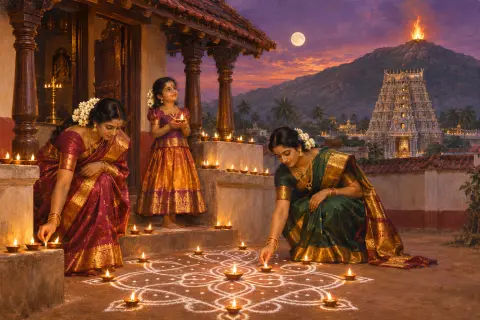
The Story
Raja has no story of its own in the Puranas. It is a farming custom of coastal Odisha, kept alive by village practice and word of mouth, and its name says what it is: raja comes from rajaswala, the Sanskrit word for a woman who is menstruating. The belief behind it rests on older texts. The Puranas call the earth Bhudevi, a goddess and the consort of Vishnu, and in the Bhagavata Purana (Canto 3, chapter 13) Vishnu as the boar Varaha lifts her out of the cosmic ocean. Odia farmers treat the first days of the monsoon as her period, when she must rest. So for three days no one ploughs or digs, and on the fourth day she is bathed and the sowing can begin.
Why the earth rests
In Hindu tradition the earth is a goddess. In the Puranas she is Bhudevi, also called Prithvi or Vasumati, and she is a consort of Vishnu. When Vishnu took the form of Varaha, the boar, it was Bhudevi he lifted out of the cosmic ocean. In Odisha, where Vishnu is worshipped as Jagannath, Bhudevi is honoured as one of his wives.
The farmers of Odisha connect the coming of the rains with the earth becoming fertile, the same way a woman's cycle is connected with her ability to bear children. So the first days of the monsoon are treated as Bhudevi's menstruation. Just as many families let a woman rest during her period, they let the earth rest. No ploughing, no digging, no sowing, no building that breaks the ground.
After three days the earth is bathed and is ready to receive seed. In that sense Raja is a pause before the year's hardest farm work begins. It is a festival of waiting, and of respect for what gives life.
Four days, each with its own name
The day before the festival is Sajabaja, the day of getting ready. Houses are cleaned, kitchens are stocked, spices are ground, and enough is cooked ahead so that the festival days can be easy.
The first day is Pahili Raja, the first Raja. The second is Raja Sankranti, which is also Mithuna Sankranti, when the sun moves into Gemini and the solar month of Ashadha begins. The third is Bhuin Daahana or Basi Raja. On these three days the earth is left alone.
The fourth day is Vasumati Snana or Vasumati Gadhua, the bath of the Earth Mother. Women take the grinding stone, the sila, which stands for Bhudevi in many homes, and bathe it with water and turmeric paste. They decorate it with flowers and vermilion and offer fruit and seasonal food. With that bath the festival is over and life goes back to normal.
A festival for girls and young women
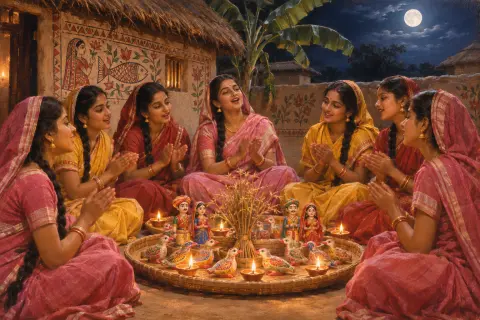
Raja belongs most of all to unmarried girls and young women. The idea is simple: if the earth is resting in her womanhood, the young women of the house should rest and be celebrated too. For three days they do no housework. They do not cut or grind, and by custom they avoid walking barefoot on the ground, so as not to disturb the resting earth.
They bathe early, put on new saris or dresses, paint their feet with alta, wear flowers and jewellery, and spend the days with friends. In many villages girls are seen as future mothers, and the festival is a way of wishing them a full and healthy life ahead.
In recent years many people in Odisha have also spoken about Raja as a festival that treats menstruation as natural and worthy of respect, not as something to hide. That reading is modern, but it grows from the old custom itself.
Swings, songs and poda pitha
The best-known sight of Raja is the swing. Families tie swings, called doli, to the branches of mango and banyan trees, or build them from wood and rope. There are different kinds, such as ram doli, charki doli and pata doli. Girls take turns swinging high and singing Raja songs, short folk songs about love, the monsoon, longing and everyday life.
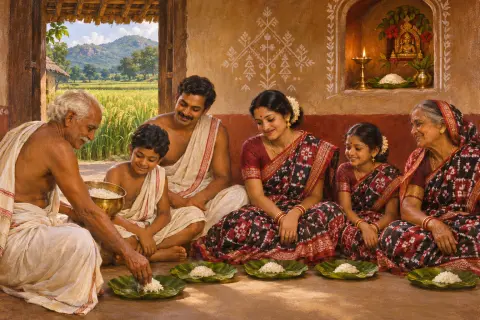
Then there is food. The festival dish is poda pitha, which means burnt cake. It is made from rice and black gram batter with coconut, jaggery and cardamom, wrapped in leaves and baked slowly until the outside is dark and the inside is soft. Homes also make other pithas like chakuli and manda, and everyone eats Raja paan, a betel leaf filled with sweet spices.
Men and boys have their own fun. Village games, kabaddi matches, card games and folk performances fill the afternoons. In towns, Raja melas and cultural programmes are now common, and Odia families living in other states and abroad gather for Raja meets.
Raja beyond the village
Raja is most strongly kept in coastal Odisha, in districts such as Puri, Cuttack, Balasore and Ganjam, but Raja Sankranti is a public holiday in the state and the festival is now celebrated all over Odisha, in cities as much as in villages.
The same belief, that the earth menstruates at the start of the monsoon, is found elsewhere in eastern India. At the Kamakhya temple in Assam, the Ambubachi Mela at about the same time marks the goddess's yearly menstruation, and the temple stays closed for three days. Raja is the home and field version of that idea, kept by ordinary families rather than in one shrine.
In the Gita (7.9) Krishna says: I am the sweet fragrance of the earth and the life in all beings. Anyone who has smelled the ground after the first monsoon rain knows that fragrance. Raja asks us to stop for a few days and treat that earth, and the women who carry life, as sacred. It is a reminder that what feeds us is not a tool to be used without rest, but a presence of the divine to be cared for.