The Story
The oldest written account of Jagannath's chariot festival is in the Purushottama Kshetra Mahatmya of the Skanda Purana (Vaishnava Khanda), which tells how King Indradyumna established the worship of Jagannath at Puri and describes a yearly journey of the deities on chariots to the Gundicha temple. Temple tradition in Puri explains why the journey is made: the deities go to stay for a week at the house of Gundicha, the queen whose devotion is remembered in that temple's name, and then return home. On this one day the Lord who usually sits inside a temple that only Hindus may enter comes out onto the open road, and anyone at all can see him and pull his chariot.
The log that came from the sea
The Skanda Purana says that Indradyumna, a devout king of Avanti, longed to see Vishnu in bodily form. He learned of a sacred place on the eastern sea, Purushottama Kshetra, and went there to build a great temple. Vishnu told him in a dream that a log would come floating in from the sea, and that the images of the Lord should be made from it.
Odia tradition adds much to this. In the popular telling, the king's priest Vidyapati first finds a deity called Nila Madhava, worshipped in secret in the forest by Vishvavasu, a chief of the Shabara tribe. Vidyapati marries Vishvavasu's daughter Lalita, and only through her is he led to the shrine. When the king arrives, Nila Madhava has vanished, and the log, the daru, appears on the shore instead. Accounts differ on the details, and families tell them in different ways.
Many people see a meaning in the Shabara part of the story. Jagannath was worshipped by a forest people before any king found him, and the daitapati servants who look after the deities during Rath Yatra are, by tradition, said to descend from Vishvavasu's line.
Why the images are unfinished
The best-known part of the story is told in Odia tradition rather than in the Skanda Purana. No craftsman could cut the log. Then an old carpenter appeared, said by some to be Vishwakarma, the divine architect, and by others Vishnu himself. He agreed to carve the images on one condition: he would work alone behind closed doors for twenty one days, and no one was to open them.
After some days the sound of the chisel stopped. Queen Gundicha grew worried that the old man had died of hunger, and she persuaded the king to open the doors. The carpenter was gone. Inside stood three unfinished images, with large round eyes, no feet, and arms that end without hands.
The king was heartbroken, but a voice told him that the Lord wanted to be worshipped in exactly this form. That is how Jagannath, Balabhadra and Subhadra are seen today. Devotees often say that a Lord without hands and feet still reaches everyone, and that his wide open eyes never stop looking at the world.
The days before the chariots roll
The festival really begins on Snana Purnima, the full moon of Jyeshtha. The three deities are brought out and bathed with one hundred and eight pots of water. After this bath they are said to fall ill with fever, and for about two weeks they are kept out of public sight while the temple's servants care for them with herbal medicines. This time is called anasara.
Meanwhile carpenters in Puri build three new chariots from fresh wood, as they do every year. Jagannath's chariot, Nandighosha, has sixteen wheels and red and yellow cloth. Balabhadra's, Taladhwaja, has fourteen wheels in red and green. Subhadra's, Darpadalana, has twelve wheels in red and black. The day before the procession, devotees clean the Gundicha temple in a ritual called Gundicha Marjana.
On the morning of Rath Yatra the deities are carried out of the temple to the chariots in a rocking, swaying procession called pahandi, to the sound of gongs, conches and drums. Then the Gajapati king of Puri, the traditional ruler and first servant of Jagannath, sweeps the floor of each chariot with a gold-handled broom and sprinkles sandal water. This ritual, chhera pahanra, shows that before the Lord even a king is a sweeper.
To Gundicha and back
Then the ropes are pulled. Balabhadra's chariot goes first, Subhadra's next and Jagannath's last, along the wide Bada Danda, the Grand Road, to the Gundicha temple. Hundreds of thousands of people come to Puri. Anyone may take hold of the ropes, whatever their caste or religion, and many believe that pulling them even for a moment is a blessing.
The deities stay at Gundicha for a week. On Hera Panchami, Lakshmi, Jagannath's wife, who has been left behind in the main temple, comes looking for him. In the temple's dramatic retelling she is upset, and her attendants damage a part of his chariot before she goes home.
On Ashadha Shukla Dashami comes the Bahuda Yatra, the return journey. On the way the chariots stop at the Mausi Maa temple, the shrine of Jagannath's aunt, where he is offered poda pitha. The next day the deities are dressed in gold ornaments on their chariots, the Suna Besha, and a day later they are offered a sweet drink in tall clay pots, the Adhara Pana. On Niladri Bije they finally go back inside. Temple tradition says Lakshmi shuts the door on Jagannath at first, and lets him in only after he offers her rasagola.
Chariots far from Puri
Chaitanya Mahaprabhu, the Bengali saint, lived his last years in Puri. The Chaitanya Charitamrita (Madhya Lila, chapter 13) describes him singing and dancing with his followers in front of Jagannath's chariot, so lost in love that the crowds forgot to pull. Many Vaishnavas still keep Rath Yatra in his spirit. Odia tradition also remembers Salabega, a poet born to a Muslim father, who wrote songs for Jagannath, and the chariot is said to pause near his resting place on the Grand Road.
Rath Yatra is kept all over eastern India. In West Bengal the Rath Yatra of Mahesh near Serampore is one of the oldest in the state, children pull small chariots through the lanes, and fairs sell papad and jilipi. In Ahmedabad a large procession leaves the Jagannath temple at Jamalpur, and in Ranchi the Rath Mela at the Jagannathpur temple draws people from across Jharkhand. In Manipur the festival is called Kang, and chariots are pulled in Imphal and in neighbourhoods across the valley.
In Bihar, Rath Yatra processions are held in Patna and other towns, many of them led by ISKCON and by local Jagannath temples. Since the late 1960s ISKCON has also taken Rath Yatra abroad, and today chariots of Jagannath are pulled through the streets of London, New York and many other cities.
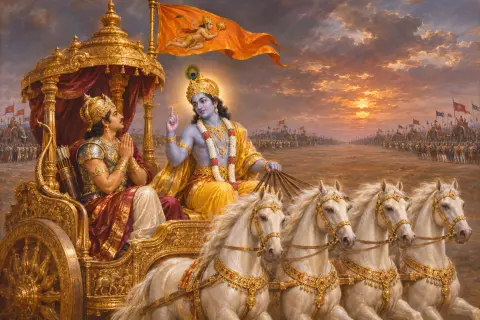
In the Gita (9.29) Krishna says: I am the same to all beings, no one is hateful or dear to me, but those who worship me with love are in me, and I am in them. Rath Yatra puts that verse on the street. For one day the Lord leaves the inner sanctum and comes out to anyone who wants to see him, and the only thing that draws him forward is the love of the people pulling the ropes.