Murugan, also called Kartikeya, Skanda and Subrahmanya, is the son of Shiva and Parvati, the young commander of the gods' army and the most loved god of the Tamil people. He was born to defeat the demon Taraka, raised by the six Krittikas, and holds the Vel, a spear with a broad leaf shaped blade. The Mahabharata, the Ramayana and Kalidasa's Kumarasambhava tell his birth, the Skanda Purana is named after him, and the Tamil Kanda Puranam tells his war with Surapadman. In the Gita Krishna says, "Among generals I am Skanda." His great days are Thaipusam, Skanda Sashti and Karthigai, and his six abodes in Tamil Nadu draw pilgrims all year.
Also called: Kartikeya (son of the Krittikas), Skanda (the leaping one, or the spilled seed), Kumara (the youth), Subrahmanya, Shanmukha and Arumugam (six faced), Senani and Devasenapati (commander of the gods' army), Guha (the hidden one), Saravanabhava (born in the reed pond), Velan (holder of the Vel), Swaminatha, Dandayudhapani (with the staff, at Palani), Muruga (the beautiful one, in Tamil)
Parents: Shiva and Parvati; in the Mahabharata also Agni and Svaha, and Ganga and the six Krittikas as those who carried and nursed him
Brother: Ganesha
Wives: Devasena (Deivanai), given to him by Indra, and Valli, daughter of a hill tribe chief in Tamil tradition. North Indian tradition often sees him as unmarried
Mount: a peacock; his banner bears a rooster
Weapon: the Vel, a leaf bladed spear
Homes: the six abodes (Arupadai Veedu) in Tamil Nadu: Thiruparankundram, Thiruchendur, Palani, Swamimalai, Thiruthani and Pazhamudircholai; in the north, the Krauncha mountain
To one whose stains have been washed away, the revered Sanatkumara shows the shore beyond darkness. Him they call Skanda; him they call Skanda.
Stories
The name Skanda first appears at the end of the Chandogya Upanishad (7.26.2), where it is given to the sage Sanatkumara. As a god he is told of in the epics. The Ramayana (Bala Kanda) has Vishvamitra tell how the Ganga and the Krittikas bore and nursed Kumara, and the Mahabharata gives a long account of his birth from Agni and Svaha in the Vana Parva and of his consecration as general of the gods in the Shalya Parva. Kalidasa's Kumarasambhava sings of the events that led to his birth. The huge Skanda Purana bears his name, and the Tamil Kanda Puranam of Kachiyappa Sivachariyar retells his war with Surapadman. Much older still, the Tamil Sangam poems already praise Murugan as the god of the hills, and the Tirumurukarruppadai of Nakkirar guides pilgrims to his shrines. Over time the Tamil god of the hills and the Sanskrit general of the gods became one.
Born from Fire, Nursed by Stars
Parvati gathers the six babies of the Saravana pool, and they become one child with six faces.
The demon Taraka had won a boon that only a son of Shiva could kill him, and Shiva was lost in meditation after Sati's death. The gods waited for Shiva to marry Parvati. When he did, the fiery seed of Shiva was too strong for anyone to hold. The tellings differ on the details, and they agree on the heart of it.
In the Ramayana (Bala Kanda) and in many Puranas, Agni carried it and then gave it to the Ganga, who laid it in a forest of reeds, the Saravana. There a shining child was born. The six Krittikas, the stars of the Pleiades, came to nurse him, and he grew six faces to drink from all six at once. That is why he is Kartikeya, son of the Krittikas, and Shanmukha, the six faced.
The Tamil telling, in the Kanda Puranam, is the one sung at Thaipusam. Six sparks from Shiva's third eye fell into the Saravana pond and became six baby boys on six lotuses. The Krittika maidens cared for them, and when Parvati came and took all six into her arms at once, they became one child with six faces and twelve arms.
Commander of the Gods
The Mahabharata (Shalya Parva) describes the gods gathering on the banks of the Sarasvati to make the young Skanda their senapati, the commander of their army. Each god gave him gifts and companions. In the Vana Parva, Indra also gives him Devasena, whose name means the army of the gods, as his wife.
Leading that army, Skanda killed the demon Taraka with his spear and freed the three worlds. Kalidasa's Kumarasambhava and the Puranas point to this victory as the reason for his birth, and the Kaumarika Khanda of the Skanda Purana tells the battle at length. The Mahabharata also tells how he split the Krauncha mountain with his spear.
This is the role Krishna names in the Gita (10.24): "Among commanders of armies I am Skanda." When Krishna wants to point to the very best general, he names this young son of Shiva.
The Vel and Surapadman
The Tamil Kanda Puranam gives the war its best known shape. Three asura brothers, Surapadman, Simhamukha and Tarakasura, had won great boons and held the gods captive. Before Murugan led the gods to war, Parvati gave him her Shakti Vel. Tamil tradition holds that she gave it on Thai Pusam, which is why that day is his.
Murugan defeated the brothers one by one. Surapadman fought on with magic, changing shape again and again, until at last he became a huge mango tree in the middle of the sea. Murugan threw the Vel and split the tree in two. Even then he did not destroy him. One half became a peacock, which he took as his mount, and the other a rooster, which he put on his banner.
The battle is acted out every year at Tiruchendur on the seashore during Skanda Sashti, in the month of Aippasi. The fast of those six days ends with Soorasamharam, the defeat of Surapadman, and the next day with Murugan's wedding to Deivanai.
The Fruit, the Hill and the Meaning of Om
A Tamil story told at Palani says the sage Narada brought a single sacred fruit to Shiva and Parvati, and they offered it to whichever son went around the world first. Murugan flew off on his peacock. Ganesha simply walked around his parents, saying they were his whole world, and won the fruit. Murugan, hurt, left Kailash and stood on the hill of Palani as a renunciant with only a staff. Shiva and Parvati followed him and said, "You yourself are the fruit," pazham nee, and tradition says this is how the hill got its name. The Shiva Purana tells a similar contest over who would marry first.
Another Tamil story belongs to Swamimalai. Brahma could not explain the meaning of Om to the boy Murugan, so Murugan held him captive. When Shiva asked his son to explain it himself, Murugan sat on his father's lap and taught him the meaning of the Pranava. There he is worshipped as Swaminatha, the teacher of his own father. Both stories are temple and folk tradition, much loved in Tamil Nadu.
Valli, the Girl of the Hills
Tamil tradition, told in the Kanda Puranam and in many folk songs, gives Murugan a second wife who is wholly of the Tamil land. Valli was the daughter of Nambi, a chief of the hill people, the Kuravas. She was found as a baby among the valli creepers and grew up guarding her father's millet field from birds.
Murugan came to her in disguise, first as a hunter, then as an old man asking for water and shelter. Valli did not know him and kept her distance. So Murugan asked his brother for help, and Ganesha appeared as a wild elephant. Frightened, Valli ran into the old man's arms, and Murugan showed his true form. They married at Thiruthani.
Devasena, Indra's daughter, and Valli, a girl of the forest, stand on either side of him in many temples. Devotees read the pair as action and desire, or as the god accepting both the heavenly and the earthly. In the poems of the Sangam age, Murugan is already the god of the kurinji, the hill country, where Valli's people lived.
The Six Abodes
The Tirumurukarruppadai, a Tamil poem by Nakkirar in the Pattuppattu collection, guides a devotee to the places where Murugan can be found. From it comes the idea of the Arupadai Veedu, the six camps or abodes: Thiruparankundram near Madurai, where he married Deivanai; Thiruchendur on the sea, where he defeated Surapadman; Palani, where he stands as the renunciant; Swamimalai, where he taught his father; Thiruthani, where he married Valli; and Pazhamudircholai in the hills near Madurai. The poem's fifth place is "every hill where he plays", which tradition later fixed at Thiruthani.
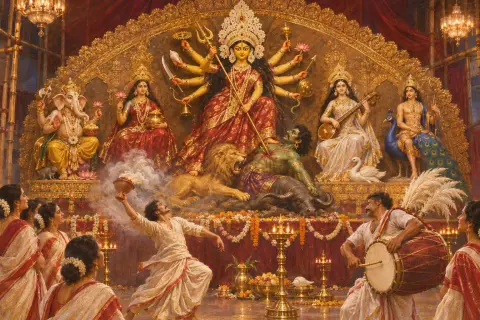
Pilgrims visit all six, and on Thaipusam the crowds at Palani run into the hundreds of thousands. Tamil communities have carried his worship to Malaysia, Singapore, Sri Lanka, Mauritius and beyond, where Thaipusam at Batu Caves is one of the largest gatherings of the year. In Odisha, girls worship him as Kumara on Kumar Purnima, and in Bengal he stands with his peacock beside Durga in the pandal.
How to recognise
•A young man, often a boy, handsome and calm. Muruga in Tamil means the beautiful one, and his youth is part of who he is: Kumara, the ever young.
•The Vel, a tall spear with a broad leaf shaped blade, is his sign. In many Tamil shrines the Vel alone stands in the sanctum and is worshipped as him. Tamil tradition says Parvati gave it to him.
•His mount is a peacock, and a rooster appears on his banner. In the Kanda Puranam both come from the demon Surapadman, split in two by the Vel.
•As Shanmukha he has six faces and twelve arms holding weapons such as the Vel, sword, bow, arrows, discus and thunderbolt. Many images give him one face and two or four arms instead.
•At Palani he is Dandayudhapani, a shaven headed boy renunciant in a loincloth holding only a staff. At Swamimalai and in many homes he is a little prince with a crown.
•He often stands between his two wives, Valli on one side and Devasena (Deivanai) on the other. In Bengal's Durga Puja image he stands with his peacock beside his mother, as a handsome young prince with a bow.
And, among the household priests (of kings), O Arjuna, know Me to be the chief, Brihaspati; among the army generals I am Skana; among lakes I am the ocean.
Krishna says, "Among commanders of armies I am Skanda." Skanda, Murugan, is named as the greatest general of all, the leader of the gods' army against Taraka, one of the forms in which Krishna's glory is easiest to see.