The Story
The oldest written account of the Karthigai festival of lamps is in Sangam Tamil poetry. The Akananuru, an anthology of love poems from the early centuries CE, describes the rows of lamps lit in the streets on the full moon of Karthigai (poem 141 is the one usually quoted), and the poet Avvaiyar also mentions the festival. The story told for the day comes from Tiruvannamalai. The Linga Purana and the Shiva Purana tell how Shiva appeared as an endless column of fire between Brahma and Vishnu, and the Arunachala Mahatmya of the Skanda Purana says that column became the hill of Arunachala. The Shiva Purana and the Arunachala Mahatmya place that first appearance on the Ardra star in the month of Margashirsha, and another page on this site tells it for Maha Shivaratri. The link with Karthigai is Tamil temple tradition, which holds that Shiva shows himself on the hill as a flame on this night every year.
The Column of Fire
The Shiva Purana (Vidyeshvara Samhita) and the Linga Purana tell that Brahma and Vishnu once argued over which of them was greater. As the quarrel grew, a column of fire appeared between them, so huge that neither its top nor its base could be seen.
They agreed that whoever found an end of the column would be the greater one. Brahma took the form of a swan and flew upward. Vishnu took the form of a boar, Varaha, and dug down into the earth. They searched for a very long time and found nothing. Vishnu came back and said honestly that he could not find the end.
In the Shiva Purana, Brahma claimed he had seen the top, and brought a ketaki flower that had been falling from above as his witness. Then Shiva appeared from the column. He praised Vishnu for his honesty and rebuked Brahma for the lie, and the ketaki flower has not been offered to Shiva since. The story is called Lingodbhava, the appearance of the linga, and many Tamil Shiva temples carve it on the back wall of the sanctum.
How the Fire Became a Hill
The Arunachala Mahatmya, a part of the Maheshvara Khanda of the Skanda Purana, takes the story to Tiruvannamalai. The fire was too fierce for anyone to come near. Brahma and Vishnu prayed that it would take a gentler form so that everyone could worship it. Shiva agreed, and the column of fire became the hill of Arunachala. In the Mahatmya Shiva says that although he was fire, his form as a hill of softened light is an act of grace.
People at Tiruvannamalai do not see the hill as a home of Shiva. They see it as Shiva himself, and that is why so many walk barefoot around its base. Tamil temple tradition says that on Karthigai night Shiva shows his old form again, as a flame on the summit, and the Maha Deepam is lit in memory of that.
The temple also keeps a second story. Parvati did penance at Arunachala, and Shiva gave her the left half of his body, becoming Ardhanarishvara, half Shiva and half Parvati. On Karthigai evening the festival image of Ardhanarishvara is brought out of the sanctum just before the hill flame is lit.
The Maha Deepam at Tiruvannamalai
At the Arunachaleswarar temple, Karthigai Deepam is the last and biggest day of a ten day festival. Before dawn, around four in the morning, priests light the Bharani Deepam inside the temple: five large lamps on one tray, for the five forms of Shiva, from which more lamps are lit.
In the evening, crowds fill the temple courtyards and the streets and look up at the hill. Around six, as the sun sets and Ardhanarishvara comes out, a signal is given and the Maha Deepam is lit on the summit, in a huge cauldron of ghee with a thick cloth wick. A great cry of 'Annamalaiyarukku Arohara' goes up. The flame burns for about eleven days and can be seen from many kilometres away.
Many devotees carry ghee up the hill as an offering for the lamp. Hundreds of thousands walk the girivalam, the path of about fourteen kilometres around the hill, on Karthigai night, and many come back to walk it on every full moon.
Murugan and the Six Krittikas
Karthigai is the Tamil name of the Krittika star cluster, the Pleiades, and the day also belongs to Murugan. In the Skanda Purana and the Tamil Kanda Puranam, six sparks from Shiva fell into the Saravana pool and became six baby boys. Six women, the Krittikas, raised them with love.
When Parvati came and took the six children in her arms together, they became one child with six faces, Arumugam or Shanmukha. Because the Krittikas had raised him, he is also called Karthikeya. The six mothers were honoured as the six stars of the Krittika cluster.
So Murugan devotees keep the Karthigai star day every month with a fast, and Karthigai in the month of Karthigai is the biggest of them. Murugan temples across Tamil Nadu light their own deepam on this day.
Lamps at Home, and Beyond Tamil Nadu
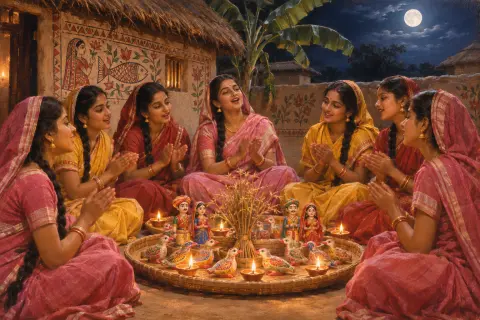
In most Tamil homes the festival is simple and beautiful. The house is cleaned, a kolam is drawn at the door, and at dusk the family lights rows of agal vilakku, small clay lamps, on the doorstep, along the walls and windowsills and around the kolam. Many families light lamps for three evenings in a row. Children love the moment the whole street turns gold.
The special foods are pori urundai, balls of puffed rice bound with jaggery, along with appam and adai. In front of many temples a tall pile of dried palm leaves, the sokkapanai, is set on fire after the evening puja. In villages children used to spin maavali, small bundles of burning palm flower charcoal swung on a rope to throw sparks.
In Kerala the day is Thrikarthika, and homes and Devi temples are lit with lamps in the evening. Tamil communities in Sri Lanka, Malaysia and Singapore keep the day the same way, with lamps at home and in temples. Many Vishnu temples in Tamil Nadu also hold their own lamp festival, Vishnu Deepam, around the same days.
Brahma and Vishnu tried to measure the light and could not. In the Gita (13.18) Krishna speaks of that light as 'the light of all lights, beyond darkness, seated in the hearts of all.' On Karthigai night no one tries to measure it. People simply light one more small lamp at the door, and then another, until the whole street is bright. The great fire on the hill and the little flame on the doorstep are the same fire.