The Story
The oldest full telling of Parvati's penance for Shiva is in Kalidasa's poem Kumarasambhava (canto 5), and the Shiva Purana tells it again at length in its Rudra Samhita (Parvati Khanda). Both describe how Parvati, reborn after Sati's death, won Shiva through years of hard tapas, and how Shiva came in disguise to test her before accepting her. Neither text gives a date. The link to Shravana Shukla Tritiya comes from the Teej vrat katha, a folk tradition read aloud in homes, which says this is the day Shiva accepted her. That is why women keep Hariyali Teej, and why the monsoon swings and songs are dedicated to Shiva and Parvati.
From Sati to Parvati
Shiva's first wife was Sati, daughter of Daksha. Daksha disliked Shiva and held a great sacrifice without inviting him. Sati went anyway, and when her father insulted her husband in front of everyone, she gave up her body in the sacrificial fire. Shiva, broken by grief, withdrew into deep meditation in the Himalaya.
Sati was born again as the daughter of Himavan, king of the mountains, and his wife Mena. She was named Parvati, the daughter of the mountain. The Shiva Purana says that from childhood her heart was set on Shiva, and the sage Narada told her parents she was meant to be his wife.
Kama's arrow
Shiva sat lost in meditation and noticed nothing. Parvati served him every day, bringing flowers and water, but he did not open his eyes. The gods needed Shiva to marry, because only his son could defeat the demon Taraka. So they sent Kamadeva, the god of desire, to stir his heart.
Kama shot his flower arrow at Shiva while Parvati stood near him. For a moment Shiva was shaken. Then he understood what had happened, opened his third eye, and burned Kama to ash. Parvati went home in shame. She saw that beauty and charm would never win him.
The penance and the test
So Parvati chose the hardest path. Against her mother's pleading she went into the mountains to do tapas. Kalidasa and the Shiva Purana describe how she stood in the cold through winter, sat among fires in summer, lived through the rains in the open, and ate less and less until she lived on leaves, then on nothing at all. Because she gave up even leaves, she came to be called Aparna.
At last Shiva came to her disguised as a young ascetic. He mocked the one she was praying for: a wanderer who smears himself with ash, wears snakes, lives in burning grounds and has no family. Why waste her life on him? Parvati grew angry and refused to listen to another word against Shiva. She got up to leave.
Then Shiva showed his true form. Kalidasa says Parvati trembled and could neither go nor stay, like a river stopped by a mountain. Shiva told her, "From today I am your servant, bought by your penance." Their wedding followed, with all the gods present, and in time their son Kartikeya was born and defeated Taraka.
Why this day
Neither Kalidasa nor the Shiva Purana ties the penance to a date. The popular Teej vrat katha, read aloud in many homes, says that Parvati did penance for many lifetimes, often said to be one hundred and eight, and that on Shravana Shukla Tritiya Shiva accepted her. Married women keep the day for a long and happy married life, and young women for a partner they can love as Parvati loved Shiva.
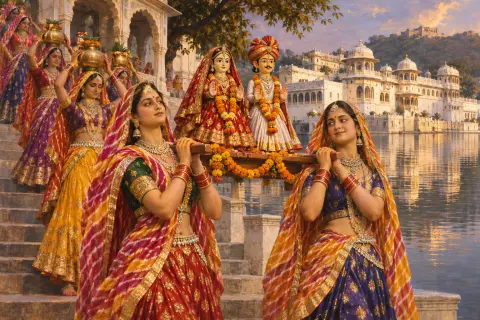
That is why Parvati is worshipped as Teej Mata in Rajasthan. In Jaipur her image is carried out of the City Palace in a royal procession on Teej and again the next day, called Budhi Teej. In Vrindavan, at the Banke Bihari temple, Krishna sits on a golden swing on this day, a reminder that the monsoon swing belongs to Radha and Krishna too.
How the day is kept
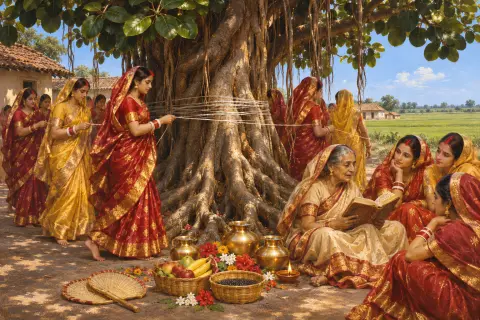
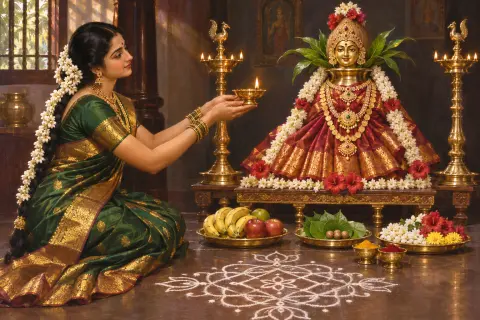
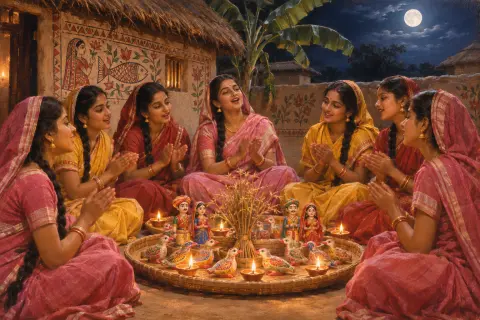
Women wear green, put mehendi on their hands and fill their arms with green and red bangles. Swings are hung from trees or in courtyards and decorated with flowers. Women swing in turns and sing Teej songs about the rain, the swing and Shiva and Parvati. Many fast and then worship clay or painted images of Shiva and Parvati in the evening. The fast is usually lighter than the strict waterless fast of Hartalika Teej.
A married daughter's parents send her a sindhara: new clothes, bangles, mehendi, sweets and ghevar, the honeycomb sweet that fills Rajasthan's shops in this season. In Haryana this bundle is called a kothli and is often brought by her brother. Many new brides spend their first Teej at their parents' home. In Punjab, the day opens Teeyan, when girls and women gather for weeks of swings, songs and giddha dancing.
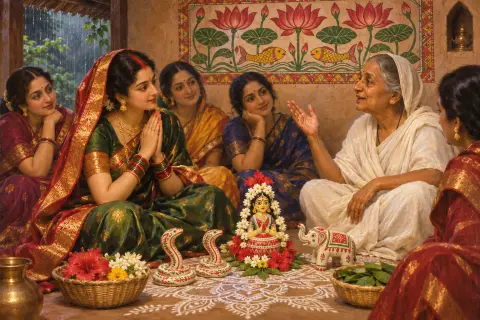
In Bihar the big Teej is Hartalika Teej in Bhadrapada, but Shravana Shukla Tritiya matters too. In Mithila it is the last day of Madhushravani, a festival of about two weeks in which newly married women worship Gauri and Shiva and the snake goddess, listen to stories told by older women, and wear clothes and eat food sent by their in-laws. In the Bhojpur region, Sawan is the season of kajari songs and swings, sung in the same spirit.
Parvati did not win Shiva by luck or by charm. She won him by holding to her vow when everything argued against it, and by not letting anyone talk her out of it. In the Gita (6.23) Krishna says that yoga should be practised with firm resolve and a mind that does not lose heart. Parvati's tapas is that verse lived out. Hariyali Teej celebrates the joy at the end of the story, the swings and the songs and the green. It also remembers the steady effort that made that joy possible.