
Radha
Krishna's beloved
Radha is the cowherd girl of Vraja whom Hindu devotional traditions honour as Krishna's beloved and his dearest devotee, and whom many worship as his own divine power. Braj tradition makes her the daughter of Vrishabhanu and remembers Barsana as her home. She is not named in the Bhagavata Purana or the Mahabharata. She enters through a few early poems, then Jayadeva's Gita Govinda in the twelfth century, the Brahma Vaivarta Purana and the songs of poets such as Vidyapati, Chandidas and Surdas. Today she is worshipped beside Krishna as Radha-Krishna in temples across India, her birthday is kept on Radha Ashtami, and the Holi of Barsana is played in her name.
Also called: Radhika, Radharani (queen Radha), Shriji (in Barsana), Kishori (the young one), Ladli (the darling), Vrishabhanu Nandini (daughter of Vrishabhanu), Radhe, the name devotees call out in greeting in Braj
Father: Vrishabhanu, a cowherd chief of Vraja
Mother: Kirtida in Braj tradition; the Brahma Vaivarta Purana calls her Kalavati
Home: Barsana, on a hill west of Govardhan; one tradition says she was born at Raval near Gokul
Beloved: Krishna
Marriage: accounts differ; the Brahma Vaivarta Purana has Brahma marry her to Krishna in the Bhandira forest, while Bengali tradition makes her the wife of a cowherd named Ayan, and her love for Krishna a love outside marriage
Close friends: the sakhis, led by Lalita and Vishakha, in Braj and Gaudiya tradition
Eternal home: Goloka, Krishna's highest heaven, in the Brahma Vaivarta Purana
कंसारिरपि संसारवासनाबद्धशृङ्खलाम्। राधामाधाय हृदये तत्याज व्रजसुन्दरीः॥
kaṁsārir api saṁsāra-vāsanā-baddha-śṛṅkhalām, rādhām ādhāya hṛdaye tatyāja vraja-sundarīḥ.
And Krishna, the enemy of Kamsa, holding Radha in his heart, the chain that bound all his longing, left the other beautiful women of Vraja.
Stories
Radha has no early scripture of her own. The Bhagavata Purana, the main account of Krishna's childhood, speaks of the gopis but never names her, and the Mahabharata does not mention her. Her name appears in a few early Prakrit and Sanskrit verses, such as one often cited from the Gatha Saptashati, an anthology of love poems. The first long work that puts her at the centre is Jayadeva's Sanskrit Gita Govinda, written in eastern India in the twelfth century. The Brahma Vaivarta Purana then tells her life from her birth in Goloka to Vraja, and the poets of the following centuries, Vidyapati in Mithila, Chandidas in Bengal, Surdas in Braj, filled it with songs. The traditions of Chaitanya, Nimbarka, Vallabha and the Radha Vallabh sampradaya gave her a place in theology, some placing her even before Krishna. So her story is honestly a story of poetry and devotion, and it differs from one tradition to another.
The gopi the Bhagavata does not name
In the tenth book of the Bhagavata Purana, Krishna dances with the gopis on an autumn night and then suddenly disappears. In chapter 30 the gopis search the forest for him. They find his footprints, and beside them the footprints of one woman. He has taken her away with him alone, and the other gopis say she must have worshipped him more truly than any of them (10.30.28).
The word they use for worshipped is aradhita. Later Vaishnava teachers heard Radha's name hidden in it, and many devotees read this gopi as Radha. The Bhagavata itself does not say so. It goes on to say that this gopi, too, grew proud, and Krishna left her as well, until all of them found him again together.
Devotees answer the silence in different ways. Some say the Bhagavata keeps Radha's name hidden because she is too dear to be spoken of openly. Scholars note that her story is simply later. Both agree that what is said of her later grew out of these chapters.
Jayadeva's Gita Govinda
Jayadeva, a poet of eastern India, wrote the Gita Govinda in Sanskrit in the twelfth century. It tells one story in twelve cantos. It is spring in Vrindavan. Radha sees Krishna playing with other gopis and turns away hurt. Krishna, who has been searching for her, now leaves the others and holds Radha in his heart, as the verse at the top of this page says (3.1).
Through the middle of the poem, Radha's friend (sakhi) goes back and forth between them. She tells Krishna how Radha is pining, and tells Radha how Krishna waits for her in the grove. Radha quarrels, softens and at last goes to him, and the poem ends with their meeting. Each canto has songs set to ragas, which is why it has been sung ever since.
Odia tradition tells a legend about the poem. Stuck on a line in which Krishna asks to place Radha's foot on his head, Jayadeva put down his pen and went to bathe; when he came back the line had been written for him, in what devotees say was Krishna's own hand. This is a story told by devotees, not a fact of history. The songs of the Gita Govinda are still sung in the Jagannath temple at Puri, and the poem shaped Odissi dance and countless paintings.
Radha in the Brahma Vaivarta Purana
The Brahma Vaivarta Purana gives Radha the place the Bhagavata leaves open. It describes her as Krishna's eternal partner in Goloka, his highest heaven, appearing from his left side at the beginning of creation. In this Purana she is the goddess of the rasa, the source of all the gopis, and Krishna cannot be complete without her.
It tells how a quarrel in Goloka ended with Krishna's companion Sridama cursing Radha to be born on earth and to live for a hundred years apart from Krishna. So she is born in Vraja to the cowherd Vrishabhanu and his wife Kalavati. The Purana also describes Brahma joining Radha and Krishna in marriage in the Bhandira forest, while the child Krishna is in her care.
Other traditions tell their relationship differently. The Gaudiya Vaishnavas of Bengal, following poets like Chandidas, see Radha as married to another man and her love for Krishna as a love that breaks every social rule, which to them makes it the purest picture of the soul's love for God. Each reading is held with reverence by its own followers.
Barsana, Radha Kund and the land of Braj
Many stories of Radha are kept in the places of Braj rather than in books. One tradition says she was born at Raval, a village on the Yamuna near Gokul, and that her family later moved to Barsana, a small hill town west of Govardhan. The Shriji temple, also called Ladli Ji, stands on Barsana's hill. Nandgaon, Krishna's village in this tradition, is close by, and the Lathmar Holi played between the two towns retells their teasing.
A well-loved folk story says that baby Radha would not open her eyes until Yashoda came visiting with the infant Krishna; the first thing she ever saw was him. No scripture records this. It is told in Braj because it says, in a child's way, what devotees believe about her.
Near Govardhan lie two ponds, Radha Kund and Shyam Kund. Braj and Gaudiya tradition say that after Krishna killed the bull demon Arishta (Bhagavata Purana 10.36), Radha teased him that he must wash away the sin of killing a bull. Krishna struck the earth and called all the holy rivers into one pond; Radha and her friends dug their own beside it with their bangles. Pilgrims bathe in Radha Kund at midnight on Ahoi Ashtami.
The poets and saints of Radha
In Mithila, in present-day Bihar, Vidyapati wrote hundreds of songs in Maithili about Radha in the fourteenth and fifteenth centuries: her first sight of Krishna, her waiting through the rainy nights, her grief when he left for Mathura. In Bengal, Chandidas sang of her in Bengali. In Braj, Surdas wrote of Radha and the gopis answering Uddhava, Krishna's messenger, when he came from Mathura to teach them to stop grieving; the Bhagavata tells the gopis' reply (10.47), and Surdas gave it Radha's voice in his Bhramar Geet.
Chaitanya Mahaprabhu, the Bengali saint of the sixteenth century, loved these songs. His followers, the Gaudiya Vaishnavas, teach that Radha is Krishna's hladini shakti, his own power of joy, and that Chaitanya himself was Krishna come to taste Radha's love. In Vrindavan, Hit Harivansh founded the Radha Vallabh tradition, where Radha is worshipped first, and the Nimbarka tradition worships the two together.
This is why, across north and east India, people greet each other with 'Radhe Radhe' or 'Jai Shri Radhe', and why in many temples her name is spoken before his: Radha-Krishna, Radhe-Shyam, Sita-Ram. For devotees she is the way to Krishna.
How to recognise
- •A young woman with a fair, golden complexion, standing at Krishna's left side. The contrast is deliberate: poets call her golden and him dark as a rain cloud, and devotees see the two as one love in two colours.
- •Dressed as a cowherd girl of Braj in a long skirt (lehenga) and an odhni over her head, often blue, which the poets call nilambara, or red. She wears bangles, anklets, a nose ring and flowers in her hair.
- •Her hands are joined in devotion, hold a lotus or a garland, or rest in Krishna's. In paintings she often holds a flute he has left behind, or looks away in a lovers' quarrel while a friend (sakhi) carries messages.
- •On a swing with Krishna in the monsoon (Jhulan), throwing colour at Holi, or walking with him by the Yamuna. The Kishangarh painting known as Bani Thani, from eighteenth century Rajasthan, gave her a famous long-eyed profile.
- •In some Vrindavan temples there is no image of Radha at all. In the Radha Vallabh temple, a crown or a cushion beside Krishna stands for her, because devotees there say she cannot be put into an image.
- •In Barsana she is worshipped as Shriji, and in Gaudiya temples the pair is shown with the sakhis Lalita and Vishakha. Chaitanya Mahaprabhu is understood by his followers as Radha and Krishna in one body, golden with Radha's colour.
Festivals
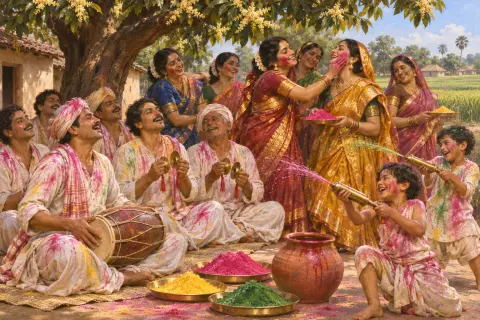 HoliMar 21 - Mar 22, 2027The colours of Holi are told as the play of Radha and Krishna, and Barsana, her town, holds the famous Lathmar Holi.
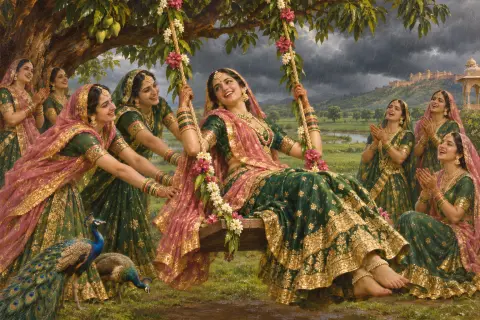 Hariyali TeejAug 4, 2027The monsoon swing of this season belongs to Radha and Krishna in Braj, and Vrindavan's temples bring out swings for them.
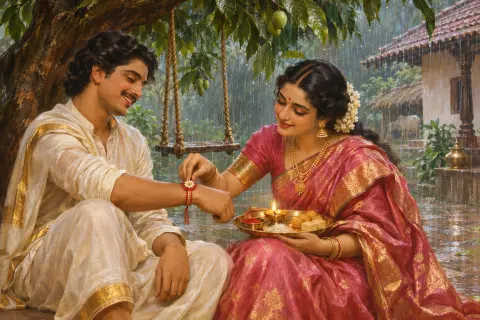 Raksha BandhanAug 17, 2027In Bengal the full moon closes Jhulan Yatra, the swing festival of Radha and Krishna.
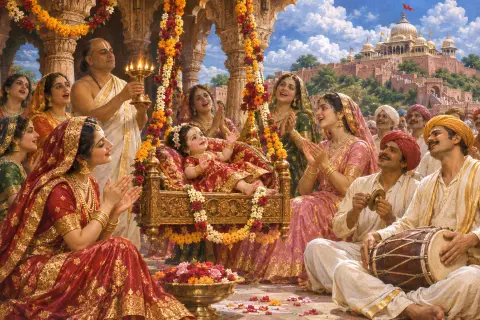 Radha AshtamiSep 8, 2027The festival of her birth, kept with the biggest celebrations in Barsana and Vrindavan.
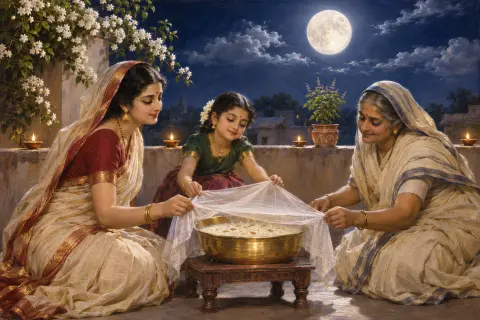 Sharad PurnimaOct 14, 2027Later tradition names her as the gopi Krishna took away alone during the Raas on the autumn full moon night.
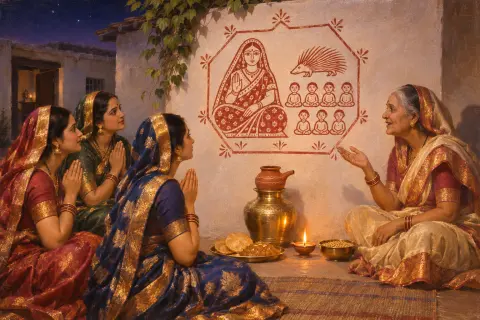 Ahoi AshtamiOct 22, 2027Couples hoping for a child bathe in Radha Kund near Govardhan at midnight on this day.
Paintings
3 paintingsAsk about Radha
Ask Gita Chat about Radha and what their story can teach you.