The Story
Ahoi Ashtami does not come from one of the major Puranas. It is a vrat of north Indian homes, and its source is the vrat katha, the story women tell one another during the evening puja, passed from mother-in-law to daughter-in-law. The katha is told in more than one version. In the best known, a woman accidentally kills the young of a porcupine (syahu, saahi) while digging clay before Diwali, loses her own sons, and gets them back through repentance and the worship of Ahoi Mata. Some tellings, including a Punjabi one, make the animal a lion cub. That is why mothers fast on this day, and why the porcupine is drawn beside the goddess.
The Clay Pit in the Forest
In the most common version of the katha, a moneylender's wife had seven sons. A few days before Diwali she went into the forest to dig clay to repair and plaster her house, as families did before the festival. A porcupine lived there with her young in a burrow in the bank.
As she dug, her spade struck one of the porcupine's young, and it died. She had not seen it and had not meant it. But she knew what she had done, and she went home with a heavy heart.
Within the year, the katha says, her seven sons died one by one. Some tellings say the grieving porcupine cursed her; others only say that sorrow followed sorrow. Either way, the mother who had lost one child now saw the woman lose all of hers.
What the Old Women Told Her
Broken, the woman told a neighbour everything, and the story went around the village. The older women came to her. They said that by confessing her mistake honestly she had already washed away half of it.
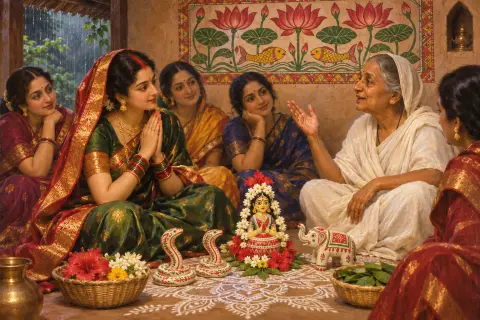
They told her to keep a fast on the Ashtami of Kartika, to draw Ahoi Mata on the wall together with the porcupine and its young, to worship them, and to ask for forgiveness from her heart. She did so year after year. The katha ends with her seven sons returned to her, and that, families say, is how the vrat began.
There is no clever trick in this version. A woman makes a mistake that costs a life, owns it in front of everyone, grieves for the other mother as well as for herself, and keeps faith year after year. That is what the fast asks of the women who keep it.
The Youngest Daughter-in-Law
A second version is told in many Hindi-speaking homes. A moneylender had seven sons and seven daughters-in-law and one daughter. Before Diwali the daughter-in-law and the daughter went to dig clay, and the daughter accidentally killed Syahu's cub. Syahu said she would bind the girl's womb. The girl begged her sisters-in-law to take the curse in her place. Only the youngest agreed, and after that every child she bore died on the seventh day.
A pandit told her to serve the Surahi cow, Syahu Mata's friend. She quietly cleaned the cow's place every morning until the cow caught her at it and agreed to help. On the way to Syahu across the seven seas, the young woman saved a garuda's chick from a snake, and the grateful mother bird carried them both the rest of the way.
Syahu Mata was pleased with her service and blessed her with seven sons and seven daughters-in-law. When she went home she found them there. She made seven Ahoi, offered seven pans (kadhai) of food in thanksgiving, and the other daughters-in-law asked how her womb had been opened.
The Evening Puja
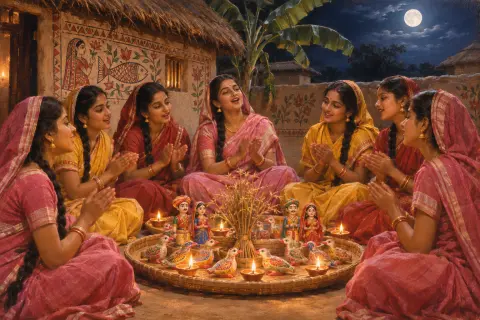
The fast begins at dawn. Many women keep it nirjala, without even water, and do their housework as usual. Before sunset the wall or a sheet of paper gets the picture: Ahoi Mata in red ochre (geru), inside a frame with eight corners for the eighth day, the porcupine and seven children beside her. Many families now use a printed Ahoi calendar instead.
In front of it go a kalash of water and, on top of it, the karva, the small spouted clay pot, often the same one used on Karva Chauth. Offerings are eight puris, eight puas and halwa, with water chestnuts, radish and rice in some homes. Many families also worship a small silver Ahoi, called the syahu, with roli, rice and milk.
The eldest woman tells the katha while the others listen holding wheat grains or rice in their hands. When the first stars appear, the women offer water to the stars from the kalash and break the fast. Some wait for the moon instead, which rises late on this night. The fast used to be kept for sons. Today many mothers keep it for all their children, daughters as well as sons.
Radha Kund, and Bihar's Jitiya
On the same night, many couples who hope for a child bathe in Radha Kund, the sacred pond near Govardhan in Mathura district. The bathing begins at midnight and goes on through the night. Couples stand in the water to pray and offer a white pumpkin (kushmanda, or petha) wrapped in red cloth, and couples whose prayer was answered come back to give thanks. In Braj this night is also called Bahulashtami.
Ahoi Ashtami is strongest in western Uttar Pradesh, Delhi, Haryana, Punjab, Rajasthan and Madhya Pradesh. In Bihar and Jharkhand it is not a major festival. There, the mothers' fast for their children is Jivitputrika, known as Jitiya, kept a month earlier on Ashvin Krishna Ashtami with a strict nirjala fast.
In the Gita (9.17) Krishna says, "I am the father of this world, and the mother." The woman in the katha learns that the porcupine's young were as precious to their mother as her sons were to her. Ahoi Ashtami asks mothers to pray for their own children with that wider heart: every child, of every creature, has a mother who waits for it to come home.