The Story
The Bhagavata Purana, the main scripture of Krishna's life, never names Radha. Her name appears in a few early poems, such as a verse often cited from the Prakrit anthology Gatha Saptashati, but the first long texts about her are later: Jayadeva's Sanskrit poem Gita Govinda from the twelfth century, and the Brahma Vaivarta Purana, which tells of her birth in Vraja as the daughter of Vrishabhanu. The day of her birth, the eighth day of the bright half of Bhadrapada, comes from Vaishnava tradition. Devotees keep it because, for them, Radha is the one who loved Krishna most completely, and the way to Krishna passes through her.
A name the Bhagavata leaves unsaid
The tenth book of the Bhagavata Purana tells how Krishna danced the rasa with the gopis of Vraja on an autumn night, and then suddenly vanished. In chapter 30 the gopis search the forest for him. They find his footprints, and beside them the footprints of one woman. He has taken her away with him alone.
The gopis say of her: "Surely the Lord has been worshipped by this one" (10.30.28). The word they use for worshipped is aradhita. Later Vaishnava teachers heard Radha's name hidden in it, and many devotees read this gopi as Radha. The Bhagavata itself does not say so. It is honest to say that Radha's story grew in later poems, Puranas and the living devotion of Vraja.
Radha in the Brahma Vaivarta Purana
The Brahma Vaivarta Purana gives Radha the place the Bhagavata leaves open. It describes her as Krishna's eternal partner in Goloka, his highest heaven, appearing from his own left side. In its telling, a quarrel in Goloka ends with Krishna's companion Sridama cursing Radha to be born on earth and live for a time apart from Krishna.
So she is born in Vraja to the cowherd Vrishabhanu and his wife, whom this Purana calls Kalavati (Braj tradition calls her Kirtida). The Purana also describes Brahma joining Radha and Krishna in marriage in the Bhandira forest. Other Vaishnava traditions tell the relationship differently, and some prefer to leave it as a love beyond any ceremony. Each tradition holds its own reading.
Barsana, Raval and the baby who kept her eyes closed
The places of Radha's childhood are part of Braj's own memory rather than any one book. One tradition says she was born at Raval, a village on the Yamuna near Gokul, and that her family later moved to Barsana, a small hill town west of Govardhan. The Shriji temple, also called the Ladli Ji temple, stands on Barsana's hill, and the town is known everywhere as Radha's home.
A well-loved folk story says that baby Radha would not open her eyes. Her parents worried, until Yashoda came visiting with the infant Krishna. When he was near, Radha opened her eyes for the first time, and the first thing she saw was him. No scripture records this. It is told in Braj because it says, in a child's way, what devotees believe about her: Krishna was all she wished to see.
Jayadeva, Vidyapati and the poets
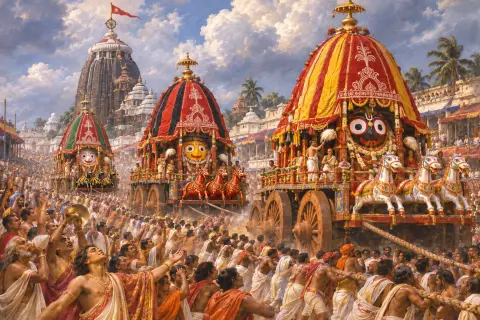
Jayadeva's Gita Govinda, written in Sanskrit in eastern India in the twelfth century, is the poem that brought Radha to the centre. It opens with the verse above: Nanda sends young Krishna home through the dark woods with Radha. It then follows their longing, their quarrel and their meeting again in the spring groves of Vrindavan. Its songs are still sung in the Jagannath temple at Puri.
In Mithila, in present-day Bihar, the poet Vidyapati wrote hundreds of songs in Maithili about Radha and Krishna in the fourteenth and fifteenth centuries. His songs of Radha's waiting and separation travelled east to Bengal, where the saint Chaitanya Mahaprabhu loved to hear them along with the Gita Govinda and the songs of Chandidas. Vidyapati's songs are still sung in Mithila today.
Out of this poetry grew whole traditions centred on Radha. The Gaudiya Vaishnavas who follow Chaitanya see her as Krishna's own power of joy. In Vrindavan, the Radhavallabh tradition and the Nimbarka tradition worship Radha and Krishna together, often with Radha first.
How the day is kept
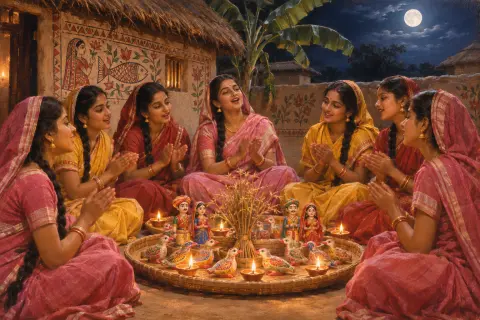
In Barsana the celebrations start before dawn. At the Shriji temple the image of Radha is bathed in milk, curd, ghee, honey and sugar, then dressed in new clothes and jewellery. Crowds climb the hill steps, sing birth songs called badhai, and share sweets. Vrindavan's temples, including Radha Vallabh and the ISKCON temple, hold abhishek, kirtan and feasts, and Gaudiya temples across Bengal, including Mayapur, do the same.
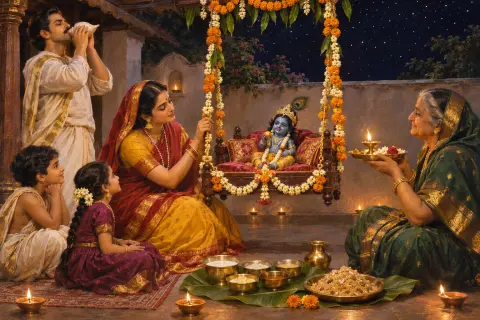
Many devotees fast until midday, when Radha's birth is celebrated with puja, and then eat simple prasad. At home, people bathe a small image or picture of Radha and Krishna, offer flowers, lotus and sweets, and read or sing about her.
In Bihar and Uttar Pradesh, Radha Ashtami is kept mostly in Radha-Krishna temples and Vaishnava homes, and Vidyapati's Radha songs are sung in Mithila. In many households of these states the same day also begins the sixteen-day Mahalakshmi vrat, a separate observance for the goddess Lakshmi.
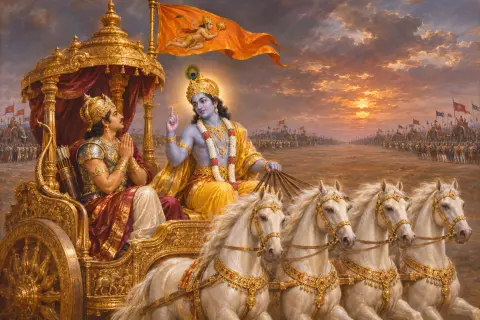
In the Bhagavad Gita (18.65) Krishna says: fix your mind on me, love me, worship me, bow to me, and you will come to me; I promise you truly, because you are dear to me. Devotees see Radha as the person who lived that verse fully. Her mind never left Krishna. Radha Ashtami does not ask for great learning. It asks you to love as she did, and it carries Krishna's promise that such love is returned.