Shesha, also called Ananta and Adishesha, is the king of the nagas, the great serpent with a thousand heads. In the Mahabharata he is the eldest son of Kadru, who left his quarrelling brothers to do penance and was given the task of holding up the earth. In the Puranas Vishnu rests on his coils on the cosmic ocean, and he is counted as Vishnu's own power: he is born as Balarama, Krishna's elder brother, and later texts say also as Lakshmana, Rama's brother. In the Gita Krishna says, "Among the nagas I am Ananta." He is seen in every picture of Vishnu asleep on the ocean, and in the great reclining images of Srirangam and Thiruvananthapuram.
Also called: Ananta (the endless), Adishesha (the first Shesha), Sheshnag, Sankarshana (a name he shares with Balarama in the Bhagavata), Nagaraja (king of the nagas), Sahasrashirsha or Sahasraphana (thousand-headed), Bhujagendra (lord of serpents)
Parents: the sage Kashyapa and Kadru, mother of the nagas (Mahabharata, Adi Parva)
Brothers: the nagas, among them Vasuki and Takshaka; he is the eldest
Sister of the nagas: Manasa, in the Puranas and Bengal tradition, is a sister of Vasuki
Home: beneath the underworlds, at the base of the cosmos, holding up the earth; and on the ocean of milk as Vishnu's bed
Incarnations: Balarama in the Mahabharata and the Bhagavata Purana; Lakshmana in later Ramayanas; Patanjali and Ramanuja in tradition
Friend: Garuda, whom Brahma gives him as a companion in the Mahabharata, even though Garuda is the enemy of his brothers
मूर्धन्यर्पितमणुवत्सहस्रमूर्ध्नो
भूगोलं सगिरिसरित्समुद्रसत्त्वम् ।
आनन्त्यादनिमितविक्रमस्य भूम्नः
को वीर्याण्यधिगणयेत्सहस्रजिह्वः ॥
On one head of the thousand-headed one the round earth, with its mountains, rivers, seas and creatures, is set like a speck of dust. His might is beyond measure because he is endless. Who could count his powers, even with a thousand tongues?
Stories
Shesha's oldest story is in the Mahabharata (Adi Parva, the Astika section), where he is a serpent who chose penance over his brothers' cruelty. Section numbers below follow K. M. Ganguli's translation. The Vishnu Purana (Book 2, chapter 5) and the Bhagavata Purana (Book 5, chapter 25) place him at the bottom of the universe, holding the earth, and make him a form of Vishnu himself, called Sankarshana. Through the Puranas he becomes Vishnu's bed on the ocean and, in the Bhagavata, Balarama. Later Ramayanas such as the Adhyatma Ramayana and Tulsidas's Ramcharitmanas add that Lakshmana was Shesha, and South Indian tradition says he was born again as the grammarian Patanjali and the teacher Ramanuja.
The Serpent Who Chose Penance
The sage Kashyapa had two wives, Kadru and Vinata. Kadru asked for a thousand serpent sons, and Vinata for two sons stronger than all of them. Kadru's sons were the nagas, and the eldest of them was Shesha. Vinata's son was Garuda (Adi Parva, sections 16 and 35).
Kadru and her sons cheated Vinata in a bet and made her their slave, and the nagas were proud and cruel. Shesha could not bear to live with them. He left and did hard penance alone, living on air, at Gandhamadana, Badari, Gokarna, Pushkara and in the Himalaya, until his skin and flesh dried on his bones (section 36).
Brahma came and asked what he wanted. Shesha said his brothers were wicked and hated Vinata and her son, and he did not want to live among them. He wished only that his mind would always delight in dharma. Brahma was pleased and gave him a task: the earth was unsteady, and he should hold it still. Shesha went down through an opening in the earth and has held it on his head ever since. Brahma gave him Garuda as a friend.
The Bed of Vishnu
When a cosmic age ends and everything dissolves into a single ocean, Vishnu sleeps on the coils of Shesha, and that is why he is called Narayana, the one who rests on the waters. A lotus grows from his navel with Brahma on it, and a new world begins. The Vishnu and Brahma pages tell this.
The name Shesha means what remains. Many explain it this way: when everything else has dissolved, he is what is left. Ananta, his other name, means without end.
The calendar keeps this sleep each year. On Devshayani Ekadashi in Ashadha, Vishnu is said to lie down on Shesha in the ocean of milk, and on Dev Uthani Ekadashi in Kartika he wakes. In the great reclining temples of the south, the god is always on Shesha: Ranganatha at Srirangam, Padmanabha at Thiruvananthapuram.
Ananta at the Bottom of the World
The Vishnu Purana (2.5) takes us below the seven underworlds. There, it says, lives Shesha, a form of Vishnu himself, called Ananta. He has a thousand heads, each marked with a shining jewel, and he wears the whole earth on his head like a garland. When he yawns, the earth trembles with its forests, mountains and seas. At the end of each age the fire that destroys the worlds comes from his mouths, as Rudra, whom the text calls one with Balarama. The sage Garga, it adds, learned the science of the stars from him.
The Bhagavata (5.25) describes the same Ananta. The earth on one of his thousand hoods looks no bigger than a white mustard seed. The sage Narada sings his praise there, in the verse at the top of this page: who could count his powers, even with a thousand tongues?
For the Bhagavata he is not only a serpent but Sankarshana, a form of the Lord who draws the world back into himself. This is the link to Balarama, who is also called Sankarshana.
Balarama: Shesha on Earth
Balarama leaves his body, and Shesha returns to the sea.
When Vishnu came to be born as Krishna, the Bhagavata (10.2.8) says he told his power Yogamaya to move "my portion called Shesha" from Devaki's womb into Rohini's, so that Kamsa could not kill the child. That child was Balarama, who was also called Sankarshana because he was drawn from one womb to another. On the night Krishna was born, Shesha followed Vasudeva across the Yamuna and spread his hoods over the baby against the rain (10.3.49).
Balarama is the elder brother all through Krishna's life: the ploughman, fair where Krishna is dark, quick to anger and quick to forgive. He fights beside Krishna in Mathura, drags the Yamuna with his plough, and refuses to take sides in the Kurukshetra war.
The Mahabharata tells how he left the world (Mausala Parva, section 4). After the Yadavas destroyed each other at Prabhasa, Krishna found Balarama sitting alone under a tree in yoga. As Krishna watched, a great white serpent with a thousand heads came out of Balarama's mouth and went towards the sea. The ocean and the great nagas, Vasuki and Takshaka among them, came out to receive him, and he entered the waters.
Lakshmana, Patanjali and Ramanuja
Valmiki's Ramayana says only that Rama's three brothers were born from portions of Vishnu (Bala Kanda 18). Later Ramayanas go further. The Adhyatma Ramayana and Tulsidas's Ramcharitmanas say that Lakshmana was Shesha himself, who came with Rama to serve him. Many people know Lakshmana this way, as the brother who served and guarded Rama and Sita through all the years of exile.
Tradition also names Shesha as the source of two great teachers. The grammarian and yoga teacher Patanjali is said to be his incarnation, which is why Patanjali is shown with a serpent's hood, and an old prayer praises him as having come to cleanse the mind by yoga, speech by grammar and the body by medicine.
The Sri Vaishnava tradition of South India holds that the teacher Ramanuja (eleventh to twelfth century) was also Adishesha come again, and that Balarama and Lakshmana were his earlier births. These are traditions of faith, not statements of the epics.
Shesha in Worship
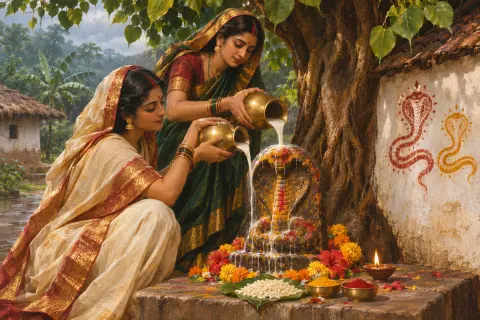
Shesha is rarely worshipped on his own; he is honoured with Vishnu. On Nag Panchami families worship the nagas, and many keep him in mind as their king. In the Gita (10.29) Krishna names him among his glories: among the nagas I am Ananta.
The seven hills of Tirumala are called Seshachalam, and temple tradition says they are Shesha's body, with Venkateswara standing on his head. On Anant Chaturdashi families worship Vishnu as Ananta, the endless, and tie a thread with fourteen knots; the name is shared with the serpent, and many pictures of the day show Vishnu resting on him.
How to recognise
•A great serpent with many hoods spread like a canopy. The texts give him a thousand heads; painters and sculptors show five, seven or nine. His coils make Vishnu's bed on the ocean of milk, and his hoods shade Vishnu's head.
•His colour is white. The Vishnu Purana (2.5) describes him shining like a white mountain, in dark garments with a white necklace and a single earring, a jewel on each of his thousand hoods, and a plough and a pestle in his hands, the same weapons as Balarama.
•In reclining Vishnu temples (Anantashayana), such as Srirangam's Ranganatha and Thiruvananthapuram's Padmanabhaswamy, he is the great coiled bed under the god. The name Thiruvananthapuram is usually explained as the city of the holy Ananta.
•Sometimes he is shown in human form from the waist up, with folded hands and a hood of serpents behind his head, as in images of Patanjali, whom tradition holds to be his incarnation.
•In Krishna pictures he follows Vasudeva across the Yamuna, spreading his hoods over the newborn to keep off the rain.
•Balarama, his incarnation, is fair, dressed in blue, carries a plough, and in many images, including Balabhadra at Puri, has a serpent hood behind his head.
I am Ananta among the Nagas; I am Varuna among water-deities; Aryaman among the Manes I am; I am Yama among the governors.
Krishna says, "Among the nagas I am Ananta." Sridhara Swami's commentary explains that Ananta here is Shesha, king of the nagas, and notes that the Gita has just named Vasuki as the best of the sarpas, the venomous serpents (10.28), while Shesha leads the nagas.