The Story
The oldest written accounts of this day are in the Puranas. The Padma Purana gives a whole chapter to Prabodhini Ekadashi, the waking Ekadashi of the bright half of Kartika (Uttara Khanda, chapter 61 in N. A. Deshpande's English translation), and praises fasting on it and staying awake through its night. The Narada Purana (Purva Bhaga, chapter 120, verses 51 and 52) gives the rite itself: fast on Prabodhini, and at night wake the sleeping Keshava with songs, music and offerings of grapes, sugarcane, pomegranates, bananas and water chestnuts. The day is kept because Vishnu, who went to sleep four months earlier on Devshayani Ekadashi, is said to wake on it, and that ends Chaturmas.
The Long Sleep of Chaturmas
Vishnu's sleep begins on Devshayani Ekadashi in the month of Ashadha, around June or July, just as the rains arrive. For the next four months, many families avoid weddings, housewarmings and other big new beginnings. Monks and serious practitioners often stay in one place and keep extra vows, like giving up certain foods or eating once a day.
The idea behind Chaturmas is practical as much as spiritual. In the rains, travel was hard, food spoiled easily and illness spread. Slowing down, eating simply and turning inward made sense. The story of the sleeping Lord gave that season a meaning: when the outer world is wet and heavy, look inside.
On Dev Uthani Ekadashi this period comes to an end. The rains are over, the harvest is in, and life speeds up again. In much of North India the wedding season starts soon after, and families who waited all monsoon begin fixing dates.
Waking the Lord
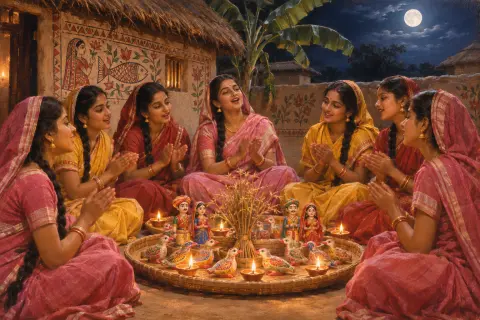
In villages and towns across North India, women prepare for the evening by drawing Vishnu's footprints with rice paste or red ochre on the floor, leading from the door to the place of worship. Seasonal produce like sugarcane, water chestnuts, sweet potatoes and fresh jaggery is laid out, because this is what the land is giving at that time of year.
Often a small canopy is made by tying sugarcane stalks together, with the image of Vishnu or a Shaligram stone placed under it. After dark, lamps are lit, bells are rung and plates are tapped while women sing simple songs, "uttho dev, baitho dev" (get up, Lord, sit up, Lord), asking him to wake and bless the house. The tone is affectionate, almost like waking a child.
There is a gentle humour in it. The God who never really sleeps is being woken by his devotees. The ritual is less about Vishnu and more about the people singing: it is their own attention that is waking up after a slow season.
Vrinda and the Tulsi Plant
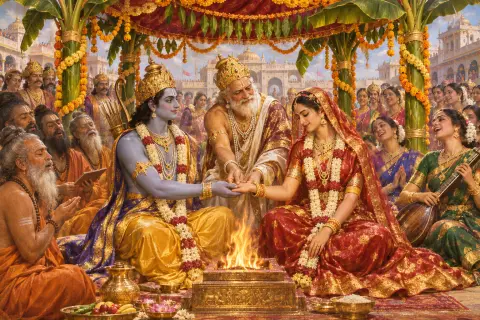
Tulsi Vivah, the wedding of the tulsi plant to Vishnu, is celebrated on Dev Uthani Ekadashi or on the next day, depending on family and regional custom. Its story is told in the Puranas, and the details differ from one telling to another.
In a well known version, Vrinda was the devoted wife of the powerful asura Jalandhara. Her faithfulness protected him, so no one could defeat him, not even the gods. To end his cruelty, Vishnu took Jalandhara's form and came to Vrinda. Her vow was broken and Jalandhara fell in battle. When Vrinda learned the truth, she cursed Vishnu to become a stone, the Shaligram, and gave up her life. From the place where she died grew the tulsi plant.
Moved by her devotion, Vishnu promised that he would always be with her, and that no worship of him would be complete without tulsi leaves. The yearly wedding of tulsi with a Shaligram or an image of Krishna honours that promise. It is a story that does not hide the hard parts. It asks how a promise is kept after harm has been done, and the answer it gives is lasting respect.
Kartiki Ekadashi at Pandharpur
In Maharashtra the same day is known as Kartiki Ekadashi. Large numbers of pilgrims walk to Pandharpur to see Vitthal, a form of Krishna who stands on a brick with his hands on his hips, waiting for his devotees.
The pilgrims, called warkaris, sing the abhangs of saints like Tukaram and Namdev as they walk. Ashadhi Ekadashi, when Vishnu goes to sleep, draws the bigger crowds, but Kartiki Ekadashi closes the circle. The Lord who was sung to sleep is now sung awake.
Dev Uthani Ekadashi teaches that rest and waking both have their season. Slowing down is not failure, and starting again is not a betrayal of the quiet time. The real waking the day asks for is our own: to see clearly, act kindly and begin the next season with attention.